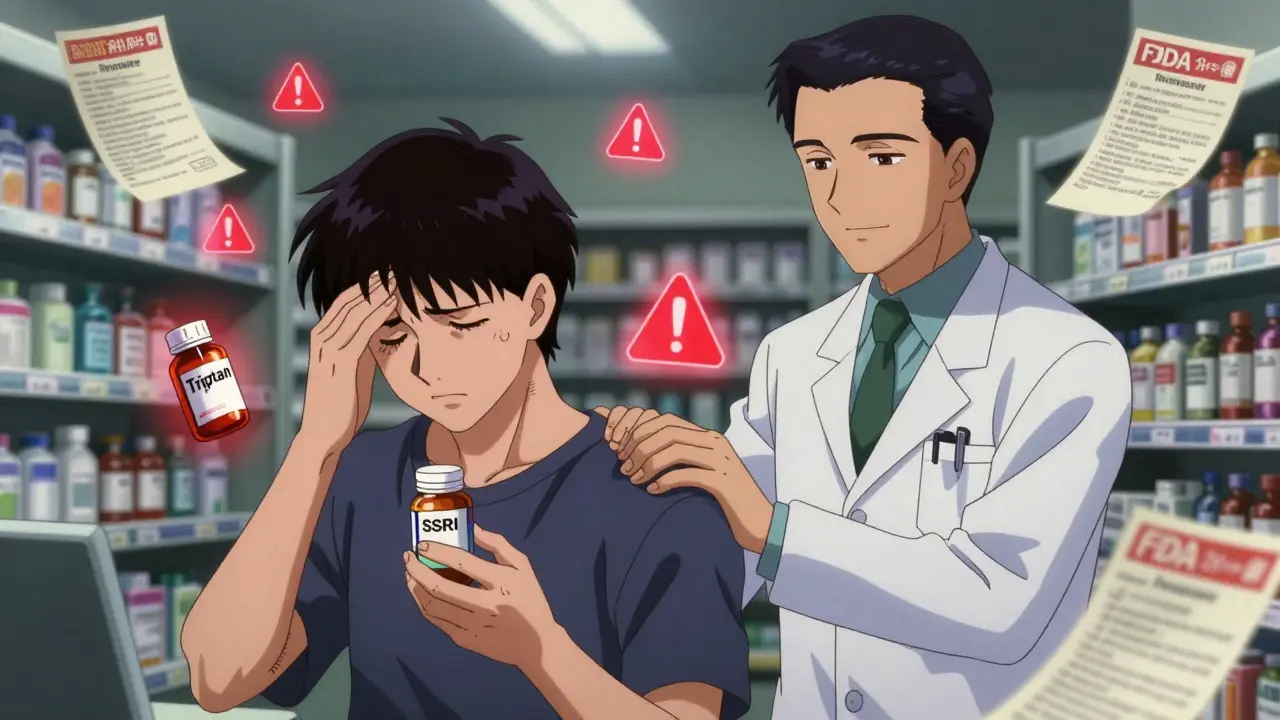
For over a decade, millions of people with migraines who also take antidepressants have been told they can’t use triptans - the most effective acute migraine treatment - because of a supposed risk of serotonin syndrome. It’s a warning that’s haunted pharmacies, clinics, and patient forums. But here’s the truth: triptans and SSRIs together are not the dangerous combo the FDA once claimed they were.
What’s the real story behind the warning?
In 2006, the U.S. Food and Drug Administration (FDA) issued a safety alert. It said combining triptans - like sumatriptan or rizatriptan - with SSRIs or SNRIs (common antidepressants like sertraline or venlafaxine) could cause serotonin syndrome. A scary, potentially fatal condition. The warning spread fast. Pharmacists started refusing to fill prescriptions. Doctors hesitated. Patients were left with fewer options for their migraines, even if their depression or anxiety was under control. But here’s what no one told you: that warning wasn’t based on real cases. It was based on theory. Pharmacologists looked at how these drugs work in the body and guessed there might be a problem. They didn’t look at actual patients. They didn’t check hospital records. They didn’t ask: has this ever happened?How do triptans and SSRIs actually work?
SSRIs work by blocking serotonin from being reabsorbed in the brain. That leaves more serotonin floating around in the spaces between nerve cells. More serotonin can help lift mood - which is why they work for depression and anxiety. Triptans? They’re completely different. They don’t increase serotonin levels. Instead, they latch onto specific serotonin receptors - mainly 5-HT1B and 5-HT1D - to shrink swollen blood vessels around the brain and calm overactive nerves. That’s how they stop a migraine in its tracks. Here’s the key point: serotonin syndrome isn’t caused by just any serotonin activity. It’s triggered by overstimulation of the 5-HT2A receptor. Triptans barely touch that receptor. They’re like a key that only fits one lock. SSRIs turn up the volume on all serotonin signals - but even then, serotonin syndrome from SSRIs alone is rare. And when it does happen, it’s usually from overdose or mixing with other drugs like MAOIs or tramadol - not triptans.The evidence that changed everything
In 2019, researchers from the University of Washington dug through over 61,000 patient records spanning nearly three decades. They looked specifically at people taking both triptans and SSRIs or SNRIs. Not a single case of serotonin syndrome met the strict diagnostic criteria. Zero. That study, published in JAMA Neurology, was a game-changer. It wasn’t a small sample. It wasn’t theoretical. It was real-world data from real patients. And it contradicted everything the 2006 warning suggested. Other studies backed it up. A 2010 review in the Headache journal by Dr. P. Ken Gillman concluded there was “neither significant clinical evidence, nor theoretical reason, to entertain speculation about serious serotonin syndrome from triptans and SSRIs.” That’s not a mild opinion - that’s a direct dismissal of the fear. Even the FDA’s own data tells the story. Between 2006 and 2022, their adverse event system recorded just 18 possible cases of serotonin syndrome linked to triptans and SSRIs. None were confirmed. Not one.
Why did this myth stick around?
Because fear spreads faster than facts. Pharmacy software still flags the combination as high-risk. Some electronic health records still pop up warnings. Pharmacists, trained to avoid potential harm, err on the side of caution - even when the science says caution isn’t needed. A 2022 survey by the American Migraine Foundation found 42% of patients were denied triptans because they were on an SSRI. Not because they had symptoms. Not because their doctor was worried. Just because the system said no. Patients on Reddit, Facebook groups, and patient forums are full of stories: “I was told I couldn’t take sumatriptan because I’m on Zoloft.” “My pharmacist called my doctor to argue.” “I switched to a weaker painkiller and still had migraines for days.” The emotional cost? Real. Migraine patients suffer. They miss work. They lose time with family. And now, they’re being denied one of the most effective tools they have - not because it’s unsafe, but because of an outdated myth.What do experts say now?
The headache specialist community has moved on. A 2021 survey of 250 neurologists found 89% routinely prescribe triptans alongside SSRIs or SNRIs - no extra monitoring, no special warnings, no hesitation. The American Headache Society’s 2022 consensus statement says clearly: “Clinicians should not avoid prescribing triptans to patients taking SSRIs or SNRIs due to theoretical concerns.” The European Medicines Agency never issued a warning. The Mayo Clinic updated its patient guidance in 2023 to say: “The theoretical risk has not materialized in clinical practice.” The Migraine Foundation of New Zealand runs public quizzes to debunk the myth - and the correct answer? “False.” Even drug labels have started to change. The 2023 prescribing information for Imitrex (sumatriptan) still mentions the FDA warning - but now adds: “Epidemiological studies have not shown an increased risk of serotonin syndrome with concomitant use of triptans and SSRIs/SNRIs.” That’s a quiet but powerful correction.
What should you do if you’re on both?
If you’re taking an SSRI or SNRI and you get migraines, here’s what matters:- You can safely take triptans. The risk of serotonin syndrome is not meaningfully increased.
- Don’t let a pharmacist or outdated software scare you out of treatment.
- Know the signs of serotonin syndrome - but know they’re extremely unlikely here. Symptoms include rapid heart rate, high blood pressure, fever, tremors, confusion, or muscle rigidity. These are rare even with SSRIs alone, and nearly impossible with triptans added.
- If your doctor refuses to prescribe triptans, ask them to review the 2019 JAMA Neurology study or the American Headache Society guidelines.
The bigger picture: Why this matters
This isn’t just about one drug combo. It’s about how medical guidelines get made - and how they stick around long after the evidence changes. An estimated 30% to 50% of migraine patients also have depression or anxiety. That’s millions of people. For years, they were forced to choose: treat your mood, or treat your pain. Now we know they don’t have to. The cost of this misinformation? An estimated $450 million a year in the U.S. alone - spent on less effective migraine meds, unnecessary doctor visits, ER trips for unexplained symptoms, and lost productivity. And now, researchers are moving forward. A 10,000-patient study led by Dr. Richard B. Lipton at Albert Einstein College of Medicine is tracking patients on triptans and SSRIs in real time. Through 2023, not one case of serotonin syndrome has been confirmed.Bottom line: You’re not at risk
The fear was never grounded in reality. The science was never there. The patients? They’ve been fine all along. If you’re on an SSRI and need a triptan for your migraines - take it. Your doctor can too. The evidence is clear. The warnings are outdated. The real danger isn’t the drug combination - it’s letting a myth keep you from living pain-free.Don’t let a 2006 alert stop you from getting the treatment you need. Talk to your doctor. Show them the data. And if they’re still unsure, point them to the 2019 JAMA Neurology study. Millions of people have taken this combo safely. You can be one of them.
Mario Bros
January 11, 2026 AT 04:14Finally someone says it out loud 😤 I’ve been on Zoloft and sumatriptan for 5 years. No issues. My pharmacist still gives me the side-eye like I’m smuggling cocaine. Time to update the software, not the fear.
chandra tan
January 12, 2026 AT 20:55In India, we don’t even have this debate. Doctors here prescribe triptans with SSRIs all the time. The real problem? Access. Most people can’t even afford the meds, let alone get caught up in FDA myths. Glad the science is catching up.
Ted Conerly
January 13, 2026 AT 14:44This is exactly why evidence-based medicine matters. The 2006 FDA alert was a classic case of theoretical panic over real-world data. Over 61,000 patient records and zero confirmed cases? That’s not a coincidence-it’s a correction. If your doctor still refuses, ask them to cite a single peer-reviewed case study where this combo caused serotonin syndrome. They won’t. Because it doesn’t exist.
Faith Edwards
January 13, 2026 AT 20:00It is profoundly disconcerting to observe the persistence of antiquated medical dogma in the face of unequivocal empirical disconfirmation. One cannot help but lament the institutional inertia that continues to prioritize liability over lucidity, thereby inflicting needless suffering upon a vulnerable cohort of patients who are, quite literally, being denied relief by algorithmic ignorance.
Jay Amparo
January 14, 2026 AT 22:34I’ve been telling my friends this for years. I’ve got a cousin in Mumbai on fluoxetine and rizatriptan-no issues. She’s been migraine-free for two years now. It’s heartbreaking that people in the US are still being turned away because of a myth. We need to spread this like wildfire.
Lisa Cozad
January 15, 2026 AT 07:59My neurologist prescribed sumatriptan last year even though I’m on escitalopram. She said, ‘The data’s clear. If you start feeling weird, we’ll stop it. But you’re not at risk.’ And guess what? It worked. Like, *really* worked. Why are we still scared of something that’s been proven safe?
Saumya Roy Chaudhuri
January 16, 2026 AT 02:05Oh please. You think one study changes anything? The FDA didn’t just pull that warning out of thin air. There’s *mechanistic plausibility*. And what about the 18 possible cases in their database? You call that nothing? You’re dismissing pharmacovigilance like it’s a bad Netflix show. Not everyone is as lucky as you.
Paul Bear
January 17, 2026 AT 12:40Let’s clarify terminology: serotonin syndrome requires 5-HT2A receptor overstimulation. Triptans are 5-HT1B/1D agonists with negligible affinity for 5-HT2A. SSRIs elevate synaptic serotonin but do not directly activate 5-HT2A. The pharmacodynamic overlap is statistically insignificant. Ergo, the risk is not merely low-it is functionally nonexistent. The persistence of this myth is a failure of medical education.
Jaqueline santos bau
January 19, 2026 AT 06:31But what if something goes wrong? What if your kid gets serotonin syndrome and it’s because you took that combo? Who’s gonna take responsibility? You? Your doctor? The pharmacist who filled it? This isn’t just about data-it’s about blame. And nobody wants to be the one who said, ‘It’s fine.’
Aurora Memo
January 21, 2026 AT 04:34I get why people are scared. I was too. But after reading the JAMA study and talking to my neurologist, I realized: the fear was louder than the facts. I started triptans last month. No side effects. Just relief. Maybe the real risk isn’t the drugs-it’s letting fear silence us.
Dwayne Dickson
January 22, 2026 AT 23:01So let me get this straight: you’re telling me that a $450 million annual healthcare burden, countless lost workdays, and patients being denied effective treatment-all because of a theoretical concern with zero clinical validation-is somehow acceptable? That’s not caution. That’s negligence dressed up as conservatism. And it’s costing lives in quiet, invisible ways.
Ritwik Bose
January 24, 2026 AT 19:26👏👏👏 Finally, someone told the truth. I’ve been on sertraline + rizatriptan for 3 years. No issues. My doctor showed me the 2019 paper. Now I tell everyone. 🌍💙