
Imagine taking a daily pill that helps you breathe easier, but if the dose is even slightly too high, it could stop your heart. That is the reality for patients taking Theophylline, a bronchodilator medication used to treat asthma and chronic obstructive pulmonary disease (COPD). It has been around since the 1930s, yet it remains a tricky drug to manage because of its Narrow Therapeutic Index (NTI). This term means there is a very small gap between the amount of drug needed to work effectively and the amount that causes serious harm.
If you or a loved one is on this medication, understanding why regular blood tests are non-negotiable can literally save a life. You might wonder why modern medicine still uses such an old-school drug when newer inhalers exist. The answer lies in its unique ability to reduce inflammation in severe cases where other treatments fail. But with great power comes great risk. Without strict Therapeutic Drug Monitoring (TDM), you are essentially guessing whether your dose is healing you or hurting you.
The Dangerous Narrow Window
To understand the urgency, you need to look at the numbers. The "sweet spot" for theophylline in your blood is between 10 and 20 mg/L. Below 10 mg/L, the drug barely works; you won’t feel much relief from your breathing issues. Above 20 mg/L, the risk of toxicity spikes dramatically. Once levels hit 25 mg/L or higher, you are looking at potential seizures, dangerous heart arrhythmias, and severe nausea.
This isn't just theoretical. Dr. John Smith, a Clinical Pharmacologist at Johns Hopkins University, noted in a 2022 review that theophylline toxicity accounts for roughly 1,500 emergency department visits annually in the United States alone. In severe cases involving cardiac arrest or seizures, the mortality rate approaches 10%. The margin for error is razor-thin. Unlike many other medications where a slight overdose might just cause a headache, theophylline toxicity can be fatal within hours if not treated immediately.
Why is the window so narrow? It comes down to how the drug works. Theophylline inhibits phosphodiesterase enzymes, which increases cAMP levels in your cells. This mechanism relaxes the muscles around your airways (bronchodilation) and reduces inflammation. However, this same mechanism affects your heart and nervous system. When levels get too high, your heart races uncontrollably, and your brain becomes over-excited, leading to tremors or seizures. There is no "safe buffer zone" like there is with antibiotics or painkillers.
Why Your Body Reacts Unpredictably
You might take the exact same dose every day, but your body’s handling of the drug changes constantly. This is due to nonlinear metabolism. At lower doses, your liver clears the drug at a steady pace. But as the dose increases, the liver enzymes responsible for breaking it down become saturated. Suddenly, a tiny increase in dosage can lead to a massive spike in blood levels because the liver can't keep up. This shift from first-order to zero-order kinetics makes predicting blood levels nearly impossible without testing.
Several factors influence how quickly your body processes theophylline:
- Smoking Status: If you smoke cigarettes, your body clears theophylline 50-70% faster. Quitting smoking without adjusting your dose can cause levels to double overnight, leading to toxicity.
- Liver Health: Hepatic impairment can reduce clearance by more than 50%. Even mild liver congestion from heart failure can slow metabolism significantly.
- Pregnancy: During the third trimester, clearance rates drop by 30-50%, requiring careful dose adjustments to avoid overdose.
- Age: Patients over 60 often have reduced hepatic function, making them more susceptible to accumulation and toxicity.
These variables mean that a dose that was perfect for you last year might be dangerous today. This is why guidelines from the Specialist Pharmacy Service emphasize individualized dosing rather than a "one size fits all" approach.

The Hidden Danger of Drug Interactions
One of the most common reasons for sudden theophylline toxicity is interacting with other medications. Many common drugs affect the cytochrome P450 enzymes that break down theophylline. For example, if you start taking erythromycin or clarithromycin for an infection, these antibiotics can inhibit the enzyme, causing theophylline levels to rise by 50-100% within days. Conversely, drugs like carbamazepine or St. John's Wort can speed up metabolism, dropping your levels below the effective range and leaving your asthma uncontrolled.
| Drug Class | Effect on Theophylline | Action Required |
|---|---|---|
| Macrolide Antibiotics (e.g., Erythromycin, Clarithromycin) | Increase levels by 50-100% | Reduce dose or switch antibiotic |
| Allopurinol (for gout) | Increase levels significantly | Monitor closely; likely dose reduction |
| Cimetidine (for acid reflux) | Increase levels | Avoid combination if possible |
| Rifampicin (for TB) | Decrease levels by 30-60% | Increase dose; monitor efficacy |
| St. John's Wort | Decrease levels | Avoid use; leads to poor control |
A 2023 case report in *Cureus* highlighted a 68-year-old man who developed life-threatening ventricular tachycardia after starting ciprofloxacin. His theophylline level jumped to 28 mg/L because the antibiotic blocked its breakdown. This wasn't a rare fluke; the NHS reports that 22% of adverse events stem from unmonitored interactions with macrolide antibiotics. Always tell any doctor prescribing new meds that you are on theophylline.
Getting the Timing Right: How to Monitor
Having a blood test done at the wrong time gives you useless data. To get an accurate picture of your trough levels (the lowest concentration in your system), timing is everything. For immediate-release tablets, the sample should be drawn right before your next dose. For modified-release (MR) formulations, which are more common, the test should be taken 4-6 hours after dosing. Drawing blood too soon after a dose will show artificially high peaks, while waiting too long might miss the true baseline.
When do you need these tests?
- Initial Start: Wait 5 days after starting treatment to allow steady-state levels to build up.
- Dose Changes: Re-test 3 days after any adjustment in dosage.
- Stable Patients: Check every 6-12 months if you are healthy and stable.
- High-Risk Groups: Patients over 60, those with heart/liver issues, or pregnant women need testing every 1-3 months.
- Symptom Onset: If you experience nausea, tremors, palpitations, or insomnia, get tested immediately.
The American Thoracic Society explicitly states that theophylline should never be used without appropriate monitoring capabilities. Ignoring this protocol is not just negligent; it puts patients at unnecessary risk. Some clinicians argue that low-dose therapy (200 mg/day) might be safe without monitoring, but the European Respiratory Society disagrees, noting that pharmacokinetics remain unpredictable even at lower doses.
Beyond Blood Tests: What Else to Watch
Blood tests are crucial, but they aren't the only sign of trouble. You need to monitor your body’s physical responses. Toxicity often starts with subtle signs before becoming critical. Keep an eye out for:
- Heart Rate: Tachycardia (heart rate over 100 bpm) is often the first warning sign of elevated levels.
- Nervous System: Headaches, irritability, insomnia, and fine tremors indicate central nervous system stimulation.
- Gastrointestinal: Nausea and vomiting are classic early symptoms of toxicity.
Additionally, monitor your electrolytes. Theophylline is often used alongside beta-agonists and steroids, which can deplete potassium. Low potassium combined with high theophylline levels significantly increases the risk of cardiac arrhythmias. Regular full blood counts are also recommended to check for rare side effects like bone marrow suppression.
The Future of Monitoring
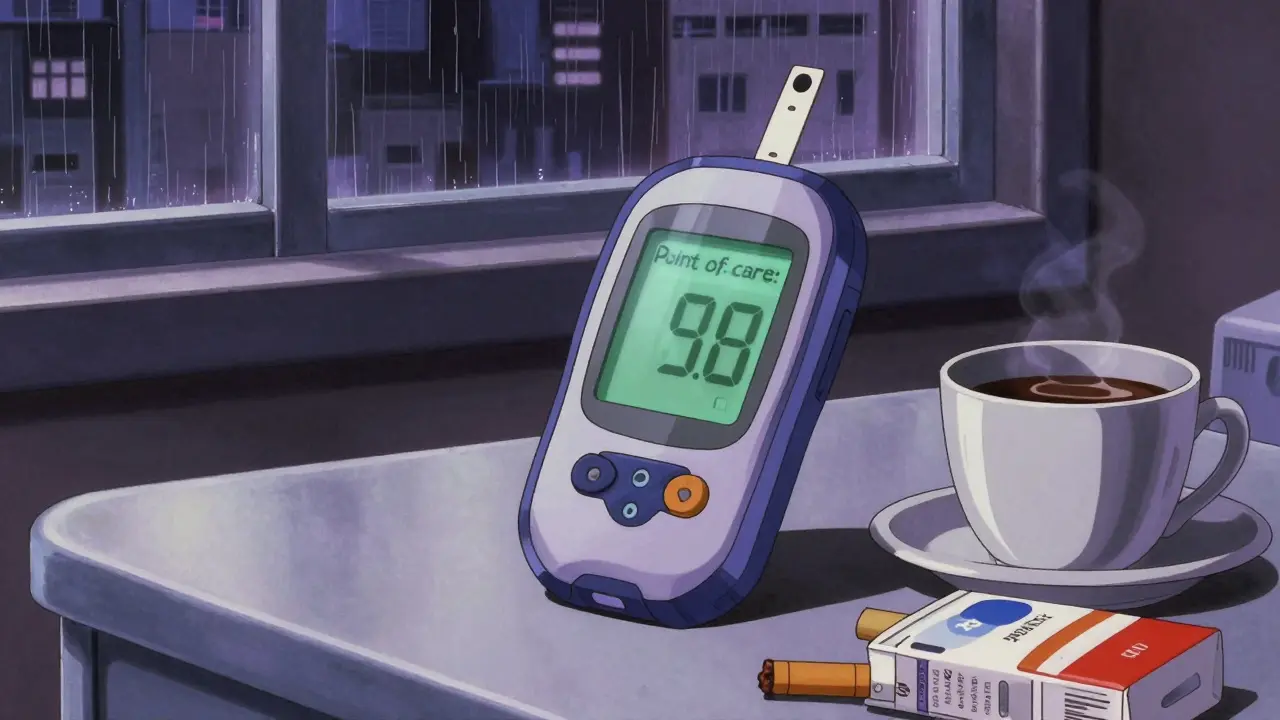
We are living in an era where technology is catching up to clinical needs. Currently, getting results requires a lab visit and waiting days. However, three companies-TheraTest Diagnostics, PharmChek Solutions, and RapidTherapeutics-are conducting phase 2 trials for handheld point-of-care monitors. These devices could provide results in under 5 minutes, similar to a glucose meter for diabetics. While promising, the American College of Chest Physicians’ 2024 guidelines reaffirm that traditional serum monitoring remains the standard until these new tools are widely validated.
Despite the availability of newer biologics and inhalers, theophylline remains relevant, especially in resource-limited settings where it costs $15-$30 per month compared to hundreds for newer therapies. Approximately 1.2 million patients in the U.S. and 850,000 in Europe still rely on it. For these patients, vigilance is their best defense. The drug is not going away anytime soon, and neither should the practice of rigorous monitoring.
What is the normal therapeutic range for theophylline?
The standard therapeutic range is 10-20 mg/L (or μg/mL). Levels below 10 mg/L may be ineffective, while levels above 20 mg/L increase the risk of toxicity. Some patients may respond to lower ranges (5-15 mg/L), but this must be determined by a specialist.
How does smoking affect theophylline levels?
Smoking induces liver enzymes that break down theophylline, increasing clearance by 50-70%. This means smokers often need higher doses. Conversely, quitting smoking can cause levels to rise rapidly, potentially leading to toxicity if the dose is not reduced.
What are the early signs of theophylline toxicity?
Early signs include nausea, vomiting, insomnia, irritability, headaches, and tremors. More severe signs involve rapid heart rate (tachycardia), palpitations, and in extreme cases, seizures or cardiac arrhythmias.
Can I take theophylline with antibiotics?
Some antibiotics, particularly macrolides like erythromycin and clarithromycin, can dangerously increase theophylline levels. Fluoroquinolones like ciprofloxacin also interact. Always inform your doctor about your theophylline use before starting any new medication.
How often should I get my theophylline levels checked?
Initially, levels are checked 5 days after starting or changing the dose. For stable patients, testing every 6-12 months is typical. High-risk patients (elderly, liver/heart conditions, pregnant) may need monthly or quarterly checks.