
Why anabolic agents matter for severe osteoporosis
Most osteoporosis drugs work by slowing bone loss. But if your bones are already dangerously weak-T-score below -2.5, especially after a fracture-you need something that builds new bone. That’s where teriparatide and abaloparatide come in. These aren’t just stronger versions of old drugs. They’re the only FDA-approved treatments that actually stimulate bone formation. For someone with a 40% risk of breaking a hip in the next five years, this isn’t a luxury. It’s a lifeline.
Before these drugs, doctors had to rely on bisphosphonates or denosumab, which stop bone breakdown but don’t rebuild. Think of them like putting a brake on a sinking ship. Teriparatide and abaloparatide are the pumps that start removing the water. They trigger osteoblasts-the cells that build bone-to go into overdrive. The result? Measurable, meaningful increases in bone density, especially in the spine and hip, where fractures are most dangerous.
How teriparatide and abaloparatide work differently
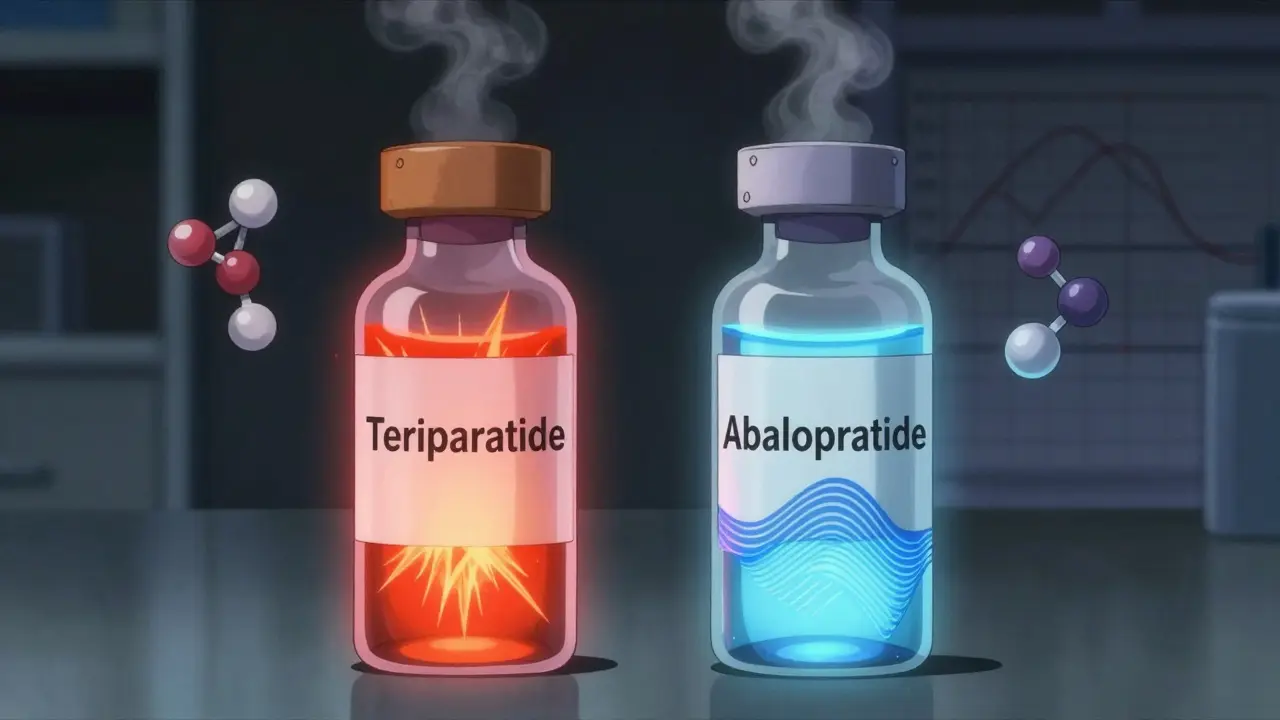
Teriparatide is a synthetic piece of human parathyroid hormone (PTH 1-34). It’s been around since 2002 and was the first drug of its kind. Abaloparatide, approved in 2017, is a synthetic copy of a different hormone-PTHrP-that naturally helps regulate bone growth in developing fetuses. On the surface, they look similar: both are daily injections, both are 34 amino acids long. But their molecular shapes interact with bone cells in distinct ways.
Teriparatide binds to the PTH1 receptor in a way that activates both bone-building and bone-resorbing pathways. That’s why some patients see a spike in calcium levels. Abaloparatide, by contrast, prefers the RG conformation of the receptor. This selective binding means it turns on bone formation more strongly while keeping bone breakdown in check. Think of it like a key that only fits one lock, not two. That’s why, in clinical trials, abaloparatide showed fewer cases of hypercalcemia-3.4% vs 6.4% with teriparatide.
Which one builds bone faster and stronger?
Data from the ACTIVE trial (2016) and follow-up studies show clear differences in how these drugs affect bone mineral density (BMD). At 18 months:
- Abaloparatide increased lumbar spine BMD by 9.7%, total hip by 3.4%, and femoral neck by 2.9%
- Teriparatide increased lumbar spine BMD by 9.3%, total hip by 2.0%, and femoral neck by 1.5%
The hip numbers matter most. Hip fractures kill. One in three people over 50 who break a hip die within a year. Abaloparatide’s advantage here isn’t small-it’s clinically significant. A 2024 real-world study of over 43,000 women found abaloparatide reduced hip fracture risk by 17% compared to teriparatide. That’s not just a number. It’s a person who walks out of the hospital instead of ending up in a nursing home.
But here’s the catch: at 18 months, the difference in spine BMD faded. That’s because teriparatide hits the spine hard and fast. If your main concern is a compression fracture in your lower back, teriparatide might get you there quicker. But if you’re worried about falling and breaking your hip, abaloparatide gives you a better shield.
Fracture risk reduction: The numbers that save lives
Both drugs cut fracture risk dramatically compared to placebo. But when you compare them head-to-head, abaloparatide pulls ahead in key areas:
- Vertebral fractures: Abaloparatide reduced risk by 86% vs placebo; teriparatide by 70%
- Nonvertebral fractures: Abaloparatide reduced risk by 43% vs placebo; teriparatide by 38%
- Hip fractures: Abaloparatide reduced risk by 43% vs placebo; teriparatide by 34%
That 9% gap in hip fracture reduction? It’s not just statistical noise. In a population of 1,000 high-risk women, abaloparatide prevents 9 more hip fractures over 18 months than teriparatide. That’s 9 people who avoid surgery, 9 who keep their independence, 9 who don’t end up in a wheelchair.
And the benefits last. The ACTIVE-EXTEND trial showed that after 18 months of abaloparatide, switching to alendronate kept those gains. At 3.5 years, 68% of patients still had hip T-scores above -2.5. That’s the gold standard: not just building bone, but keeping it.
Safety: Why side effects matter more than you think
Both drugs cause dizziness, nausea, and leg cramps. About 1 in 5 patients feel lightheaded after injection, especially the first few times. That’s why you’re told to inject while sitting or lying down. But the real safety difference is hypercalcemia.
Teriparatide raises blood calcium levels in over 6% of users. That means frequent blood tests, extra doctor visits, and sometimes hospital stays. Abaloparatide? Just 3.4%. That’s not a minor detail. It’s a game-changer for older adults with kidney issues or those already on calcium supplements.
Real-world patient reports back this up. On osteoporosis forums, people switching from teriparatide to abaloparatide often say the same thing: “My calcium levels dropped to normal within weeks. I stopped feeling tired and foggy.” One Reddit user wrote: “I was on teriparatide for 6 months. My doctor kept telling me to cut back on dairy. With abaloparatide, I could eat cheese again.”
Injection site reactions are also less common with abaloparatide-52% vs 68% with teriparatide. That’s not just comfort. It’s adherence. If you’re in pain every day, you’re more likely to skip doses. And skipped doses mean less protection.
Cost and access: The hidden barrier
Abaloparatide costs about $5,750 a month. Teriparatide, now generic since early 2024, is down to $4,200. That’s a 30% difference. But cost isn’t just about the sticker price. It’s about what happens next.
Insurance approval is harder for abaloparatide. In 2023, 44% of patients had to fight for coverage. For teriparatide, it was 28%. Many patients get denied unless they’ve failed two other drugs or had a fracture. Even then, some insurers require prior authorization for every refill.
And then there’s discontinuation. A 2024 survey of 1,207 patients found 32% stopped teriparatide within a year. Only 24% stopped abaloparatide. Why? Side effects. Cost. And, yes, insurance battles. If you’re not getting the drug, you’re not getting the protection.
Some clinics now offer patient assistance programs. Teva, the maker of generic teriparatide, has a copay card that can bring the monthly cost under $50 for eligible patients. Radius Health, the maker of abaloparatide, offers a similar program-but it’s harder to qualify for.
Who gets which drug? Expert guidelines in 2026
The American Association of Clinical Endocrinologists (AACE) updated its guidelines in 2023. Here’s what they say:
- Use teriparatide first if you’re cost-sensitive, have no prior fractures, or your main concern is spine bone density.
- Choose abaloparatide if you’ve had a nonvertebral fracture, your hip T-score is -3.0 or lower, or you’ve had hypercalcemia on other treatments.
Dr. Benjamin Leder, lead researcher on the ACTIVE trial, puts it simply: “If your hip is your biggest worry, go with abaloparatide. If your spine is the problem and you’re watching your wallet, teriparatide still works.”
But here’s the twist: many doctors still default to teriparatide because it’s been around longer. That’s changing. More specialists now start with abaloparatide for high-risk patients. The 2025 network meta-analysis confirmed abaloparatide’s edge in hip protection-and that’s shifting prescribing habits.

What happens after 18 months?
Neither drug can be used longer than 2 years. Why? Long-term animal studies showed a tiny risk of osteosarcoma (bone cancer) with continuous use. It’s extremely rare in humans-no confirmed cases in over 20 years of use-but the FDA still limits treatment to 18-24 months.
That’s why sequencing matters. After abaloparatide or teriparatide, you switch to an antiresorptive: alendronate, denosumab, or risedronate. This isn’t optional. It’s critical. Without it, you lose 40-60% of your bone gains within a year.
The ACTIVE-EXTEND trial showed that after 18 months of abaloparatide, switching to alendronate kept 68% of patients’ hip T-scores above -2.5 at 3.5 years. That’s the benchmark. If you don’t follow up, you’re undoing all the hard work.
What’s next? The future of anabolic therapy
Researchers aren’t done. Radius Health is testing a weekly version of abaloparatide. Phase 3 trials finished in late 2023. If approved in 2025, it could double adherence rates. Imagine one injection a week instead of 365 a year.
The FDA is also pushing for longer treatment windows. A draft guidance in early 2024 asked manufacturers to study 3-year regimens. If proven safe, we could see anabolic agents used for 3 years instead of 2-giving even more bone growth.
And then there’s the market. Generic teriparatide is cutting into abaloparatide’s sales. But as the population ages-with over 22% of Americans over 65 by 2030-demand for bone-building drugs will surge. By 2028, anabolic agents could make up 41% of the osteoporosis market, up from 32% today.
Practical tips for starting treatment
- Store both drugs in the fridge (2-8°C). Don’t freeze. Don’t leave them out overnight.
- Inject at the same time every day-morning is best to avoid nighttime dizziness.
- Use the injection pen correctly: pinch the skin, inject slowly, hold for 10 seconds. Ask your pharmacist to demonstrate.
- Check your calcium levels at 1 month and 6 months. If you feel nauseous or confused, get tested.
- Get a DXA scan at 6 and 18 months. If your spine BMD didn’t rise by at least 3% by month 6, talk to your doctor about switching or adding therapy.
- Plan your transition before day 1. Know what drug comes next. Don’t wait until the last injection.
Final thought: It’s not about which drug is better-it’s about which one’s better for you
There’s no single best drug. Teriparatide is cheaper, proven, and great for spine protection. Abaloparatide is more expensive but safer for your kidneys and better for your hips. The right choice depends on your fracture history, your bone density numbers, your budget, and your tolerance for side effects.
If you’re on the fence, ask your doctor: “What’s my biggest fracture risk-hip or spine? Have I had high calcium before? Can I afford the monthly cost?” Those questions matter more than brand names or marketing.
Because in the end, this isn’t about choosing between two drugs. It’s about choosing between staying independent and losing your mobility. One injection a day might seem like a burden. But it’s the difference between walking into the grocery store-and needing a wheelchair to get there.
Can I take teriparatide or abaloparatide if I’ve had radiation therapy?
No. Both drugs are contraindicated in people who’ve had radiation to the skeleton, including those treated for bone cancer or metastatic disease. The risk of osteosarcoma increases in irradiated bone, and these drugs stimulate bone growth. If you’ve had radiation, your doctor will choose an antiresorptive like denosumab or bisphosphonates instead.
Do I need to take calcium and vitamin D with these drugs?
Yes. Both drugs require adequate calcium and vitamin D to work. Without enough vitamin D, your body can’t absorb calcium properly. Without enough calcium, your bones can’t build new tissue. Most patients need 1,200 mg of calcium and 800-1,000 IU of vitamin D daily. Your doctor will check your blood levels before starting and adjust as needed.
Can I use these drugs if I have kidney disease?
Abaloparatide is safer for people with mild to moderate kidney disease because it causes less hypercalcemia. Teriparatide can raise calcium levels too high in people with reduced kidney function, increasing the risk of kidney stones or confusion. If you have stage 3 or worse kidney disease, abaloparatide is usually preferred. Always get your kidney function tested before starting.
What if I miss a dose?
If you miss one dose, take it as soon as you remember-unless it’s almost time for the next one. Don’t double up. Missing one day won’t ruin your results, but missing several in a row reduces effectiveness. If you miss more than three doses in a week, call your doctor. You might need a blood test to check your calcium levels.
Are these drugs safe for men with osteoporosis?
Yes. Both teriparatide and abaloparatide are FDA-approved for men with severe osteoporosis who are at high fracture risk. Studies show similar improvements in bone density and fracture reduction in men as in women. The same dosing, side effects, and transition protocols apply. Men are often underdiagnosed, but if you’re over 70, have a T-score below -2.5, or had a low-trauma fracture, you’re a candidate.
Erwin Kodiat
January 18, 2026 AT 20:26Jake Rudin
January 18, 2026 AT 22:21Astha Jain
January 19, 2026 AT 15:59Lydia H.
January 20, 2026 AT 07:12Phil Hillson
January 21, 2026 AT 23:45Josh Kenna
January 22, 2026 AT 20:36Christi Steinbeck
January 24, 2026 AT 14:37sujit paul
January 26, 2026 AT 02:08Tracy Howard
January 26, 2026 AT 22:08Aman Kumar
January 27, 2026 AT 15:22Valerie DeLoach
January 29, 2026 AT 15:07Lewis Yeaple
January 29, 2026 AT 22:46Jackson Doughart
January 30, 2026 AT 17:42