
Serotonin Syndrome Severity & Response Tool
Symptom Assessment
Select the symptoms currently present in the patient.
Assessment Result
Pending
Enter symptoms and temperature to generate an emergency response plan.
Imagine you’ve been taking your antidepressant for months without issue. Then, after adding a new migraine medication or even just increasing your dose slightly, your body starts acting up in ways that feel terrifyingly wrong. Your heart races, you break into a cold sweat, and your muscles start twitching uncontrollably. This isn’t just anxiety. It could be serotonin syndrome, a potentially life-threatening condition caused by excessive serotonergic activity in the central nervous system. While rare, it is a serious risk when using selective serotonin reuptake inhibitors (SSRIs) like sertraline or fluoxetine, especially when combined with other drugs that affect serotonin levels.
Understanding this condition is not about inducing panic; it’s about empowerment. The difference between a manageable medical event and a critical emergency often comes down to recognition speed. According to data from U.S. Pharmacist (2023), approximately 67% of patients show symptoms within six hours of a medication change, and 75% within 24 hours. If you know what to look for, you can save lives-including your own.
Recognizing the Triad of Symptoms
Serotonin syndrome doesn’t present as a single symptom but rather as a distinct triad affecting three major systems: cognitive, neuromuscular, and autonomic. Doctors use these categories to diagnose the condition accurately, distinguishing it from other emergencies like meningitis or neuroleptic malignant syndrome.
Cognitive Changes: This is often where it starts. Patients report feeling unusually agitated or confused. In clinical studies, agitation was reported in 92% of cases, followed by confusion (78%) and delirium (65%). You might feel like you’re losing touch with reality or experience hallucinations, which occur in about 32% of severe cases.
Neuromuscular Abnormalities: This is the most visible sign. Look for clonus-a rhythmic, involuntary muscle contraction. Spontaneous, inducible, or ocular clonus appears in 89% of cases. Other signs include hyperreflexia (overactive reflexes), muscle rigidity, and tremors. If your legs feel like they are vibrating or jerking on their own, take note.
Autonomic Hyperactivity: Your body’s automatic functions go into overdrive. Diaphoresis (heavy sweating) affects 85% of patients. Tachycardia (rapid heartbeat) occurs in 79%, while blood pressure fluctuations happen in 63%. Fever, or hyperthermia, is a late and dangerous sign, appearing in 58% of cases. Diarrhea is also common, affecting nearly half of those impacted.
| Symptom Category | Key Symptom | Prevalence Rate |
|---|---|---|
| Cognitive | Agitation | 92% |
| Neuromuscular | Clonus | 89% |
| Autonomic | Diaphoresis (Sweating) | 85% |
| Autonomic | Tachycardia | 79% |
| Cognitive | Confusion | 78% |
The Hunter Criteria: How Diagnosis Works
In an emergency room, time is critical. Doctors rely on the Hunter Serotonin Toxicity Criteria, which is considered the gold standard for diagnosis. Validated by multiple studies and recommended by the American College of Medical Toxicology, this tool boasts 84% sensitivity and 97% specificity. Despite its accuracy, misdiagnosis remains a significant problem, with under-recognition rates of 30-40% in emergency departments, according to Mayo Clinic (2023).
The criteria require the presence of a serotonergic agent plus one of the following:
- Spontaneous clonus
- Inducible clonus plus agitation or diaphoresis
- Ocular clonus plus agitation or diaphoresis
- Tremor plus hyperreflexia
- Hypertonia, temperature above 38°C (100.4°F), and either ocular clonus or inducible clonus
A key distinction lies in differentiating serotonin syndrome from neuroleptic malignant syndrome (NMS). While both involve fever and muscle issues, serotonin syndrome has a rapid onset-typically less than 24 hours-and features hyperreflexia and clonus. NMS, by contrast, develops over 7-10 days and presents with "lead-pipe" rigidity and hyporeflexia. Recognizing this difference ensures the correct treatment path is taken immediately.

Emergency Response Protocols by Severity
Treatment depends entirely on how severe the case is. Severity is classified by body temperature and the extent of organ involvement. Mild cases have temperatures below 38.5°C (101.3°F). Moderate cases range from 38.5°C to 41.1°C (101.3°F to 106°F). Severe cases exceed 41.1°C (106°F) and involve multi-organ failure risks.
Mild Cases: The primary step is immediate discontinuation of all serotonergic agents. Supportive care includes intravenous crystalloids, typically a 1-2L normal saline bolus, to maintain hydration. Benzodiazepines such as diazepam (5-10mg IV) or lorazepam (1-2mg IV) are administered every 1-2 hours as needed to control agitation and muscle spasms. Continuous monitoring for 12-24 hours is essential to ensure symptoms do not worsen.
Moderate Cases: Alongside stopping the offending drugs and administering benzodiazepines, active cooling measures become necessary. This involves evaporative cooling using fans and misting sprays. Non-serotonergic antiemetics like ondansetron (4mg IV) may be used if nausea is severe. Observation periods are extended to monitor for progression.
Severe Cases: This is a life-threatening emergency requiring intensive care. Immediate airway management with rapid sequence intubation is often required. Paralysis with non-depolarizing agents like rocuronium (1.2mg/kg IV) stops muscle contractions that generate heat. Aggressive external cooling, including ice packs to major vessels and cooling blankets, is applied. Sedation with midazolam infusions helps manage agitation. Crucially, physical restraints must be avoided, as they increase muscle activity and worsen hyperthermia, potentially converting a moderate case into a fatal one.
Common Drug Interactions to Avoid
Most cases of serotonin syndrome result from combining medications that increase serotonin levels. Understanding these interactions is vital for prevention. A 2022 meta-analysis in CNS Drugs identified high-risk combinations:
- SSRIs and MAOIs: Monoamine oxidase inhibitors prevent the breakdown of serotonin. Combining them with SSRIs carries a relative risk of 12.4, making it the most dangerous interaction.
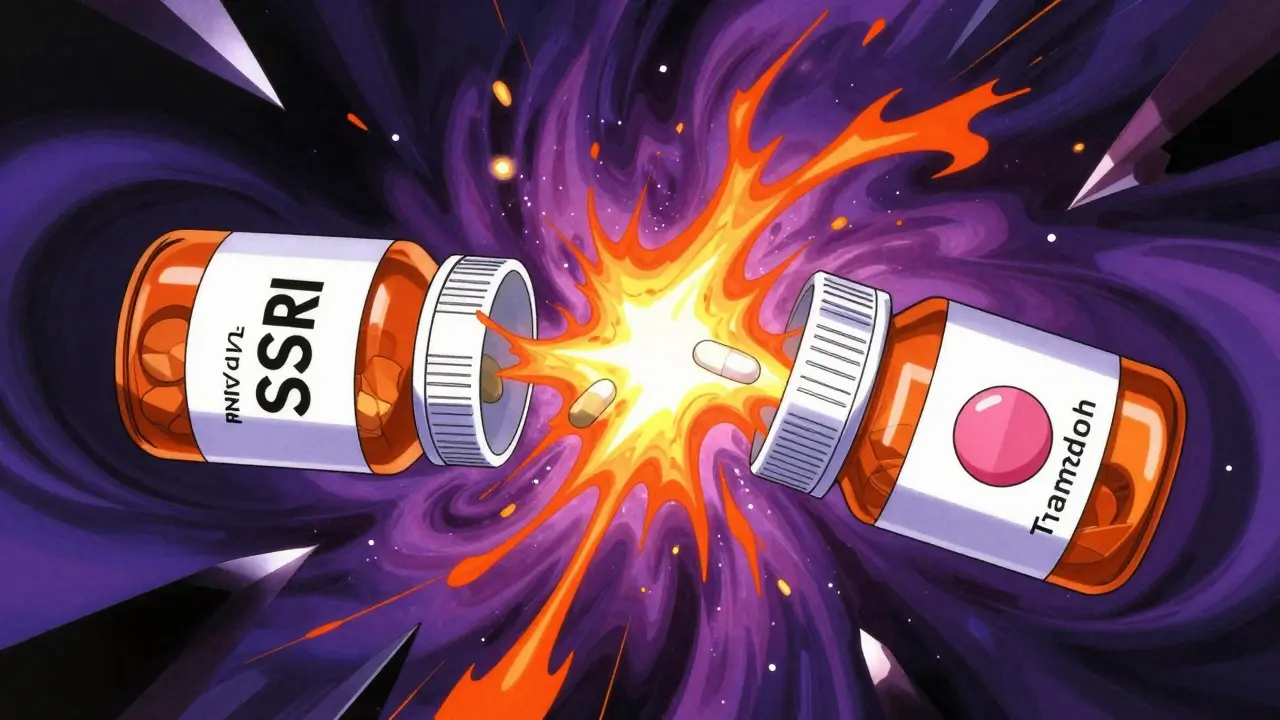
- SSRIs and Tramadol: This painkiller also inhibits serotonin reuptake. The relative risk here is 8.7. Many patients are unaware that tramadol interacts with antidepressants.
- SSRIs and Triptans: Used for migraines, triptans have a relative risk of 3.2 when mixed with SSRIs.
Even herbal supplements can trigger this reaction. St. John’s Wort, commonly used for mild depression, significantly increases serotonin levels and should never be combined with prescription SSRIs. Always disclose all supplements and over-the-counter medications to your healthcare provider.
Treatment Myths and Realities
One of the most dangerous misconceptions is that antipyretics like acetaminophen or ibuprofen will help lower the fever associated with serotonin syndrome. They do not. The hyperthermia in serotonin syndrome results from excessive muscular activity, not a change in the hypothalamic set-point. Studies confirm that antipyretics have no therapeutic role in these cases. Instead, cooling must be mechanical or chemical via paralysis.
Benzodiazepines remain the first-line treatment. Dr. Hedrick at Cedars-Sinai notes that they ease agitation, relax muscles, and prevent seizures-the most dangerous complication. Diazepam has been shown to prolong survival in animal models of serotonin toxicity. For severe cases resistant to benzodiazepines, cyproheptadine, an antihistamine with 5-HT2A antagonist properties, may be used. The typical dose is 12mg initially, followed by 2mg every two hours. However, evidence for its efficacy is limited to case reports, and it is not a substitute for supportive care.
Prognosis and Recovery
With early recognition and appropriate treatment, the prognosis is generally good. Ninety-two percent of mild-to-moderate cases resolve within 24 to 72 hours after discontinuing the offending medication. However, the timeline varies depending on the specific drug involved. Fluoxetine (Prozac), for instance, has a long half-life due to its active metabolite norfluoxetine, which can last 7-15 days. Consequently, symptoms related to fluoxetine-induced serotonin syndrome may persist for 3-4 weeks.
Severe cases carry a higher risk. Mortality rates range from 2% to 12%, heavily dependent on the speed of treatment. A 2021 study in Critical Care Medicine found an 11.3% mortality rate when treatment was delayed beyond six hours, compared to just 2.1% when treated within two hours. This underscores the importance of seeking immediate medical attention at the first sign of unusual symptoms.
How quickly does serotonin syndrome develop?
Symptoms typically appear rapidly. About 67% of patients show signs within 6 hours of a medication change or overdose, and 75% within 24 hours. This rapid onset helps distinguish it from other conditions like neuroleptic malignant syndrome, which develops over days.
Can I take Tylenol for the fever caused by serotonin syndrome?
No. Antipyretics like acetaminophen (Tylenol) or ibuprofen are ineffective because the fever is caused by excessive muscle activity, not a reset in the body's thermostat. Treatment requires stopping the causative drugs, using benzodiazepines, and applying active cooling measures.
What are the most dangerous drug combinations?
The highest risk combination is SSRIs with MAOIs (relative risk 12.4). Other dangerous mixes include SSRIs with tramadol (relative risk 8.7) and SSRIs with triptans (relative risk 3.2). Even St. John’s Wort can trigger severe reactions when combined with antidepressants.
Why are benzodiazepines the first-line treatment?
Benzodiazepines reduce agitation, relax muscles, and prevent seizures. By calming the nervous system, they directly address the root cause of the hyperthermia and neuromuscular symptoms. They are preferred because they lack anticholinergic or serotonergic properties that could worsen the condition.
How long does it take to recover from serotonin syndrome?
Most mild to moderate cases resolve within 24 to 72 hours after stopping the triggering medication. However, if fluoxetine (Prozac) is involved, recovery may take 3 to 4 weeks due to its long-lasting metabolite. Severe cases require intensive care and have a longer recovery period.