
Have you ever reached for your morning pills, taken them, and then five minutes later wondered, "Did I actually take those?" It is a terrifying feeling. For millions of people managing chronic conditions or caring for family members, this uncertainty is not just anxiety-it is a genuine health risk. Accidental double-dosing happens more often than you might think. According to the U.S. Food and Drug Administration, medication errors cause at least one death every day in the United States alone. Even worse, roughly half of all medication-related adverse events happen right here at home, not in hospitals.
Double-dosing occurs when someone unintentionally takes two doses of the same medication within the prescribed time interval. This can lead to serious overdose symptoms, dangerous side effects, or life-threatening complications. The risk is particularly high for older adults, who often manage complex regimens of four to five prescription drugs daily, and for children, whose dosing depends heavily on precise weight-based calculations. But you do not have to rely on memory alone. By combining simple physical tools with smart habits, you can build a safety net that catches these errors before they become emergencies.
The Hidden Dangers of Home Medication Errors
We tend to trust our memory implicitly until it fails us. In a 2023 survey by WesleyLife involving 1,200 caregivers, 63% of seniors reported experiencing "Did I take my pill?" anxiety at least once a week. More alarmingly, 28% admitted to accidentally double-dosing at least once in the previous year. These numbers highlight a critical gap between intention and execution in home care.
The stakes are highest for specific groups. For older adults, the complexity of modern treatment plans means a single missed or duplicated dose can disrupt blood pressure control, blood sugar levels, or heart rhythm. For children, the margin for error is razor-thin. The National Council on Patient Information and Education notes that pediatric dosing is strictly weight-based. Giving a child too much ibuprofen or acetaminophen because a parent forgot they already gave a dose an hour earlier can quickly escalate into liver damage or kidney stress. Understanding that these errors are common-and preventable-is the first step toward building a safer home environment.
Physical Tools: Pill Organizers and Visual Cues
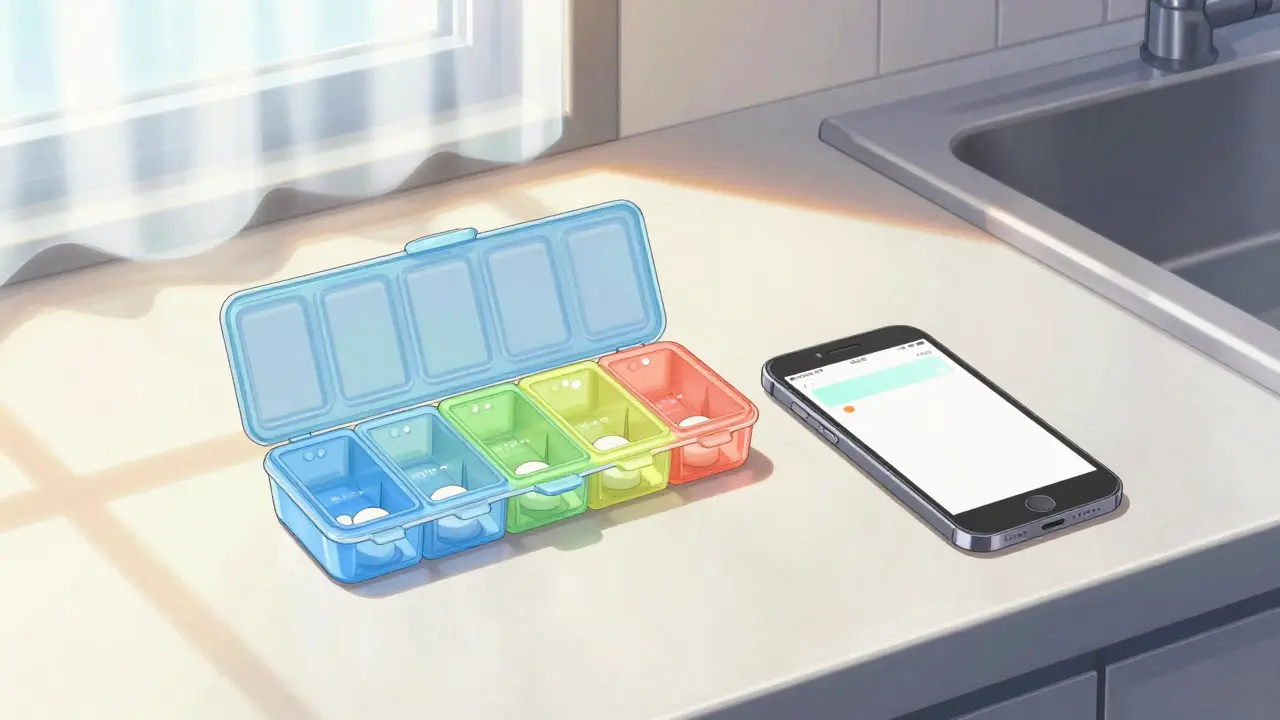
If you want to stop guessing whether you took your medicine, you need visual proof. The most effective and widely recommended tool is the pill organizer, which is a compartmentalized box designed to sort medications by day and time of day. St. Louis Children’s Hospital specifically advises using a weekly organizer with slots for AM, noon, PM, and bedtime. Why? Because an empty slot is undeniable evidence. You do not have to remember; you just look.
- Weekly Compartmentalization: Use a seven-day box with multiple daily slots. This allows you to prep your entire week on Sunday night, reducing daily decision fatigue.
- Bottle Flipping: For single-dose daily medications, Stanford Medicine suggests a low-tech trick: flip the bottle upside down after taking your dose. If the bottle is upright in the morning, you know you haven’t taken it yet.
- Smart Dispensers: For those who struggle with manual sorting, smart pill dispensers lock after the dose is dispensed. A 2023 study at Johns Hopkins found these devices reduced double-dosing incidents by 76%.
While pill organizers alone reduce errors by about 35%, they work best when paired with other strategies. They provide the visual confirmation that memory cannot.
Digital Reminders and Tracking Apps
Technology has moved beyond simple alarms. Modern medication management apps offer synchronized tracking that acts as a digital logbook. Apps like Medisafe have shown remarkable results; an independent study published in the Journal of Medical Internet Research reported an 87% improvement in adherence rates among users. These apps do more than beep-they record exactly when you mark a dose as taken.
However, technology introduces its own challenges. Setting up a smartphone app requires about 20-30 minutes of initial configuration and a few days to build the habit. Success rates skyrocket when family members help set up the system. If you are caring for an elderly parent, consider syncing their reminders with your phone. This creates a shared accountability loop. If the app says "taken," but you suspect otherwise, you have a timestamp to verify against.
For those who prefer non-digital methods, a simple paper journal works surprisingly well. One 72-year-old patient avoided warfarin toxicity during daylight saving time changes by checking off each dose in a notebook. The act of writing it down created a mental checkpoint that prevented confusion.
Measurement Accuracy: Stop Using Kitchen Spoons
If you administer liquid medications, especially to children, throw away the kitchen spoons. This is one of the most dangerous habits in home care. Children’s Healthcare of Atlanta warns that standard kitchen teaspoons vary wildly in volume, ranging from 2.5 mL to 7.3 mL. That is a variation of up to 65%. If a doctor prescribes 5 mL of cough syrup, using a large kitchen spoon could mean giving the child nearly double the intended dose.
Always use the measuring device that came with the medication-usually an oral syringe or a dosing cup marked in milliliters (mL). If that device is lost, ask your pharmacist for a replacement. Never estimate. Precision matters. Measuring the dose out exactly prevents the accidental overdoses that often occur when parents try to "top up" a dose they think was partially spit out, only to realize later the child swallowed it all.
Communication Strategies for Multi-Caregiver Households
In households with multiple caregivers-parents, grandparents, babysitters-the risk of double-dosing spikes. A staggering 41% of pediatric double-dosing cases reviewed by Children’s Healthcare of Atlanta in 2023 involved parents giving extra doses because a child initially refused the medicine, only to accept it later from another caregiver who didn’t know the first dose had been administered.
To combat this, designate one primary person responsible for medication administration. Dr. Karen Smith, a Pediatric Pharmacologist at St. Louis Children’s Hospital, notes that assigning this task to one parent reduces errors by nearly 50%. If that isn’t possible, implement a strict communication protocol:
- Use a Shared Schedule: Keep a visible medicine schedule in a central location, like the refrigerator door.
- Log Every Dose: Whether digital or paper, ensure every caregiver checks the log before administering.
- Clarify Refusals: If a child refuses medicine, wait the full prescribed interval before retrying. Do not give a "second chance" dose immediately unless directed by a doctor.
Clear communication is as crucial as the medication itself. Misunderstandings between caregivers are a leading cause of home medication errors.

Identifying Duplicate Ingredients
Double-dosing isn’t always about taking two pills of the same brand. It often happens when patients take different products containing the same active ingredient. For example, taking a dedicated painkiller alongside a cold-and-flu remedy can result in a dangerous overdose of acetaminophen or ibuprofen. Pharmacists at EssexCare Pharmacy found that 32% of double-dosing incidents they documented in 2023 involved these overlapping ingredients.
Create a comprehensive medication list that includes prescriptions, over-the-counter drugs, vitamins, and supplements. Review this list with your pharmacist annually, or whenever you start a new medication. Ask specifically: "Does this contain any ingredients already in my other medicines?" The FDA has pushed for clearer labeling of active ingredients since 2022, but it is still up to consumers to read the labels carefully. Look for terms like "acetaminophen," "ibuprofen," or "diphenhydramine" across all product packaging.
Building a Routine to Reduce Risk
Habit formation is a powerful defense against error. St. Louis Children’s Hospital recommends syncing medication times with existing daily routines, such as brushing teeth or eating breakfast. In their 2023 study, 78% of successful adherence cases incorporated medication into established habits. When taking medicine becomes part of your automatic morning ritual, the cognitive load decreases, and the likelihood of forgetting-or doubting-drops significantly.
Be mindful of disruption triggers. Travel, illness, and holiday periods are high-risk times. The American Society of Health-System Pharmacists reports a 33% increase in double-dosing incidents during holidays due to schedule changes and multiple caregivers. Plan ahead for these disruptions. Pack your pill organizer fully before traveling, and inform any temporary caregivers of your routine.
| Strategy | Effectiveness | Best For | Limitations |
|---|---|---|---|
| Pill Organizer | Reduces errors by ~35% | Seniors, multiple daily doses | Requires weekly prep; easy to lose |
| Digital App + Organizer | Reduces errors by ~62% | Tech-comfortable users, families | Initial setup time; battery dependency |
| Single Caregiver Designation | Reduces errors by ~47% | Children, multi-caregiver homes | Not feasible for all households |
| Smart Locking Dispenser | Reduces errors by ~76% | High-risk patients, dementia care | Higher cost; less flexible |
What to Do If You Suspect Double-Dosing
Mistakes happen. If you suspect you or a loved one has taken too much medication, do not panic, but act quickly. Contact the National Poison Control Center immediately at 1-800-222-1222. They provide expert, free guidance 24/7. Have the medication bottle ready to share the exact name, strength, and estimated amount taken. Do not wait for symptoms to appear. Some overdoses, particularly with sedatives or heart medications, can deteriorate rapidly. Professional advice ensures you take the right steps, whether that means monitoring at home or heading to the emergency room.
How can I tell if I have accidentally double-dosed?
Signs vary by medication but may include dizziness, nausea, confusion, excessive sleepiness, or rapid heartbeat. However, some overdoses have no immediate obvious symptoms. If you are unsure, check your pill organizer or log. If the slot is empty but you feel unwell, seek medical advice. Never guess.
Is it safe to use kitchen spoons for liquid medicine?
No. Kitchen spoons vary significantly in size, leading to doses that can be up to 65% higher than prescribed. Always use the oral syringe or dosing cup provided with the medication, measured in milliliters (mL).
What is the best way to manage medications for a child?
Designate one primary caregiver to handle all doses to avoid miscommunication. Use a written schedule and measure doses precisely with the provided syringe. Store all medications out of reach and sight of children to prevent accidental ingestion.
Can digital apps replace pill organizers?
Apps are excellent for reminders and logging, but they lack the physical visual confirmation of an empty slot. Combining both-an app for alerts and a pill organizer for visual proof-offers the highest level of protection against double-dosing.
Who should I call if I suspect an overdose?
Call the National Poison Control Center at 1-800-222-1222 immediately. They provide expert guidance on whether you need to go to the hospital or can monitor at home. Have the medication packaging ready when you call.