Every time you pick up a prescription, there’s a good chance the pill in your hand isn’t the one your doctor wrote on the paper. That’s not a mistake. It’s presumed consent-a legal system that lets pharmacists swap brand-name drugs for cheaper generics without asking you first. In 43 states and Washington, D.C., this is standard practice. You don’t sign anything. You don’t get a form. You just get a different pill, and the law says that’s okay.
How Presumed Consent Works in Real Life
Here’s how it plays out: Your doctor prescribes Lipitor for your cholesterol. The pharmacy has the generic version, atorvastatin, which the FDA says works the same way. Under presumed consent laws, the pharmacist can give you the generic without checking in with you. They don’t need your verbal yes or a signed form. The law assumes you’re okay with it-unless you’ve told them otherwise in writing or your state has an exception.
This system exists because generic drugs cost a fraction of the brand name. A month’s supply of Lipitor might run $150. The generic? Around $10. That’s not a small difference. Across the U.S., generic drugs save the healthcare system about $1.68 trillion over the last decade, according to the Association for Accessible Medicines. Most of that savings comes from these automatic swaps.
But here’s the catch: Just because it’s legal doesn’t mean it’s always simple. Pharmacists still have to follow rules. In 31 states, they must tell you after the fact-usually on the label or with a printed notice. In 19 states, they’re required to substitute generics whenever possible. In others, they can choose. And in seven states plus D.C., they still need your explicit permission before switching.
What Drugs Can Be Swapped? Not All of Them
Presumed consent applies mostly to small-molecule drugs-things like blood pressure pills, antidepressants, or statins. These are chemically simple, and the FDA has a clear system to rate their equivalence using the Orange Book. If a generic has an “A” rating, it’s considered interchangeable.
But some drugs are trickier. For example, antiepileptic medications like phenytoin or levetiracetam have a narrow therapeutic index. That means even tiny differences in how the body absorbs the drug can cause seizures or dangerous side effects. The American Epilepsy Society documented 178 cases of breakthrough seizures between 2018 and 2022 linked to generic switches. Because of this, 15 states-including Tennessee, Hawaii, and Maryland-have special rules. Pharmacists in those states can’t substitute these drugs without your explicit consent, even under presumed consent laws.
The same goes for thyroid meds like levothyroxine. A 2022 study in Health Affairs found that switching brands-even between two FDA-approved generics-can cause thyroid levels to fluctuate enough to require a doctor’s adjustment. Many pharmacists now avoid switching these unless the patient agrees.
Biosimilars Are a Whole Different Ballgame
Then there are biosimilars-cheaper versions of complex biologic drugs used for conditions like rheumatoid arthritis, Crohn’s disease, or cancer. These aren’t simple chemicals. They’re made from living cells, and even small changes in manufacturing can affect how they work.
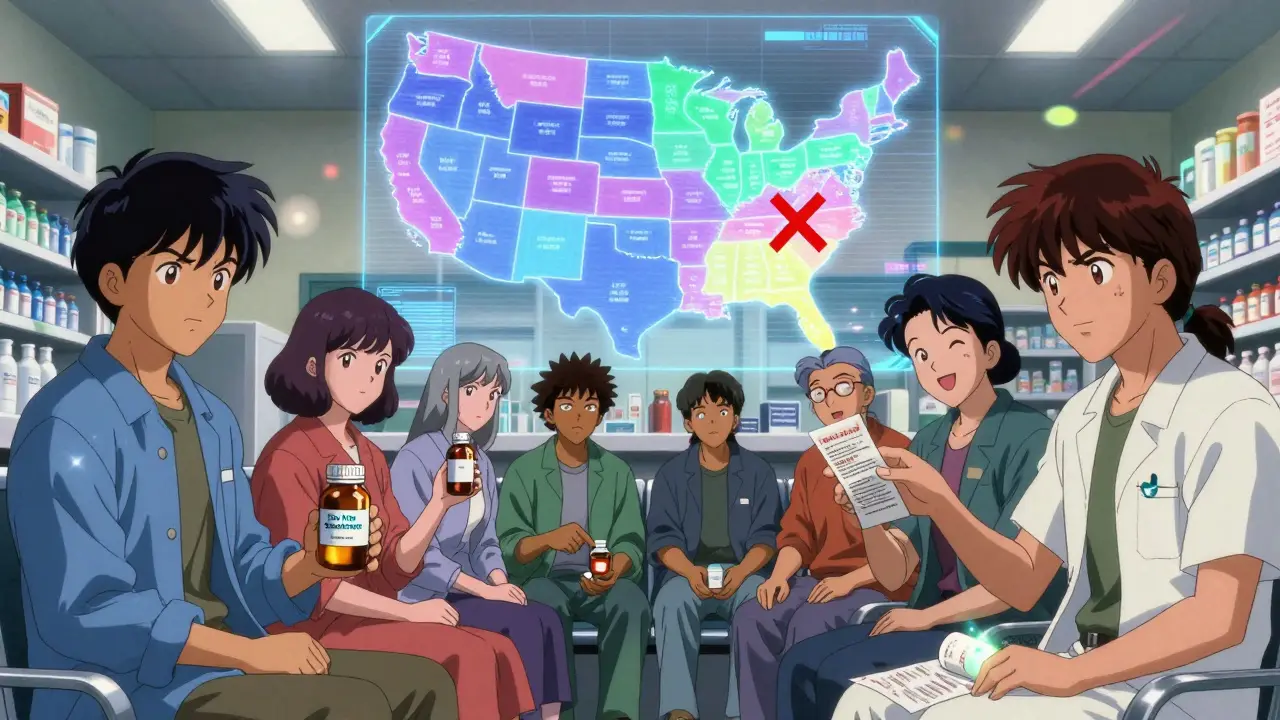
As of 2023, only 46 states allow automatic substitution of interchangeable biosimilars. Four states-North Carolina, Oklahoma, Pennsylvania, and Texas-ban it entirely. In most other states, pharmacists must get your permission, notify your doctor, and document everything. The FDA’s Purple Book lists which biosimilars are considered interchangeable, but state laws vary wildly. One pharmacy in Michigan might swap a biosimilar without asking. One in Texas can’t even try.
That’s why many patients with chronic conditions get confused. They get a new prescription, assume it’s the same drug, and don’t realize the medication they’ve been taking for years has been quietly changed.
Why Pharmacists Support It-And Why Some Patients Don’t
Pharmacists are the ones on the front lines. In presumed consent states, they save about 1.7 minutes per prescription by not having to stop and ask. That adds up to $2.8 billion in labor savings nationwide each year, according to the American Society of Health-System Pharmacists. For independent pharmacies, it means less paperwork, fewer delays, and more time to talk to patients about other things.
But patients aren’t always happy. On Reddit, a pharmacist in Ohio wrote: “95% of patients don’t notice the switch. The other 5%? They lose trust in the whole system.” On Drugs.com, most reviews praise the cost savings: “Saved me $45 a month.” But others say: “My seizure meds stopped working after the switch.”
The emotional impact matters. People don’t just take pills-they rely on them. When a drug that’s been stable for years suddenly changes, it can feel like a betrayal. Especially if they don’t know it happened.
What You Can Do to Stay in Control
You don’t have to be passive. Even in presumed consent states, you have rights:
- Ask for the brand name. You can say, “I want the name-brand version,” and the pharmacist must honor that-unless your insurance blocks it.
- Check the label. Look for the drug name. If it’s different from what your doctor wrote, you were substituted.
- Ask for documentation. In 31 states, the pharmacy must give you a notice. If they don’t, ask for it.
- Know your drug class. If you’re on a narrow therapeutic index drug (epilepsy, thyroid, blood thinners), tell your pharmacist you don’t want substitutions.
- Use your pharmacy’s app or portal. Many now send alerts when a substitution occurs.
Some pharmacists keep a “do not substitute” flag on your profile. If you’ve had a bad experience, ask them to add it. It’s your right.
The Big Picture: Savings vs. Safety
The system works well for most people. Generic drugs are safe, effective, and save billions. But the lack of uniform rules is a problem. A patient in New York might get a generic without a warning. The same patient in California gets a printed notice. In Texas, they might get the brand name because the law doesn’t allow substitution at all.
That inconsistency creates confusion. It puts pharmacists in a tough spot. One 2023 survey found that 41% of pharmacists struggle with special restrictions for certain drugs. Electronic systems often don’t flag state-specific rules correctly. One wrong click, and a patient gets the wrong drug.
Experts like Dr. Erika Lietzan from the University of Missouri say presumed consent is efficient-but only if patients are informed. The FDA insists generics are equivalent. But the American College of Clinical Pharmacy says: “Not all equivalence is created equal.”
The future may bring change. The Uniform Law Commission is drafting a model law to standardize substitution rules across states. New York and California have already tightened their notification rules. And as biosimilars grow, states will have no choice but to update their laws.
For now, the system is a balancing act: saving money while trying not to risk safety. And the only way to make sure you’re not caught in the middle is to stay informed, ask questions, and speak up.
Can my pharmacist switch my medication without telling me?
In 43 states and Washington, D.C., yes-under presumed consent laws, pharmacists can substitute generic drugs without asking you first. But in 31 of those states, they’re required to notify you after the fact, usually through a printed notice or label update. In the remaining 12 states, including Alaska and Maryland, they must get your explicit permission before switching.
Are generic drugs really the same as brand names?
The FDA says yes-for most small-molecule drugs, generics must prove they deliver the same amount of active ingredient into the bloodstream as the brand name. They’re held to the same quality standards. But for drugs with a narrow therapeutic index-like epilepsy, thyroid, or blood thinner medications-even small differences can cause problems. Some patients report side effects or loss of effectiveness after switching, which is why 15 states restrict substitutions for these drugs.
How do I know if my prescription was switched?
Check the label. The drug name will be the generic version (e.g., “atorvastatin” instead of “Lipitor”). Many pharmacies also include a notice like “This is a generic substitution” on the bottle. If you’re unsure, ask the pharmacist. You can also look up your medication in your pharmacy’s app or online portal, where substitutions are often flagged.
Can I refuse a generic substitution?
Yes. You have the right to request the brand-name drug at any time. The pharmacist must fill your request unless your insurance denies coverage. If you’ve had a bad experience with a generic before, ask your pharmacist to add a “do not substitute” note to your profile. This prevents automatic swaps in the future.
Why do some states require consent and others don’t?
Each state sets its own pharmacy laws. Presumed consent became popular because it lowers costs and speeds up dispensing. States with mandatory substitution (like California and Texas) want to maximize generic use. States with explicit consent (like Hawaii and Maine) prioritize patient autonomy. There’s no national standard, which creates confusion for patients and pharmacists alike-especially when traveling or using mail-order pharmacies across state lines.
What Comes Next?
As biosimilars become more common, the current patchwork of state laws will become harder to manage. The FDA is working on clearer guidelines. Some states are already updating their rules. And pressure is growing for a federal standard.
For now, the best protection is awareness. Know your medication. Ask questions. Don’t assume the pill in your hand is the same as last time. Your health is worth the extra minute of asking.
saurabh singh
January 4, 2026 AT 14:02Man, this hits different in India where we still fight just to get generics covered by insurance. Here, pharmacists swap meds like trading cards-no big deal. But I get it, if you’re on something like levothyroxine, even a tiny shift can wreck your whole week. I’ve seen my uncle go from stable to shaky after a switch. Just ask for the brand if it matters to you. No shame in that.
Dee Humprey
January 4, 2026 AT 22:18Check your label every time. Seriously. I used to trust the pharmacy until I realized my blood pressure med had changed and my numbers went nuts. Now I always look for the generic name. If it’s not what my doctor wrote, I ask. It takes 30 seconds and saves you from a hospital trip.
John Wilmerding
January 6, 2026 AT 01:24While the economic rationale for presumed consent is compelling, one must not overlook the epistemological implications of non-consensual pharmaceutical substitution. The FDA’s equivalence paradigm, while statistically valid, fails to account for inter-individual pharmacokinetic variance. The cumulative effect of unannounced substitutions on patient trust in the healthcare ecosystem may constitute a latent public health crisis.
Allen Ye
January 6, 2026 AT 17:17Think about it-this isn’t just about pills. It’s about autonomy. We live in a world where corporations and bureaucracies assume they know what’s best for us, and we just nod along. You don’t sign a contract when you get your meds? That’s not efficiency-that’s erasure. And now they want to do the same with biosimilars? These aren’t just chemical copies. They’re living molecules, grown in tanks, shaped by biology, not factories. We’re treating them like soda cans. One batch tastes fine, another gives you hives. And nobody tells you? That’s not healthcare. That’s gambling with your life and calling it ‘cost-saving.’
And don’t get me started on how pharmacists are stuck in the middle. They’re not villains-they’re overworked, underpaid, and forced to be the face of a system that doesn’t care if you wake up seizing because your levetiracetam was swapped with a slightly different filler. The real villain? The patchwork of state laws that make no sense to anyone except lawyers and lobbyists.
And yet, here we are. We’re supposed to be grateful for the $10 pill while the people who make the real decisions sit in boardrooms sipping espresso and talking about ‘value-based care.’ Meanwhile, I’ve got a friend who had to quit her job because the switch made her depression worse. No one warned her. No one asked. Just a new bottle. That’s not healthcare. That’s negligence dressed up as policy.
So yeah, ask for the brand. Put a ‘do not substitute’ flag on your file. Demand the printed notice. Because if you don’t, someone else’s spreadsheet is deciding whether you live or suffer.
Jason Stafford
January 7, 2026 AT 04:08THIS IS A GOVERNMENT COVER-UP. They’ve been swapping your meds since the 90s. Big Pharma and the FDA are in bed together. The ‘generic’ isn’t even the same chemical-it’s a knockoff with cheap fillers that make you sleepy, anxious, or suicidal. I know because I had a seizure after they switched my meds. The pharmacy didn’t tell me. The doctor didn’t know. The FDA says it’s ‘equivalent’-but that’s a lie. They’re testing on rats, not humans. And now they want to do this with cancer drugs? NEXT THING YOU KNOW, THEY’LL BE GIVING YOU PLACEBOS AND CALLING IT ‘BIOSSIMILAR.’
THEY’RE HIDING THE TRUTH. CHECK YOUR BOTTLE. ASK FOR THE ORIGINAL. OR YOU’LL BE NEXT.
Justin Lowans
January 8, 2026 AT 16:56The elegance of this system lies in its quiet efficiency. Generics are not merely cheaper-they’re democratically accessible. That $140 monthly savings isn’t just a line item; it’s a child’s school lunch, a bus pass, a week’s worth of groceries for someone on fixed income. The occasional hiccup with narrow-therapeutic-index drugs is unfortunate, but the solution isn’t to dismantle the system-it’s to refine it. Better labeling. Better EHR flags. Better pharmacist training. Let’s not throw the baby out with the bathwater.
Michael Rudge
January 9, 2026 AT 21:41Oh wow, so now pharmacists are just… deciding what goes into your body? How quaint. I bet they also choose your favorite flavor of toothpaste while they’re at it. Next thing you know, your therapist will be switching your antidepressants because ‘the generic is just as good’-and then you’ll be crying into your oat milk latte wondering why you feel like a ghost. How is this not medical malpractice? Oh right-because the law says so. Guess I’ll just sign my life away in the fine print of my insurance policy.
Stephen Craig
January 10, 2026 AT 03:28Ask for the brand. Put it in writing. Done.
Connor Hale
January 11, 2026 AT 06:22It’s wild how much trust we put in systems we don’t understand. You hand over your prescription like it’s a coffee order. You don’t check the label. You don’t ask. You just assume. But your body isn’t a vending machine. It notices differences-even tiny ones. Maybe the system works for most. But for the ones it doesn’t? It feels like being erased. I wish more people knew they could say no.
Roshan Aryal
January 12, 2026 AT 00:54India doesn’t have this problem because we don’t have brand-name drugs to begin with. Everything’s generic. And guess what? We don’t all die. You Americans act like this is some dystopian horror. It’s just capitalism. If you can’t afford the brand, you take the generic. End of story. Stop acting like your body is a sacred temple and your pills are holy relics. The FDA doesn’t lie. Your anxiety is the real problem.
Jack Wernet
January 12, 2026 AT 15:40Thank you for this thorough and nuanced examination. The tension between cost-efficiency and patient autonomy is one of the most pressing ethical dilemmas in modern pharmacy practice. I appreciate the emphasis on patient agency-particularly the five actionable steps outlined. Pharmacists, as accessible healthcare providers, are uniquely positioned to serve as both dispensers and educators. Greater standardization across state lines, coupled with improved digital notification systems, would significantly reduce confusion and enhance trust.