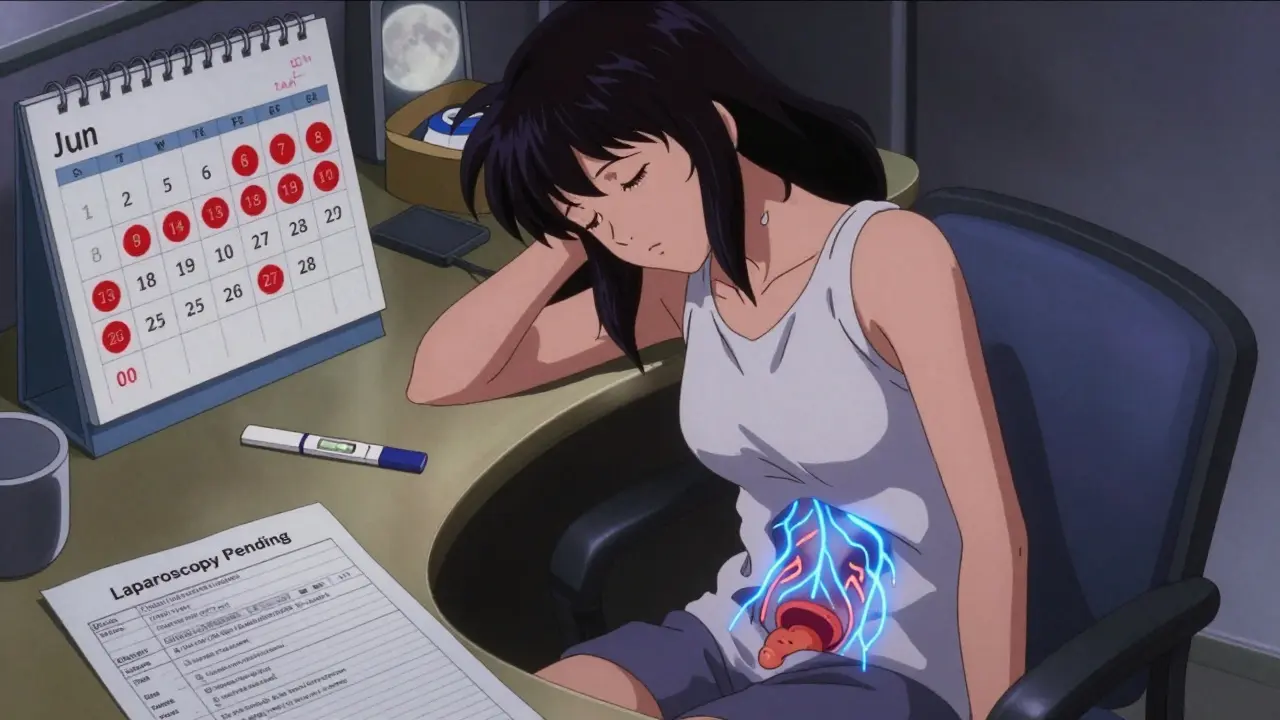
For many women, chronic pelvic pain isn’t just a symptom-it’s a life-altering mystery. Two conditions, endometriosis and a condition where the bladder wall becomes inflamed, causing pain, urgency, and frequency without infection, are often mistaken for each other. They share nearly identical symptoms: pain during sex, frequent urination, burning when peeing, and deep aches in the lower belly. But they’re not the same. And confusing them can cost years of suffering.
What You’re Really Feeling
Endometriosis happens when tissue like the uterine lining grows outside the uterus-on the ovaries, bowel, bladder, or even the diaphragm. It reacts to hormones, so pain often spikes right before or during your period. Up to 92% of women with endometriosis report cyclical pain that follows their menstrual cycle. Some also notice blood in their urine during menstruation, especially if lesions are on the bladder.
Interstitial cystitis (IC), also called painful bladder syndrome, doesn’t follow your cycle. The pain is usually constant, though it can get worse around your period. It’s not caused by infection, but the bladder wall becomes irritated and inflamed. Women with IC often feel the urgent need to pee-even if they just went-and can’t hold it long. Bladder capacity drops. Normal bladders hold 400-600 mL. IC patients average 300-400 mL, and pain kicks in way before that.
The Overlap That Tricks Doctors
A 2011 study of 178 women with chronic pelvic pain found that 65% had both endometriosis and IC at the same time. That’s not rare-it’s the norm. In fact, women with endometriosis are up to four times more likely to develop IC. This is why so many women get misdiagnosed.
Doctors often start with the bladder. If you’re peeing a lot and it burns, you’re sent for a urine test. If it’s clean, you’re told you have IC. But what if the real problem is endometriosis growing on your bladder wall? That happens in 1-12% of endometriosis cases. And when it does, the symptoms look exactly like IC. A 2022 study from Hofstra Northwell found that up to 80% of patients diagnosed with IC actually had undiagnosed endometriosis.
One woman on Reddit shared her story: after seven years of IC treatment, her third laparoscopy revealed stage IV endometriosis on her bladder. Within months, her urinary symptoms dropped by 80%. She wasn’t alone. A 2022 survey of 1,243 endometriosis patients found that 68% were first diagnosed with IC.
How You Get Diagnosed
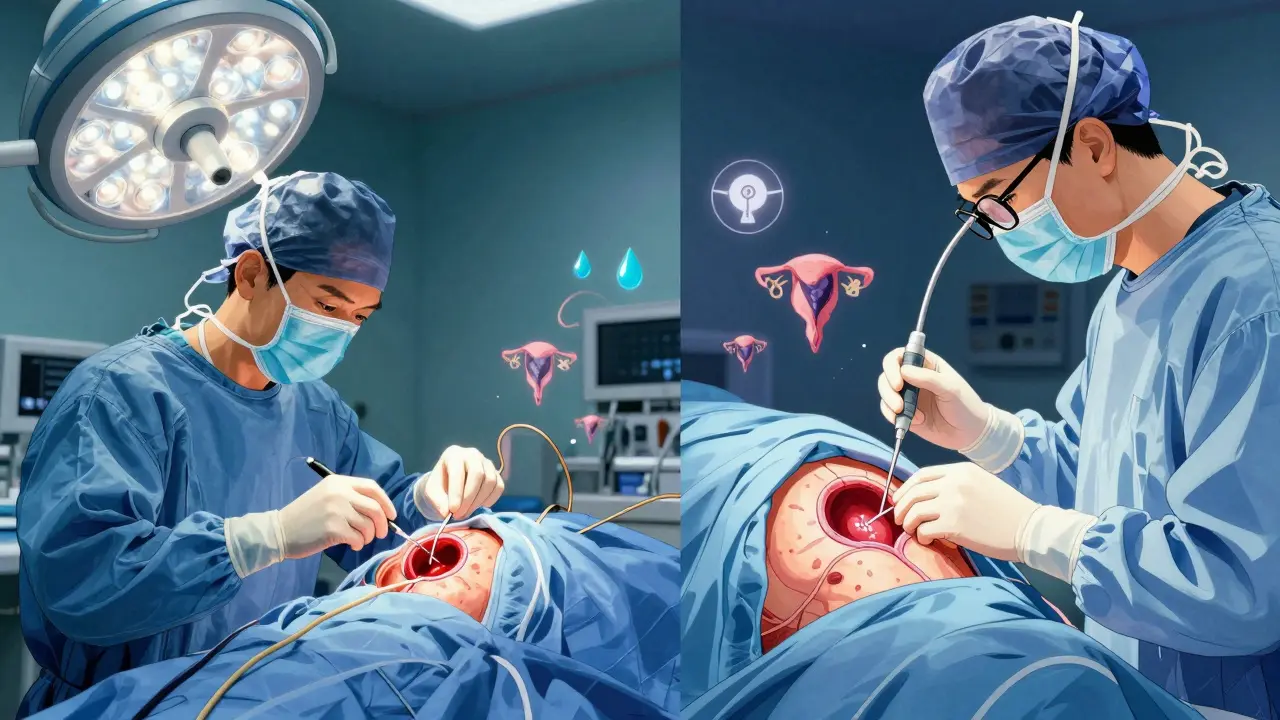
Endometriosis diagnosis is surgical. The only way to confirm it is through laparoscopic surgery, where a surgeon removes tissue and sends it to a lab. It’s not a simple procedure. In the U.S., it costs between $5,000 and $15,000. Recovery takes 2-4 weeks. And only about 15% of OB/GYNs in the U.S. are trained in the deep excision technique needed to fully remove it.
IC diagnosis is the opposite. There’s no single test. It’s a diagnosis of exclusion. First, you need to rule out infections, bladder cancer, sexually transmitted infections, and even kidney stones. Then comes cystoscopy-where a camera looks inside the bladder. Sometimes, a potassium sensitivity test (PST) is done. It’s not perfect. It’s 80% sensitive, but 20% of IC cases get missed. And if you have endometriosis on your bladder, the PST might look normal because the pain comes from nerve irritation, not bladder inflammation.
The PUF (Pelvic Pain and Urgency/Frequency) scale is often used. A score of 8 or higher suggests IC. But if you have both conditions, the score might be high because of endometriosis, not IC. That’s why doctors who only look at the bladder are missing half the picture.
Why You’re Still in Pain After Treatment
Many women go through years of treatments that don’t work because they’re treating the wrong thing. If you’re on Elmiron (the only FDA-approved IC drug), but your pain is actually from endometriosis, you’re wasting time and risking side effects. Elmiron has been linked to retinal damage in 23% of long-term users.
And pelvic floor dysfunction? It’s everywhere. A 2023 review found that 92% of women with either endometriosis or IC have tight, overactive pelvic floor muscles. These muscles aren’t just a side effect-they’re a core part of the pain. Physical therapy helps, but only if you’re also treating the root cause.
The Real Diagnostic Path
Here’s what actually works:
- Keep a symptom diary for 3 weeks. Note pain levels, when you pee, if pain changes with your period, and if sex hurts.
- Get a full pelvic exam. Ask for a referral to a specialist trained in endometriosis excision.
- Rule out UTIs with urine culture-not just a dipstick test.
- If bladder symptoms are present, get cystoscopy and consider PST-but only after ruling out endometriosis.
- Request laparoscopy if you have cyclical pain, painful sex, or bowel/bladder symptoms during your period. Don’t wait for IC to be "confirmed."
Don’t let insurance denials stop you. A 2023 survey found 44% of women were initially denied cystoscopy. Appeal. Get a letter from your doctor. This isn’t optional-it’s essential.
What’s Changing Now
In January 2024, the Endometriosis Foundation updated its surgical guidelines: all endometriosis excision surgeries must include bladder evaluation. That’s huge. It means surgeons are finally being told to look for the overlap.
The International Pelvic Pain Society launched a dual-diagnosis protocol in 2023. It requires both a gynecologist and a urogynecologist to evaluate you together. And in February 2024, the NIH gave $4.2 million to the University of Michigan to find biomarkers that can tell these conditions apart with a simple blood or urine test.
By 2030, experts predict multidisciplinary pelvic pain centers will be standard. Right now, there are only about 350 board-certified urogynecologists in the entire U.S. Most women never see one.
Your Next Steps
If you’ve been told you have IC but still have period-related pain, deep pelvic aches, or pain during sex-you need to question that diagnosis. Ask for:
- A referral to a surgeon who specializes in endometriosis excision (not ablation)
- A full pelvic floor assessment
- A cystoscopy before committing to long-term IC treatment
- Documentation of your symptoms over time
Don’t accept being passed from gynecologist to urologist and back. The system is broken. But you don’t have to wait for it to fix itself. Start with one question: Could this be endometriosis? If the answer is yes, push for the surgery. It’s the only way to know for sure.
Can endometriosis cause bladder symptoms without visible lesions?
Yes. Even without visible lesions on the bladder, endometriosis can irritate nerves that run near the bladder, causing urgency, frequency, and pain. This is called neurogenic bladder involvement. It’s often missed because imaging doesn’t show it. Laparoscopy is still needed to confirm.
Is IC a real condition or just undiagnosed endometriosis?
IC is a real condition, but it’s often misdiagnosed. Research shows many women with IC-like symptoms actually have endometriosis affecting pelvic nerves or the bladder wall. The key is not to choose one over the other-check for both. They can-and often do-coexist.
Why do I keep getting UTI diagnoses when my tests are clean?
Because the symptoms of IC and bladder endometriosis mimic urinary tract infections: burning, urgency, frequency. Many doctors don’t know about the overlap. A 2023 survey found 63% of IC patients were treated for UTIs an average of 5.3 times before getting the right diagnosis.
What’s the best way to find a specialist?
Look for surgeons certified by the American Association of Gynecologic Laparoscopists (AAGL) or those affiliated with endometriosis centers like the Endometriosis Foundation. Ask if they perform deep excision (not just burning or scraping) and if they routinely check the bladder during surgery. Avoid general OB/GYNs unless they specifically mention endometriosis expertise.
Can physical therapy help with both conditions?
Yes. Pelvic floor physical therapy helps in 70% of cases for both endometriosis and IC. Tight pelvic muscles amplify pain signals from both conditions. Therapy can reduce pain, improve bladder control, and make surgery more effective. But it won’t cure the root cause-it’s a support tool, not a solution.
Maddi Barnes
February 19, 2026 AT 10:08Okay but like… why do we still have to beg for basic care? 😒 I had 8 years of "bladder issues" until I found a surgeon who actually looked past the cystoscopy. Turns out my bladder was covered in endo like a spiderweb. They gave me Elmiron for 3 years. THREE. YEARS. And then I found out it was causing my vision to blur. Meanwhile, my pain got worse. Now I’m 32 and finally pain-free after excision. If you’re reading this and you’ve been told "it’s just IC"-go find a specialist. Don’t wait. Your body isn’t lying. 🙏
Benjamin Fox
February 21, 2026 AT 09:29Jonathan Rutter
February 23, 2026 AT 02:29You think this is bad? Try being a man trying to help a woman in your life through this. I watched my sister go from being a vibrant artist to a shell of herself-sleeping 16 hours a day, crying in the shower because she couldn’t hold her pee without pain. She was told it was "stress" for 5 years. Then she found a doctor who actually listened. The surgery? $12k out of pocket. Insurance said "not medically necessary." Meanwhile, her boss at the coffee shop gave her a gift card for "being dramatic." I’m not mad. I’m just… done. This system is designed to break women. And we’re supposed to be grateful when someone finally notices?
Jana Eiffel
February 23, 2026 AT 15:42It is both a clinical and sociocultural imperative to recognize the epistemological hierarchy that privileges bladder-centric diagnostics over systemic pelvic pathology. The reductionist paradigm of symptom localization-particularly when applied to hormonally modulated conditions-perpetuates a patriarchal epistemic injustice wherein women’s somatic narratives are pathologized as psychogenic or exaggerated. The convergence of neurogenic involvement, fibrotic adhesion, and visceral hypersensitivity necessitates a multimodal diagnostic framework, not a binary either/or schema. One must interrogate not merely the presence of lesions, but the ontological weight of pain as experienced.
John Cena
February 25, 2026 AT 14:56aine power
February 27, 2026 AT 13:40Tommy Chapman
February 27, 2026 AT 16:29Irish Council
February 28, 2026 AT 18:35Freddy King
March 1, 2026 AT 10:04Look, the neurogenic bladder involvement angle is legit. But let’s not get lost in the cytokine soup. The real issue is the lack of autonomic nervous system integration in pelvic pain protocols. You can’t treat a visceral sensory overload with a scalpel and a PUF scale. You need neuromodulation + excision + pelvic floor re-education. It’s a triad. Skip one, and you’re just rearranging deck chairs on the Titanic. Also-Elmiron? More like El-MI-RON. That’s a scam with a side of retinal dystrophy. The FDA’s asleep at the wheel.
Laura B
March 2, 2026 AT 22:42Robin bremer
March 3, 2026 AT 13:37Jayanta Boruah
March 5, 2026 AT 01:52The diagnostic algorithm presented is fundamentally sound, yet insufficiently contextualized within the global healthcare disparity matrix. In India, where urogynecologists number fewer than 200 and laparoscopic facilities are accessible to less than 3% of the population, such protocols remain aspirational. The emphasis on surgical excision presupposes infrastructural privilege. A more equitable framework must integrate teleconsultation, community health worker triage, and low-cost biomarker development-particularly for low- and middle-income countries where women endure pain for decades without even a urine test.
Hariom Sharma
March 5, 2026 AT 12:33Nina Catherine
March 5, 2026 AT 21:42Taylor Mead
March 6, 2026 AT 01:23