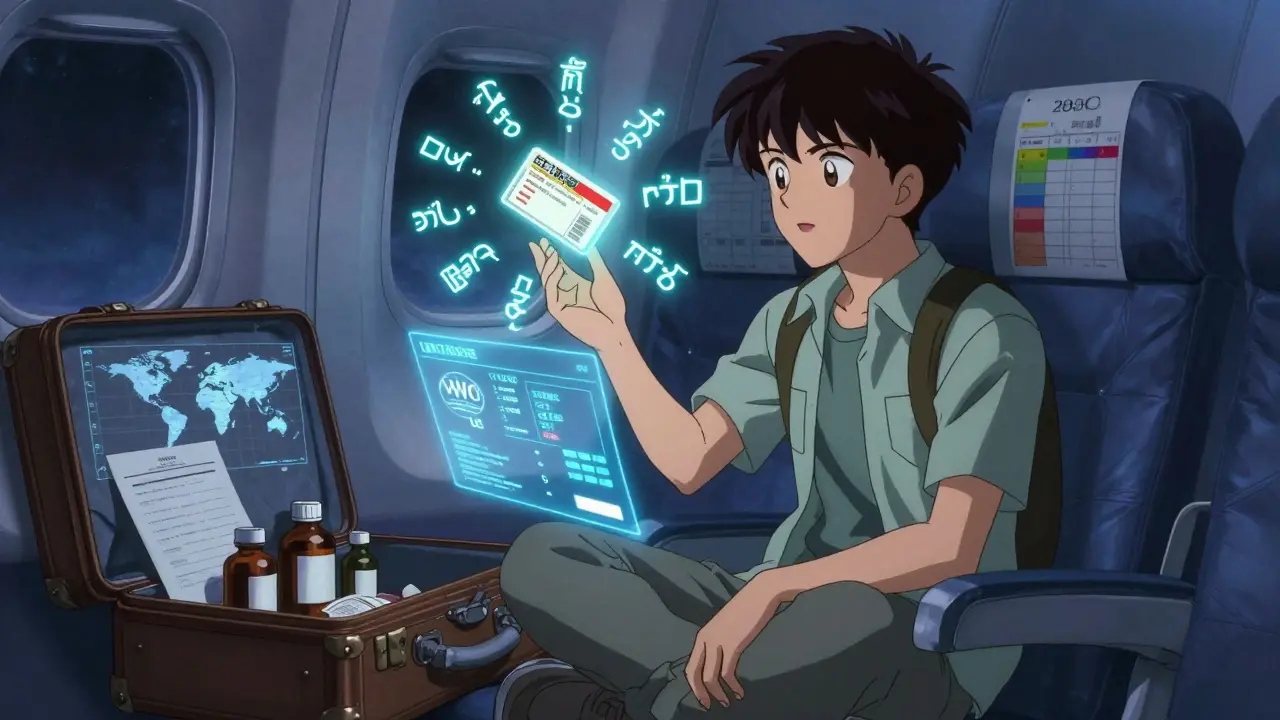
When you’re crossing time zones, your body doesn’t care about your flight schedule. It cares about when you last took your pill. If you’re on a medication like warfarin, insulin, or levothyroxine, a single missed or doubled dose can lead to serious health problems-especially when you’re far from home. The problem isn’t just forgetting your pills. It’s misreading the label.
Prescription labels aren’t just instructions. They’re legal documents, customs checkpoints, and safety nets all rolled into one. And when you’re flying from London to Tokyo or New York to Bangkok, those tiny print lines can mean the difference between a smooth trip and a hospital stay. Here’s how to actually read them-not just glance at them-before you leave.
What’s Actually on Your Prescription Label?
Your prescription label has seven key pieces of information. Most people only look at the name and dose. That’s not enough. You need to check all of these before you pack your bag:
- Patient name - Must match your passport exactly. No nicknames. No initials. If your passport says "Elizabeth Anne Smith," your label can’t say "Liz Smith."
- Medication name - Both brand and generic. Brand names vary by country. Your "Lipitor" might be called "Atorvastatin" everywhere else. In Japan, it’ll be in kanji. In Saudi Arabia, it’ll be in Arabic.
- Dosage strength - Is it 10 mg? 500 mg? 10 IU? Units matter. A mistake here can be deadly.
- Directions for use - "Take one tablet daily" sounds simple. But is it morning? Night? With food? On an empty stomach? The label should say "q24h" (every 24 hours) or "q12h" (every 12 hours), not "take at bedtime."
- Prescribing doctor - Name, phone, and clinic. Customs agents may ask. Airlines may ask. Your hotel nurse might ask.
- Pharmacy info - Name, address, license number. This proves the script is real. Many countries require this.
- Prescription number - For tracking. If you lose your pills, this helps pharmacies refill them abroad.
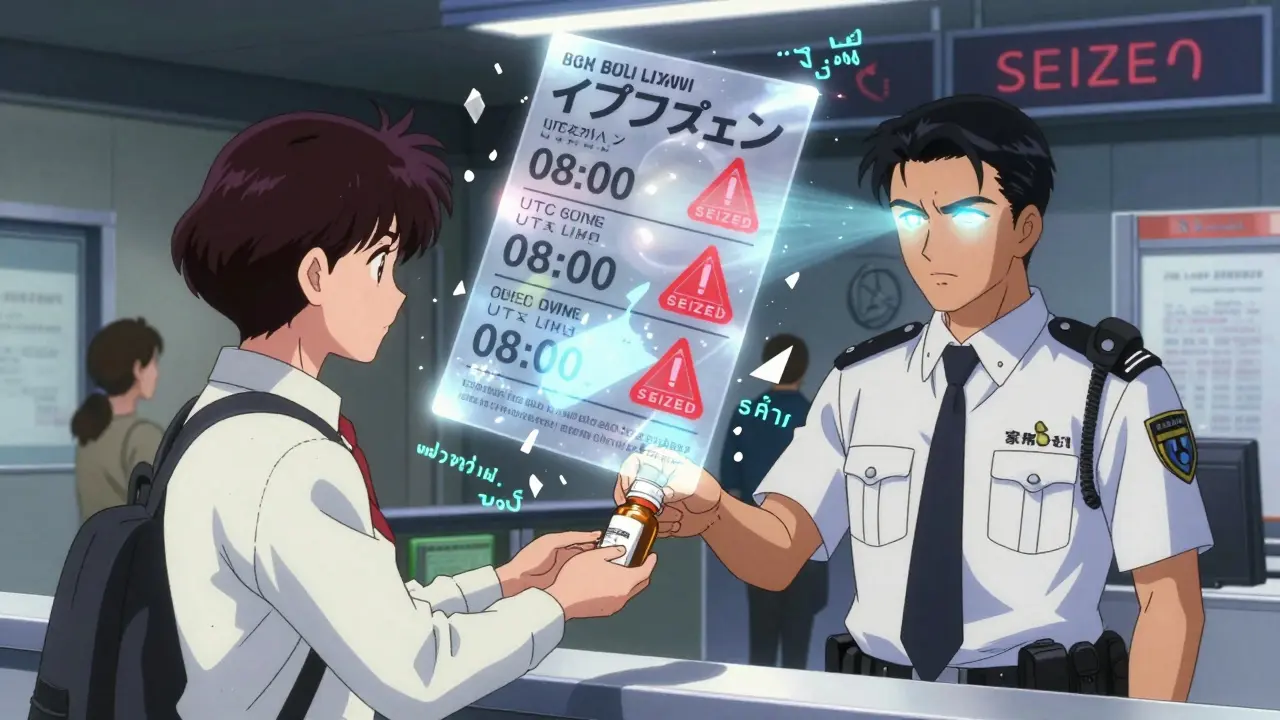
These aren’t suggestions. They’re requirements in over 60 countries. Japan, Thailand, and Saudi Arabia have strict rules. If your label doesn’t have the right details, your meds could be seized at customs. You might be detained. You might miss your flight.
Time Zones Don’t Care About Your Schedule
When you land in Bangkok, your body doesn’t reset. Your liver still thinks it’s 3 a.m. in London. If you take your blood thinner at 9 p.m. London time, and you don’t adjust, you could be taking it at 4 a.m. Bangkok time. That’s not just inconvenient-it’s dangerous.
Here’s what you need to know:
- Look for "q24h" or "q12h" on the label. That means every 24 or 12 hours, regardless of local time.
- Convert your schedule to Coordinated Universal Time (UTC). It’s the global standard. If you’re on a 12-hour schedule, your doses should be spaced exactly 12 hours apart in UTC-not local time.
- Use the WHO’s free Medication Time Zone Converter app. It’s downloaded over 287,000 times. Type in your meds, your departure and arrival cities, and it shows you exactly when to take each dose.
Insulin users: don’t rely on "take with meals." That’s too vague. You need to know your insulin’s peak effect time. If it peaks 2-4 hours after injection, and you’re flying east across 8 time zones, you’ll need to delay your next dose by 2-3 hours to avoid low blood sugar. This isn’t guesswork. It’s science.
One traveler in Prague took double the dose of levothyroxine because she thought "take in the morning" meant her new local morning. She ended up in the ER with a racing heart. Her label didn’t say "take at 08:00 UTC." It just said "morning."
Country Rules Vary-A Lot
What’s allowed in the U.S. might be banned in Singapore. What’s fine in Germany might be seized in Dubai.
- Japan: All prescription labels must include kanji for the active ingredient. If your label says "ibuprofen," it’s not enough. You need "イブプロフェン." 43% of U.S. travelers were delayed in 2022 because of this.
- Thailand: Labels must have both English and Thai. No exceptions. They check at every airport.
- Saudi Arabia: The active ingredient must be written in Arabic. In Q1 2023, 22% of seized medications were due to missing Arabic names.
- European Union: Labels must include the patient’s name in the local language. So if you’re traveling to Spain, your label should say "María García," not "Maria Garcia."
- Caribbean nations: Many require English and Spanish. But only 37% of U.S. prescriptions meet this standard.
Don’t assume your doctor’s prescription is travel-ready. Ask your pharmacist: "Does this meet international travel requirements?" Most major U.S. pharmacies now offer to add multilingual active ingredient names and UTC timing upon request. 78% of them do it for free.
What to Pack-And What Not To
TSA says you don’t need original containers. But that’s not true everywhere. In Japan, customs officers still demand them. In Australia, you need a doctor’s letter if you’re carrying more than a 30-day supply.
Here’s what to do:
- Keep pills in their original bottles. Even if you’re using a pill organizer, bring the labeled bottles too.
- Carry a printed copy of your prescription with the doctor’s contact info.
- Bring a letter from your doctor explaining why you need each medication. Especially if it’s a controlled substance like opioids or stimulants.
- Never put pills in unmarked containers. No Ziploc bags. No empty pill boxes. You’ll get stopped.
One traveler on Reddit packed her insulin in a cooler with no labels. She was detained for 3 hours at Narita Airport. The officer thought it was a drug. She had no paperwork. She didn’t even know the generic name.
Tools That Actually Work
You don’t need apps that sell subscriptions. You need free, reliable tools:
- WHO Medication Time Zone Converter - Free app. Works offline. Converts your schedule to UTC. Shows you what time to take each dose in every country you visit.
- International Society of Travel Medicine Checklist - Download the PDF. It tells you exactly what to check on your label. Includes liquid medication guidelines (e.g., concentration per mL for syringes).
- Color-coded chart - Make a simple paper chart. Use red for morning doses, blue for night, green for meals. Tape it to your suitcase. 89% of frequent travelers who used this reported zero timing errors.
Don’t rely on your phone’s alarm. Batteries die. Time zones change. A printed schedule doesn’t.
What to Do Before You Leave
Start 4-6 weeks before departure. Here’s your checklist:
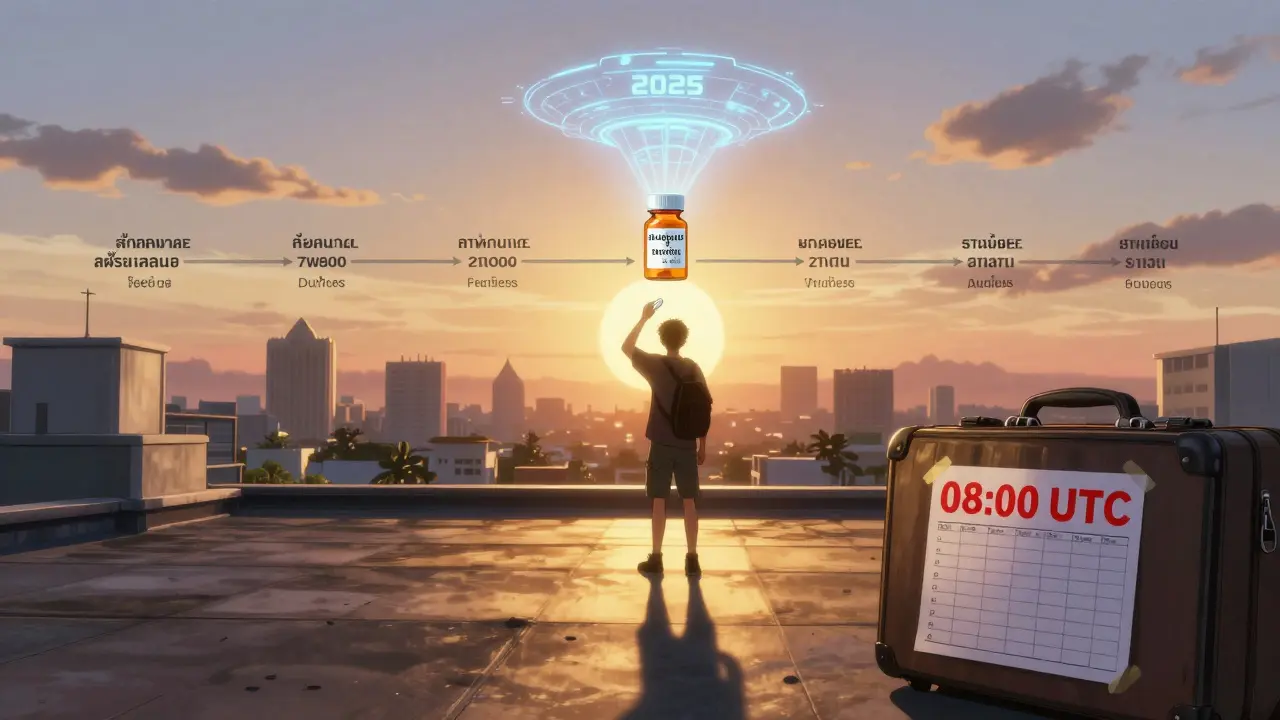
- Call your pharmacy. Ask them to add UTC timing to your label. Example: "Take one tablet at 08:00 UTC (03:00 EST)."
- Request multilingual active ingredient names. Especially if you’re going to Asia or the Middle East.
- Get a doctor’s letter. Especially for controlled substances or injectables.
- Download the WHO app. Test it with your meds. Make sure it matches your label.
- Print your medication schedule. Put it in your wallet. Put a copy in your carry-on. Put a copy in your checked bag.
- Check your destination country’s rules. Search "[Country] import medication rules 2026" on the WHO or IATA website.
One patient crossing six time zones for a medical conference used a 3-day adjustment plan from Mayo Clinic. She shifted her doses by 1 hour per day until she matched local time. She had zero side effects. Her doctor called it "the gold standard."
What Happens When You Get It Wrong
It’s not just about feeling sick. It’s about cost, risk, and consequences.
- Missed doses of antibiotics can lead to drug-resistant infections. One study found a single missed dose reduced effectiveness by up to 40%.
- Warfarin users who misread timing had 3x higher risk of bleeding or clotting events.
- Travelers with medication errors are 70% more likely to need emergency evacuation. Costs range from $15,000 to $250,000.
- Japan seized 1,247 medication cases in 2023. 68% were due to labeling issues.
- Thailand fined 83 travelers between $500-$5,000 in 2023 for improper documentation.
These aren’t rare cases. They’re routine. And they’re preventable.
What’s Changing-And What’s Coming
The system is slowly improving. By December 31, 2025, the WHO will require all international prescription labels to include a "travel supplement" section with UTC timing and multilingual names. Fourteen countries are already testing it.
Some airlines now use the Universal Medication Travel Card (UMTC). It links your prescription to destination rules. If you’re flying with a partner airline, you can scan a QR code on your label and see if your meds are allowed.
Next? Augmented reality labels. Pilots in Singapore and Dubai are testing smart labels that change their instructions based on your GPS location. If you land in Paris, the label on your bottle automatically updates to show local time. It’s not sci-fi-it’s coming in 2025.
But until then? You’re still responsible. Your label. Your schedule. Your health.
What if my prescription label doesn’t have UTC timing?
Ask your pharmacist to add it. Most major U.S. pharmacies now offer this for free. If they won’t, use the WHO Medication Time Zone Converter app to manually calculate your doses in UTC. Write them down on paper and carry them with your meds.
Can I put my pills in a pill organizer for travel?
Yes-but only if you also carry the original labeled bottles. Customs and airline staff may ask to see the prescription. Never travel with pills in unlabeled containers. You risk seizure or detention.
Do I need a doctor’s note for my medication?
For most medications, it’s not required-but highly recommended. For controlled substances, insulin, or more than a 30-day supply, you absolutely need one. It should include your diagnosis, dosage, and why you need it. Print two copies.
What if I lose my prescription label while traveling?
If you have a doctor’s letter, your pharmacy contact info, and the prescription number, you can usually get a replacement. Call your pharmacy and ask them to email a copy to a local pharmacy at your destination. Always carry a digital copy in your email or cloud storage.
Are there countries where my medication is banned?
Yes. Many countries ban common U.S. medications. For example, the U.S. version of pseudoephedrine (in cold medicine) is illegal in Japan and Thailand. Melatonin is restricted in Saudi Arabia. Always check your destination’s rules before you go. The WHO and IATA websites have updated lists for 2026.
Nicole Blain
March 17, 2026 AT 05:04Just took a 12-hour flight to Tokyo with my insulin and honestly? I printed out the WHO app schedule and taped it to my pill case. 🙌 No more guessing. Also, got my label updated with "03:00 UTC" - life changer. Don't be like me in 2021 when I took my dose at 11 p.m. local time and woke up sweating at 3 a.m. 😅
Kathy Underhill
March 17, 2026 AT 12:49The core issue isn't labeling. It's the assumption that medical systems are universal. They're not. A prescription is a legal contract between a patient and a jurisdiction. When you cross borders, you're entering new legal ecosystems. The label isn't just instructions - it's your passport to safety. And no app replaces knowing your own pharmacology.
Srividhya Srinivasan
March 18, 2026 AT 19:49Of course the government and Big Pharma want you to rely on "free apps" - it's a trap! Who owns the WHO app? Who controls the data? What if they secretly track your meds and sell it to insurers? I heard a guy in Mumbai got flagged because his levothyroxine dose was "anomalous" - now his insurance premium doubled! And don't get me started on kanji - it's a surveillance tool disguised as language! They're coming for your pills, people!
Prathamesh Ghodke
March 19, 2026 AT 18:56Man, I used to think this was overkill until my cousin got detained in Dubai for carrying melatonin. She had the bottle but no Arabic label. Spent 8 hours in a room with a guy who spoke zero English. We got her sorted, but it was brutal. Bottom line: don't be that person. Ask your pharmacist to print the multilingual version. It takes 10 minutes. Save yourself the nightmare.
Stephen Habegger
March 20, 2026 AT 15:10Good stuff. Just added UTC times to my labels last week. Took me 20 minutes at the pharmacy. They didn't even charge me. Now I can sleep on flights without stressing. Pro tip: print two copies - one in your wallet, one in your carry-on. Easy.
Justin Archuletta
March 20, 2026 AT 22:33YESSSS!!! I used to just wing it until I missed a dose in Thailand and ended up in a hospital with a 300-dollar bill and zero dignity. Now I have a color-coded chart stuck to my suitcase. Red = morning. Blue = night. Green = eat. It’s dumb, but it works. Don’t overthink it. Just do the thing.
Sanjana Rajan
March 20, 2026 AT 23:32Wow, another "traveler guide" that sounds like it was written by a pharmaceutical lobbyist. You really believe the WHO app is free? It's a Trojan horse. And why are we trusting pharmacists? They're paid by insurance companies. Also, "multilingual labels"? That's just the U.S. pushing its medical imperialism overseas. Why can't we just use local doctors? Oh right - because they're all in the pocket of Big Pharma too. 😒
Kyle Young
March 20, 2026 AT 23:58It's fascinating how deeply we embed trust into physical artifacts - a piece of paper with ink, a bottle with a label. We treat these as sacred objects, yet they're entirely contingent on bureaucratic systems we rarely interrogate. What if the label is wrong? What if the pharmacist misprints? What if the language translation is inaccurate? The real solution isn't more labels - it's systemic literacy. We must teach patients to interrogate their own prescriptions, not just follow them.
Aileen Nasywa Shabira
March 22, 2026 AT 03:51Oh wow, so now we're supposed to be grateful that Big Pharma finally deigned to print our meds in "kanji"? Please. This whole post reads like an ad for Walgreens' "travel wellness package." And let's not pretend the WHO app isn't harvesting data. I bet they're building a global medication profile database. Next thing you know, they'll be auto-adjusting your doses based on your flight path. #WakeUp
Kendrick Heyward
March 22, 2026 AT 14:42I cried reading this. My mom had a stroke because she took her blood thinner at the wrong time during a trip to Mexico. She didn't know about UTC. The label just said "take daily." That's it. No time. No context. No warning. Now I carry a laminated card with her meds, the UTC times, and her doctor's number. I don't travel without it. Don't wait until it's too late.
lawanna major
March 24, 2026 AT 09:23While the practical advice here is sound, the underlying assumption - that patients are passive recipients of medical authority - remains unchallenged. The prescription label, as described, is a tool of compliance, not empowerment. True safety lies not in multilingual labels or UTC conversions, but in patient autonomy: understanding pharmacokinetics, knowing your drug's half-life, recognizing interactions. The system we're told to trust was never designed to protect us - only to regulate us. Perhaps the real travel tip is to become your own pharmacist.
Ryan Voeltner
March 25, 2026 AT 20:49This is a meticulously researched and profoundly necessary guide. The intersection of medical safety, cultural competence, and international regulation is rarely addressed with such clarity. I commend the author for elevating a mundane administrative task - reading a prescription label - into a global health imperative. The inclusion of jurisdiction-specific requirements is particularly valuable. I have shared this with my entire medical travel advisory network. Well done.
Linda Olsson
March 27, 2026 AT 09:21Of course you're supposed to use the WHO app - because who else would you trust? The same organization that told us masks were useless in 2020 and then told us they were mandatory in 2021? And now they're telling us to trust a QR code on a pill bottle? This isn't safety - it's social engineering. They want you dependent on their systems. And what happens when the app goes down? Or the server crashes? Or the algorithm decides your levothyroxine is "too high" for your flight route? You're screwed. This whole thing is a trap.