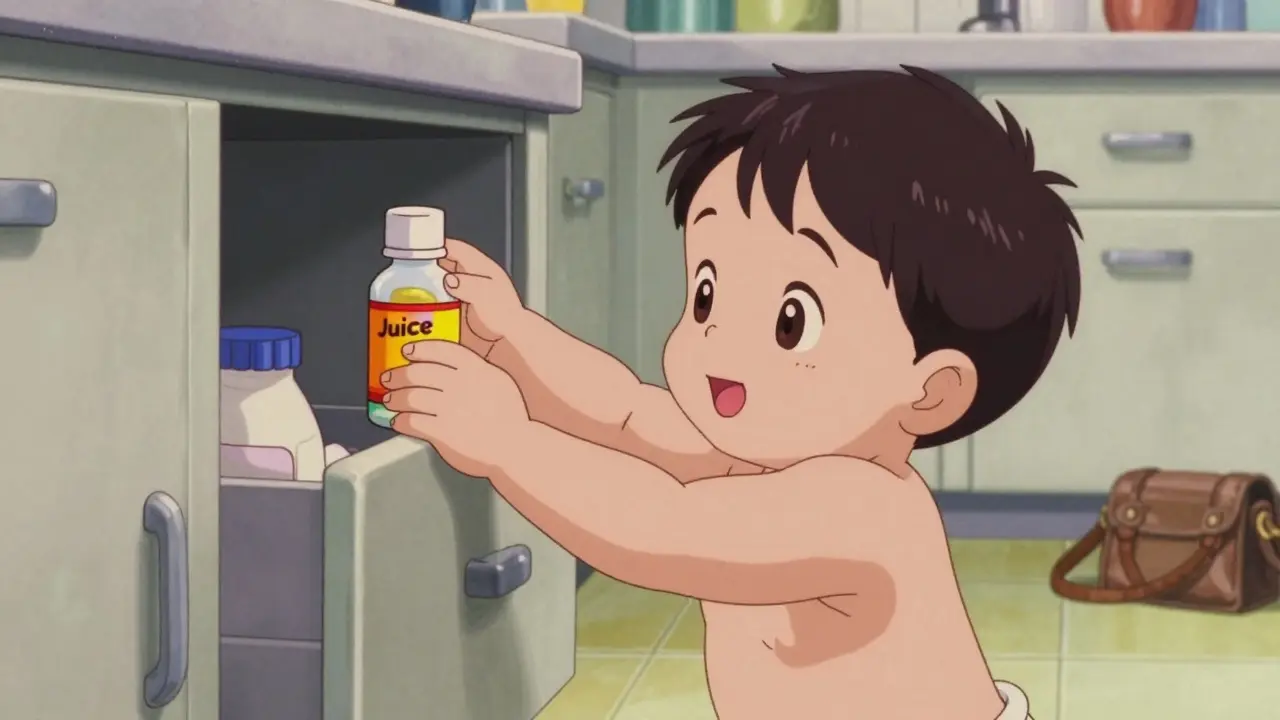
Every year, over 50,000 children under six in the U.S. end up in emergency rooms because they swallowed something they shouldn’t have. These aren’t accidents caused by neglect - they’re the result of normal childhood curiosity. A 15-month-old crawling under the couch finds a dropped pill. A two-year-old pulls open a drawer and grabs a bottle that looks like juice. A three-year-old mimics their parent and swallows what they think is candy. These are exploratory ingestions - not accidents, but predictable outcomes of development. And they’re preventable.
Why Young Children Are at Risk
Children under five are natural explorers. Their world is built through touch, taste, and movement. By the time they’re 12 months old, they’re pulling open drawers, climbing on chairs, and reaching for anything within arm’s reach. By 18 months, they’re walking, climbing, and opening containers. By two, they’re learning to mimic adults - including taking pills or sipping from bottles. According to the American Association of Poison Control Centers, 90% of all childhood poisonings happen in kids under six. The highest risk? Kids between 1 and 4 years old. Boys are slightly more likely to be involved, and children with hyperactive temperaments are at higher risk too. But the real culprit isn’t behavior - it’s environment. Most of these ingestions happen at home. And they’re not random. They follow patterns:- 75% are exploratory - the child is simply investigating their world
- 69% of serious cases involve liquid medications, not pills - liquids are easier to swallow and don’t trigger the gag reflex like powders
- 22% of poisonings occur when visitors leave handbags or backpacks on the floor, containing medications or cosmetics
- Button batteries, e-cigarette liquids, and concentrated cannabis edibles are rising threats
Lock It Up - The 5-Foot Rule
The single most effective way to stop an ingestion? Keep dangerous items out of reach. Not just out of sight - out of reach. The National Safety Council found that storing all medications, cleaners, and chemicals in locked cabinets at least 1.5 meters (5 feet) above the floor prevents 82% of access attempts by children under four. That’s not a suggestion - it’s a medical standard. Don’t rely on high shelves in the kitchen. Kids climb. They pull down curtains. They stack chairs. A cabinet on a counter? Still accessible. A cabinet with a lock? That’s the baseline. Use child-resistant locks on cabinets, drawers, and even refrigerators. Look for ones that require a two-step motion - push and turn, or slide and lift. Simple latch locks won’t hold a determined toddler. And don’t forget the bathroom. Toothpaste, mouthwash, shampoo, and vitamins are all common culprits. A locked medicine cabinet is non-negotiable.Don’t Mix It Up - The 3-Container Rule
One of the most dangerous mistakes parents make? Storing household cleaners in food containers. Or keeping pills in a candy jar. Or putting hand sanitizer in a soda bottle. The National Safety Council’s data shows that keeping products in their original containers prevents 29% of poisonings. Why? Because kids recognize shapes, colors, and labels. A bottle that looks like juice? They’ll drink it. A box labeled “Lemon Scented Cleaner”? They’ll think it’s a drink. Follow the 3-container rule:- Keep all medications in their original bottles with child-resistant caps
- Store cleaners and chemicals in their original containers - never transfer them
- Never store cleaning products next to food or drinks - even on opposite sides of the counter
Medication Mistakes - Why Kitchen Spoons Are Dangerous
Parents think they’re being careful. They open a bottle of liquid medicine, pour a teaspoon into a spoon, and give it to their child. But here’s the truth: a kitchen teaspoon is not a measuring tool. The American Academy of Pediatrics found that 76% of parents make dosing errors when using kitchen utensils. That’s 3 out of 4 families giving the wrong amount - too much or too little. A calibrated dosing syringe? Only 12% make errors. Always use the device that came with the medicine. Not a spoon. Not a shot glass. Not a medicine cup from last year. Use the syringe, dropper, or dosing cup that came with the bottle. And always read the label twice - once for the dose, once for the concentration. Some liquid medicines are 160 mg per 5 mL. Others are 320 mg per 5 mL. Confusing them can be deadly. Also, never use adult medications for children. Even “a little bit” of ibuprofen meant for a 150-pound adult can cause organ failure in a 20-pound toddler.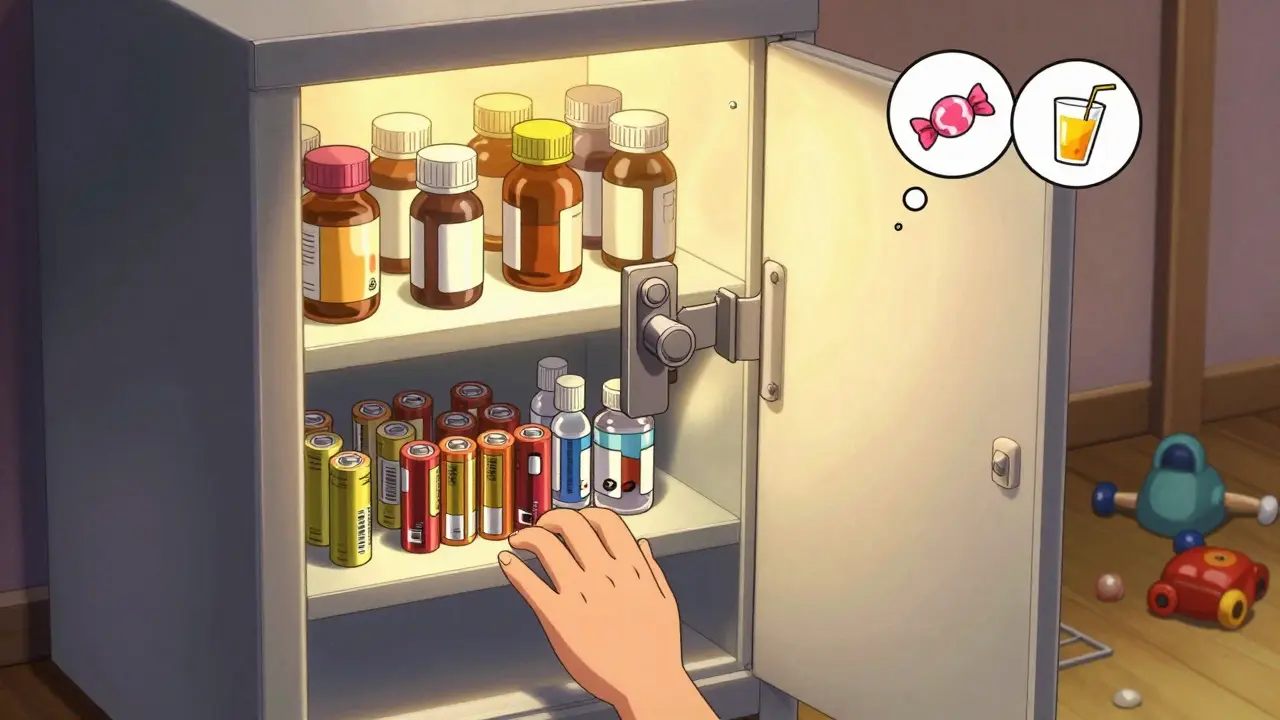
The Hidden Hazards You’re Not Thinking About
Most people think of pills and cleaners. But the real dangers today are new - and sneakier.- Button batteries: Found in remote controls, toys, and hearing aids. A child swallows one, and tissue damage starts in 15 minutes. 85% of severe injuries happen in kids under four. Keep them locked away. If a child swallows one, go to the ER immediately - no waiting.
- E-cigarette liquids: Nicotine refills look like juice boxes. 17% of toddler nicotine poisonings come from these. The liquid can kill a child with one swallow. Store them in locked cabinets - not on the counter.
- Laundry pods: They look like candy. Even after industry changes, they still cause 11% of pediatric poisonings. Keep them in high, locked drawers.
- Cannabis edibles: In states where marijuana is legal, 7% of pediatric poisonings now come from gummies, cookies, or brownies. They’re often labeled “medicinal” - but to a child, they’re just candy.
- Buprenorphine: Used to treat opioid addiction. Exposure has risen 156% since 2010. It’s not just opioids - it’s a different kind of overdose with different symptoms.
What Works - And What Doesn’t
Child-resistant packaging saved lives. Between 1974 and 1992, it cut aspirin deaths by 45%. But it’s not foolproof. The FDA calls it “child-resistant, not child-proof.” A determined 2-year-old can still open most caps. That’s why storage matters more than the cap. Bittering agents like denatonium benzoate are added to many cleaners and antifreeze. Research shows they reduce multiple swallows by 68%. But they don’t stop a single fatal dose. So they’re a backup - not a solution. Activated charcoal? Once widely used. Now, the Society for Academic Emergency Medicine says it’s rarely helpful. Don’t give it at home. Don’t assume it’s a cure. Call poison control instead.What Every Parent Should Do - Right Now
Here’s your checklist. Do this today.- Install locks on every cabinet, drawer, and fridge that holds medicine, cleaners, or chemicals
- Move all medications, batteries, and e-liquids to a locked cabinet at least 5 feet high
- Throw away old, unlabeled, or expired medicines - don’t keep them in drawers
- Use only the dosing tool that came with the medicine - never a spoon
- Keep purses, bags, and coats off the floor - visitors bring risks
- Know the number: 1-800-222-1222 (Poison Control). Save it in your phone. Say it out loud right now.
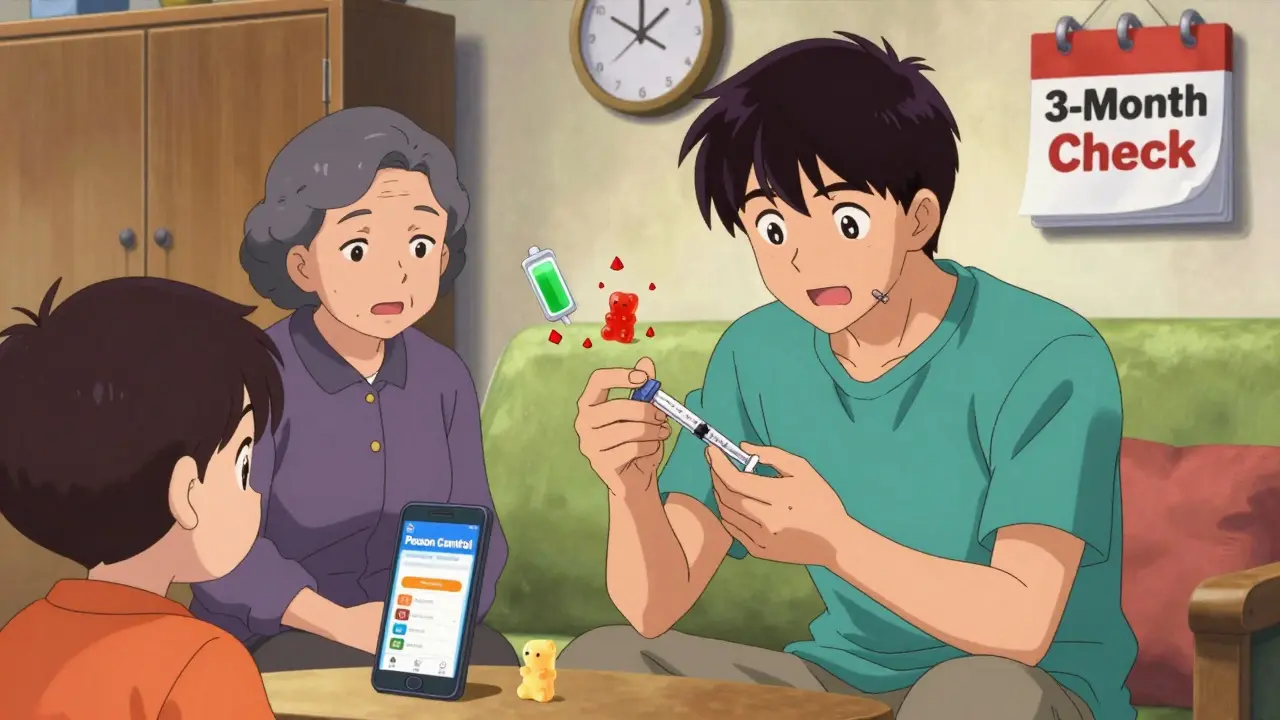
- Check your home at child’s-eye level every 3 months - as kids grow, new risks appear
When You’re Not Alone - Grandparents, Babysitters, and Caregivers
Most homes have multiple caregivers. And that’s where safety breaks down. A 2021 study in Pediatrics found that 63% of households had safety lapses when care switched between parents, grandparents, or babysitters. Why? Because one person locks everything. Another leaves meds on the nightstand. One uses a syringe. Another uses a spoon. Solution? Have a 10-minute conversation with every caregiver. Show them where the locked cabinet is. Demonstrate how to use the dosing syringe. Tell them: “No bags on the floor. No pills in the candy jar. No kitchen spoons.” And if you’re visiting someone else’s home? Ask: “Where do you keep the medicine?” Don’t assume. Always check.What to Do If Something Happens
If you suspect your child swallowed something dangerous - don’t wait. Don’t Google it. Don’t try to make them throw up. Call Poison Control immediately: 1-800-222-1222. It’s free. It’s 24/7. It’s staffed by nurses and pharmacists trained in poison emergencies. The Society for Academic Emergency Medicine says 78% of positive outcomes happen when help is called within 30 minutes. That’s the window. If your child is unconscious, having trouble breathing, or seizing - call 911 first, then call Poison Control. Keep the container. Bring it to the ER. It tells the doctors what they’re dealing with. And don’t feel guilty. This isn’t about blame. It’s about action. Even the most careful parents have near-misses. What matters is what you do next.The App That Saves Lives
There’s a free tool most parents don’t use: the Poison Control mobile app. It’s rated 4.7 out of 5. 89% of users say they found critical information within 90 seconds of a suspected ingestion. It has:- Instant access to Poison Control’s 24/7 hotline
- Step-by-step guidance for over 1,000 substances
- Emergency checklists for batteries, nicotine, and edibles
- Location-based info on local ERs
Can child-resistant packaging prevent all pediatric overdoses?
No. Child-resistant packaging reduces access, but it’s not foolproof. Studies show that 20% of toddlers can open standard child-resistant caps within minutes. The real solution is combining packaging with secure storage - keeping medicines in locked cabinets at least 5 feet high. Caps are a backup, not a primary defense.
Why are liquid medications more dangerous than pills for young children?
Liquids are easier to swallow and don’t trigger the gag reflex like powders or crushed pills. A child can gulp down a full dose of liquid medicine without choking or spitting it out. The American Academy of Pediatrics found that liquid medications cause 69% more injuries than solid forms. This is why dosing accuracy matters so much - a kitchen spoon can deliver 42% more or less than the intended dose.
How often should I check my home for poisoning risks?
Every 3 months. Children develop new skills quickly - crawling, climbing, walking - and each milestone opens new access points. The CDC recommends checking your home at child’s-eye level every 3 months. Pay special attention when your child starts pulling up (8-10 months), walking (12-15 months), or opening drawers (18-24 months).
Is it safe to store medicine in a pill organizer?
Only if it’s locked away. Pill organizers are not child-resistant. They’re designed for adults to manage daily doses. If you use one, keep it inside a locked cabinet. Never leave it on the counter, nightstand, or in a purse. The CDC reports that 29% of poisonings happen when medications are removed from original containers.
What should I do if my child swallows a button battery?
Go to the emergency room immediately. Do not wait for symptoms. Do not try to induce vomiting. Button batteries can cause severe internal burns in as little as 15 minutes. Even if your child seems fine, internal damage may already be starting. Call 911 or go straight to the ER - and bring the battery packaging if you have it.
Alex Ogle
February 8, 2026 AT 05:17Let me tell you about the time my 18-month-old got into the Advil. Not the bottle - the *box*. The one I thought was safely tucked behind the cereal. She’d pulled it down with her teeth, chewed the cardboard, and swallowed two tablets like they were gummy bears. I didn’t even notice until she started drooling. Took her to the ER. They said it was lucky she didn’t have liver damage. Now? Every single thing that’s not food goes in a lockbox. Even the damn hand sanitizer. I don’t care how ‘child-resistant’ the cap is. If it’s within 5 feet of the floor, it’s a hazard. I’m not trying to be paranoid. I’m trying to keep my kid alive.
Lyle Whyatt
February 8, 2026 AT 20:35I live in Australia, and honestly, the 5-foot rule is a game-changer. We had a similar scare with a laundry pod - looked like a jellybean, smelled like citrus. My 2-year-old had it in his mouth before I even registered he’d grabbed it. Since then, I’ve installed lockable cabinets in every room where meds or cleaners are stored. Even the bathroom. Even the car. I keep a small emergency kit in my bag now - a dosing syringe, the Poison Control number, and a printed checklist. It’s not about being perfect. It’s about being prepared. And yeah, I’ve started asking friends, ‘Where do you keep your meds?’ Turns out, most people don’t even think about it until it’s too late.
MANI V
February 10, 2026 AT 06:00Let’s be real - this isn’t about ‘exploratory ingestion.’ It’s about lazy parenting. You think your kid is ‘curious’? That’s just a fancy word for ‘uncontrolled.’ If you can’t teach a child not to touch things that aren’t food, then maybe you shouldn’t have them. I’ve seen parents leave pills on the nightstand because ‘they forgot.’ Forgot? No. You just didn’t care enough to lock it up. And now you’re surprised when your child nearly dies? This isn’t science. It’s negligence dressed up as developmental psychology. Lock it. Or don’t have kids.
Susan Kwan
February 10, 2026 AT 07:42Oh, so now we’re blaming toddlers for being toddlers? Cute. Let me guess - you also think ‘child-resistant caps’ are a real solution? I’ve watched my niece open those things like they were birthday presents. The real problem? We treat kids like fragile porcelain dolls instead of biological machines that are wired to explore. The solution isn’t more locks - it’s better education. Teach kids early: ‘This is not food.’ Don’t hide it. Explain it. Make it boring. And for god’s sake, stop storing bleach next to juice. That’s not negligence - that’s a crime.
Random Guy
February 11, 2026 AT 04:09bro i just put all my meds in a locked drawer and now my 3yo thinks i’m the dragon who guards the treasure. she asks for ‘the magic box’ every night. i’ve started calling it ‘the bad medicine castle.’ she’s obsessed. also, i keep the dosing syringe in a sock. no one else knows where it is. not even my wife. #parentinghacks
Tasha Lake
February 12, 2026 AT 09:11As a pediatric nurse, I can confirm: liquids are the silent killers. The concentration variance between OTC ibuprofen formulations is terrifying - 160mg/5mL vs 320mg/5mL. One wrong syringe fill, and you’re looking at hepatotoxicity. And don’t get me started on button batteries. A 2022 study showed 78% of cases involved devices from remote controls or hearing aids. Parents don’t realize those things are lithium-ion grenades. The real issue? We’re still using outdated packaging standards. The FDA needs to mandate QR-coded, tamper-evident, child-sealed containers - not just caps. And yes, the Poison Control app? I have it pinned. I’ve used it three times. Saved lives. Every. Time.
Andy Cortez
February 12, 2026 AT 14:24Locking everything up? That’s just fear-based parenting. My cousin’s kid got into a bottle of cough syrup - turned out it was just honey and lemon. No harm done. Kids are resilient. You don’t need to turn your house into a vault. I’ve seen parents with 17 locks on their cabinets and still forget to supervise. It’s not about containment - it’s about presence. If you’re constantly hovering, maybe you’re not letting your kid grow. Let them explore. Teach them. Don’t barricade the world.
Jacob den Hollander
February 13, 2026 AT 23:24I just want to say - thank you for writing this. I’m a single dad, and I didn’t know half this stuff. My daughter’s 2, and I thought ‘just keep it out of reach’ was enough. I didn’t realize she could climb a chair, pull the curtain, and still get to the cabinet. I installed two locks last night. One on the bathroom, one on the kitchen. And I downloaded the app. I’m not proud of how late I was to this. But I’m glad I’m here now. If you’re reading this and you’re scared - you’re not alone. We all mess up. What matters is what we do next. Thank you.
Andrew Jackson
February 15, 2026 AT 17:10This article is a textbook example of modern American moral decay. We have reduced parental responsibility to a checklist of locks and apps. Where is the moral authority? Where is the discipline? The child is not a victim of environment - he is a reflection of his caregivers’ failure to instill obedience. In my youth, we were taught: ‘Do not touch.’ No locks. No apps. Just respect. Now, we infantilize children and criminalize homes. This is not safety. This is surrender.
PAUL MCQUEEN
February 17, 2026 AT 12:48So… we’re just supposed to lock everything? What about the cost? Not everyone can afford childproof cabinets. And what about grandparents? Do they have to remodel their whole house? This feels like a rich person’s solution. I’m not saying don’t be careful - but this reads like a corporate marketing campaign disguised as public health advice. ‘Buy our locks! Download our app!’ It’s exhausting.
Kathryn Lenn
February 18, 2026 AT 05:07Wait - so the government is telling us to lock up medicine… but they’re the same ones who approved cannabis gummies with cartoon logos? And didn’t regulate button battery placement? This is a distraction. The real problem? Pharma companies push liquid opioids and nicotine solutions to parents under the guise of ‘convenience.’ They profit from the chaos. And now we’re being told to buy more locks? No. We need systemic reform. Not babysitting tips. This is a corporate cover-up.
Chima Ifeanyi
February 19, 2026 AT 05:57Interesting. In Nigeria, we don’t lock anything. Kids get into everything. We teach them: ‘If you don’t know what it is, don’t touch.’ No cabinets. No apps. Just discipline. And guess what? Poisonings are rare. Why? Because we don’t coddle. We don’t treat children like lab rats. We teach boundaries. The West overcomplicates everything. Locking a drawer? That’s not parenting - that’s engineering a prison. The real solution? Parental presence. Not infrastructure.
Tori Thenazi
February 20, 2026 AT 11:37Okay, but… what if the lock breaks? What if the power goes out? What if the app gets hacked? What if the Poison Control line is busy? I’ve read about people who trusted the app - and then their kid died because the server crashed. And don’t even get me started on how the government uses this to track your home inventory. I’ve got sensors on my cabinets. I know who’s accessing what. I’m not trusting anyone. Not even the ‘experts.’
Elan Ricarte
February 22, 2026 AT 03:17Look - I’m not saying you’re wrong. But let’s be real: we’re in a society where people leave their kids in cars because ‘it’s just 5 minutes.’ Then they act shocked when their kid gets into a bottle of hand sanitizer? That’s not curiosity - that’s neglect. And now you want to blame the packaging? Nah. Blame the fact that we’ve outsourced parenting to apps and checklists. The real danger isn’t the pill. It’s the belief that a lock can replace attention. You can’t childproof a life. You have to be in it.