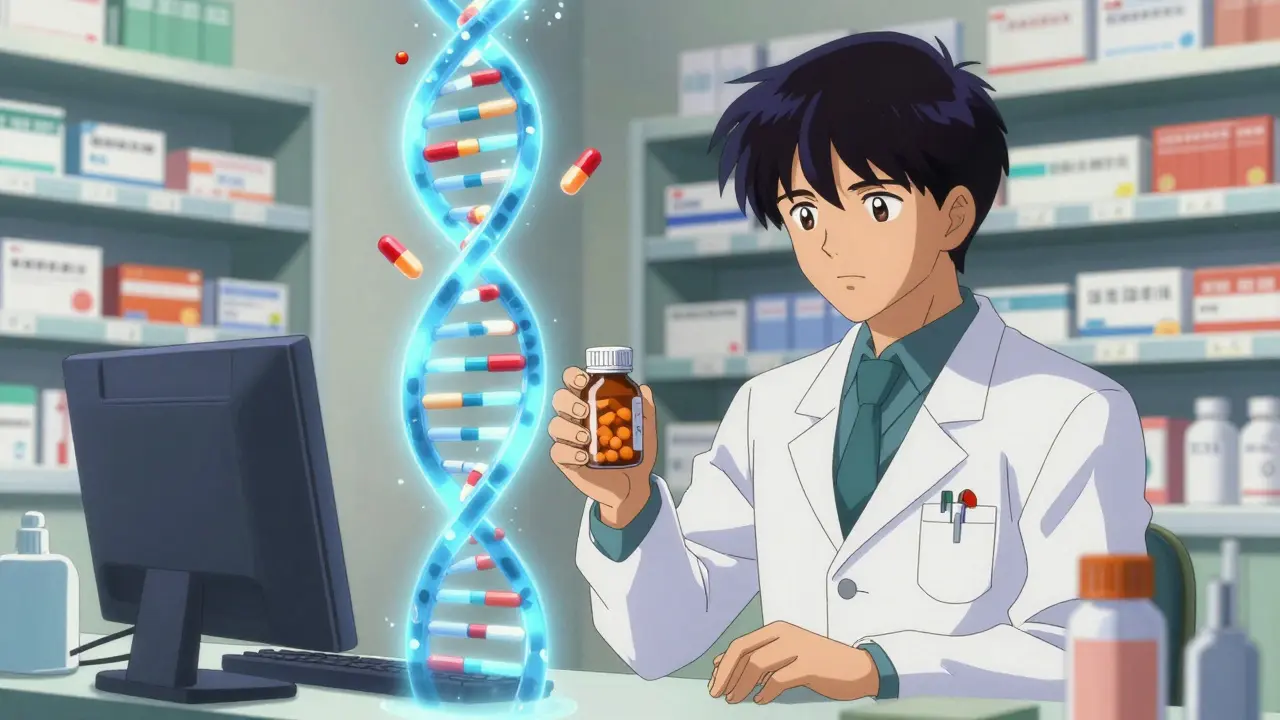
The Missing Piece in Your Medication Puzzle
You might think your doctor has covered all the bases when checking for drug interactions. You hand over a list of prescriptions, supplements, and over-the-counter meds. The pharmacy software beeps, warning you about a specific combination. That system checks two drugs against each other. But it ignores the third player in the game: your DNA.
This oversight leaves patients vulnerable to adverse events that could have been prevented. A study published in Nature Reviews Drug Discovery back in 2019 estimated that adverse drug reactions cost the U.S. healthcare system $30 billion every single year. Much of this burden comes from unpredictable responses to standard dosing schedules. We now know that genetics accounts for anywhere from 20% to 95% of variability in how your body handles a specific drug.
That is why pharmacogenomics has moved from theoretical science to a practical necessity. By analyzing genetic markers, clinicians can predict how you metabolize medicines before you even take the first pill. This approach transforms safety management from reactive troubleshooting to proactive protection.
What Pharmacogenomics Actually Means
Pharmacogenomics (PGx) is the study of how genetic variations affect individual responses to medications, significantly influencing drug interaction risk through gene-drug and drug-drug-gene interactions. It differs slightly from pharmacogenetics, which usually focuses on single-gene effects. The term formally entered the medical dictionary when the National Institutes of Health adopted it in 2005. Since then, the field has matured into a framework for clinical decision-making.
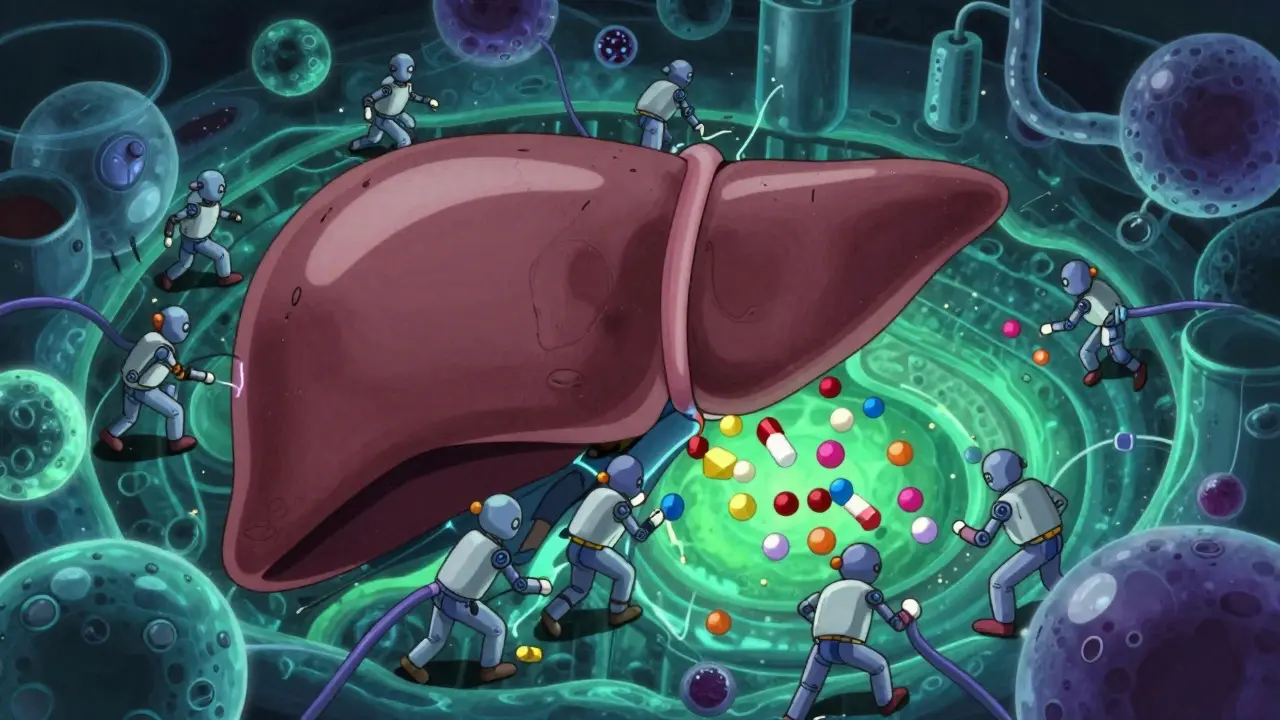
Think of your liver as a massive processing factory. Inside this factory sit specialized workers called enzymes. One major family of these workers is known as the Cytochrome P450 (CYP) enzymes responsible for metabolizing many commonly prescribed medications including antidepressants and painkillers. These enzymes process roughly 75% of all modern drugs. Some people inherit genes that make these enzymes slow movers, while others have super-fast versions.
If you carry a "slow metabolizer" genotype, a drug intended to leave your system quickly might linger too long, causing toxicity. Conversely, a "rapid metabolizer" might clear the drug so fast that it never reaches therapeutic levels. Traditional drug-checkers do not see this variance. They assume average metabolism across the population. This assumption fails for millions of patients.
Three Ways Genetics Breaks Down Drug Safety
Understanding the mechanics helps you grasp why the risk changes. When we talk about drug-drug-gene interactions (DDGIs), we are looking at three specific mechanisms. The first is inhibition. In this scenario, Perpetrator Drug A stops Enzyme X from working. Drug B relies on Enzyme X to break down. Suddenly, Drug B builds up to dangerous levels.
The second mechanism is induction. Here, Perpetrator Drug A tells Enzyme X to work overtime. Drug B gets destroyed before it can help you. The result is treatment failure rather than toxicity. Finally, there is phenoconversion. This is a subtle but critical concept. Imagine your genetics say you are a normal metabolizer. However, taking an inhibitor creates a temporary state where your liver acts like a poor metabolizer. Your genetic potential is overridden by chemical interference.
| Mechanism | Effect on Victim Drug | Clinical Outcome |
|---|---|---|
| Inhibition | Reduced metabolism, increased concentration | Risk of toxicity or overdose symptoms |
| Induction | Increased metabolism, reduced concentration | Treatment failure or sub-therapeutic levels | ight>
| Phenoconversion | Alters genetic phenotype temporarily | Unexpected response matching different genotype |
A classic example involves the enzyme CYP2D6. Many antidepressants depend on this pathway. A patient who is genetically a poor metabolizer takes Codeine. The liver cannot convert Codeine into Morphine to manage pain. The drug does nothing. But add another common drug like Paroxetine to the mix. Even if they had normal genetics initially, the combination creates a toxic environment. The FDA Table of Pharmacogenetic Associations currently lists nearly 150 gene-drug pairs with clinical implications. This number grew from just a handful in the early 2000s.
The Hidden Risk Factor Beyond Standard Checkers
You might wonder if your current pharmacy app is enough. Research indicates otherwise. A study published in the American Journal of Managed Care analyzed community pharmacy populations. When researchers added genetic polymorphisms to their interaction analysis, the estimated probability of interaction impacts jumped by over 90%. Major impact interactions rose by 30%. The difference is stark.
Standard databases like Lexicomp flag thousands of potential conflicts. But most are theoretical. They ignore the patient's biology. When you layer genetics on top, the clinically relevant interactions increase further. The European Medicines Agency notes that pharmacokinetic interactions account for about 60% of significant PGx issues. The remaining 40% involve pharmacodynamics-how drugs affect the body's receptors. Both categories rely heavily on genetic status.
Dr. Julie Johnson, Editor-in-Chief of Clinical Pharmacology & Therapeutics, highlighted this gap in a 2022 editorial. She stated that preemptive testing could reduce clinically relevant interactions by up to 30% in patients taking multiple medications. For polypharmacy patients-those managing five or more prescriptions-the stakes are highest. Polypharmacy affects roughly 13% of adults. Each added pill increases the surface area for error. Genetics narrows the safe options.

Putting Guidelines into Practice
Knowledge means little without execution. The Clinical Pharmacogenetics Implementation Consortium (CPIC is an international organization established in 2009 providing evidence-based guidelines for applying genetic information to drug prescribing decisions) sets the standard here. Since 2009, they have published actionable guides. As of 2023, over 30 genes and 100 drug-gene pairs have official recommendations.
Consider Azathioprine. It treats autoimmune diseases but causes severe bone marrow suppression in people with low TPMT enzyme activity. The guidelines explicitly recommend reducing dosage to 10% of the standard amount for poor metabolizers. Without testing, these patients face life-threatening side effects. With testing, they get full benefit safely.
Major institutions are already operationalizing this. The Mayo Clinic began preemptive testing in 2011. Their reports show that 89% of patients had at least one actionable variant. Clinical alerts triggered by these results cut inappropriate prescribing by nearly half. Vanderbilt University follows suit with their PREDICT program, having tested over 100,000 patients. These centers integrate findings directly into Electronic Health Records. The doctor sees the alert when writing the prescription.
However, barriers remain significant. Community hospitals lag behind academic giants. A survey from the American Society of Health-System Pharmacists found that only 8% of community hospitals offer the service compared to 42% of academic centers. Cost is a driver, but infrastructure is bigger. Integrating complex genetic data into legacy hospital IT systems requires investment. Estimates suggest about $1.2 million per healthcare system setup.
Barriers and Future Directions
We cannot ignore the friction. Only about 15% of U.S. healthcare systems have integrated PGx testing into routine electronic workflows. Furthermore, many pharmacists feel unprepared. A survey of 1,200 practitioners showed that only 28% felt adequately trained to interpret results. The solution involves better education. CPIC provides standardized definitions like allele function charts, but doctors need time to learn them. Studies suggest a clinician needs 15 to 20 hours of training to interpret these profiles confidently.
Insurance coverage complicates matters too. While reimbursement codes exist, payers often deny claims for "investigational" uses. The average payment for a comprehensive panel ranges between $250 and $400, which remains a hurdle for out-of-pocket consumers. Despite this, the market is surging. Valued at $7.2 billion in 2022, industry analysts project growth to over $24 billion by 2030.
Looking forward, artificial intelligence will play a larger role. Recent experiments show AI models incorporating genetic data improve warfarin dosing accuracy by 37% compared to standard algorithms. The NIH's All of Us Research Program has returned results to hundreds of thousands of participants, building a massive database for future refinement. By 2026, we are likely seeing the transition from post-hoc reaction to pre-emptive prevention become the norm for high-risk groups.
Equity remains a challenge. Most genetic data comes from populations of European ancestry. Only 2% of research participants represent African ancestry in some studies. Expanding diversity is essential for global guidelines to work for everyone.
Can pharmacogenomic testing prevent drug interactions?
Yes, by identifying genetic variants that alter drug metabolism, clinicians can choose medications less likely to interact. Testing allows for dose adjustments that mitigate risks associated with both poor and rapid metabolism phenotypes.
What is the difference between pharmacogenomics and pharmacogenetics?
While terms are often used interchangeably, pharmacogenetics typically refers to the study of single gene effects, whereas pharmacogenomics looks at the genome-wide impact on drug response, encompassing broader genomic variation.
Does my doctor need a special referral for this test?
Most specialists, including psychiatrists and cardiologists, can order the tests directly. Primary care physicians may refer to genetic counselors depending on local practice standards and insurance requirements.
How long do pharmacogenomic results last?
Your DNA does not change over your lifetime, so results are permanent. Unlike blood tests, you only need to undergo genetic profiling once unless new genes are discovered relevant to your regimen.
Is insurance likely to cover the cost?
Coverage varies widely. Medicare and private insurers are increasing approval rates, especially for drugs like warfarin, antidepressants, and opioids. Checking specific CPT codes with providers beforehand ensures billing accuracy.
Rick Jackson
March 31, 2026 AT 15:23Great read.
Amber Armstrong
April 1, 2026 AT 01:54I honestly think this stuff changes everything for people like me who take so many meds just to feel normal every single day. We spend hours reading labels and asking pharmacists what can go wrong but nobody tells us that our actual body chemistry might be totally different than theirs. My grandmother used to get terrible side effects from antidepressants because she processed chemicals way slower than average according to her doctor. It was always blamed on stress or aging until someone finally mentioned genes which made total sense after years of frustration. Knowing your liver enzymes work faster or slower before you even swallow a pill sounds like magic compared to guessing games we play now. Insurance companies love to talk about cost savings but rarely actually cover these tests unless you push really hard during open enrollment periods. I worry that smaller clinics wont have the funding to update their systems while big hospitals get all the cool tech tools first. Patients end up suffering through trial and error phases where nobody feels great for months on end just trying to find a dose. The data here suggests ninety percent more interactions get caught when genetics are included in the equation which is terrifying when you stop to think about it. We deserve better than reactive medicine that waits until something explodes in our bloodstream before taking action. Doctors want to help but their current software just screams generic warnings that don't account for biological differences at all. It feels like science fiction becoming reality finally arriving in our local pharmacies slowly but surely everywhere. I hope this spreads quickly because everyone deserves to live without worrying if their morning coffee interacts with their heart medication unexpectedly. The future of personalized care depends on making this standard instead of a luxury option for only the wealthy few. Please share this information with anyone managing chronic conditions because it really matters for safety daily.
Beccy Smart
April 2, 2026 AT 04:02This seems like way too much trouble to deal with honestly 😩
Carolyn Kask
April 2, 2026 AT 11:56Of course America leads the way in medical innovation while charging patients three hundred dollars out of pocket for a blood test nobody wants.
Ruth Wambui
April 3, 2026 AT 00:26The corporate machine definitely benefits when doctors keep switching prescriptions endlessly rather than fixing the root cause once and for all.
Michael Kinkoph
April 4, 2026 AT 18:31Indeed!!!
One must consider
the implications!!
Serious!!!
sanatan kaushik
April 6, 2026 AT 14:29My village uses herbs mostly but modern science helps us understand why some things hurt. It is good to know the truth before we drink poison. People should care about this more in my home country too.
Debbie Fradin
April 6, 2026 AT 15:22Don't hold back on the details because most folks just nod along without understanding anything anyway.
Jonathan Alexander
April 7, 2026 AT 03:56This is absolutely heartbreaking when you realize how many lives were ruined by simple errors.
Charles Rogers
April 8, 2026 AT 23:30You clearly lack the foresight to see that technology always fails people who rely on it too much. Trust your gut instinct instead of machines.
Adryan Brown
April 10, 2026 AT 10:35Everyone brings a valid point to the table and we should listen to all sides of this issue carefully before rushing into new policies.
Vikash Ranjan
April 12, 2026 AT 09:47I disagree completely with the optimism here because history shows these things never work for the average person.
Biraju Shah
April 13, 2026 AT 01:08We need to demand better standards now and stop accepting the current broken system as our new normal.