You've probably been at the pharmacy counter and heard the pharmacist ask, "Do you want the generic version?" For many of us, this brings up a nagging question: if it's so much cheaper, is it actually doing the same thing as the expensive brand-name version? It's a fair worry. When your health is on the line, paying more feels like a safety net. But the reality is that the price gap between brand and generic drugs isn't about quality-it's about patents, marketing, and the way the pharmaceutical industry works.
The bottom line is that choosing generics is one of the fastest ways to slash your healthcare spending without sacrificing your health. In fact, while generic and biosimilar medicines make up about 90% of all prescriptions filled in the U.S., they only account for about 12% of the total spending. That is a massive difference in value. If you're trying to figure out why the price difference is so extreme and whether you should make the switch, here is everything you need to know.
Why the Price Gap Is So Huge
To understand why Generic Drugs is pharmaceutical products containing identical active ingredients as brand-name drugs, manufactured to the same standards of quality and performance cost so much less, you have to look at how a drug is born. When a company creates a new medication, they spend billions on research, clinical trials, and FDA approvals. To recover those costs and make a profit, the government grants them a patent. This gives the company a monopoly-they are the only ones allowed to sell the drug for a set number of times, allowing them to set a high brand-name price.
Once that patent expires, other companies can enter the market. These companies don't have to repeat those billion-dollar clinical trials; they just have to prove that their version is "bioequivalent." This is where the Hatch-Waxman Act is a 1984 U.S. law that established the Abbreviated New Drug Application (ANDA) pathway, allowing generic manufacturers to enter the market without repeating costly clinical trials comes in. Because the generic makers skip the expensive R&D phase, they can sell the drug at a fraction of the cost. In many cases, generics cost roughly 79% to 85% less than the brand-name equivalent.
Does "Cheaper" Mean "Lower Quality"?
This is the most common myth about medication. Many people feel that because a generic is cheaper, it must be a "watered down" version. That is simply not true. The FDA is the Food and Drug Administration, the federal agency responsible for protecting public health by ensuring the safety, efficacy, and security of human drugs requires generics to have the same active ingredient, strength, dosage form, and route of administration as the brand drug.
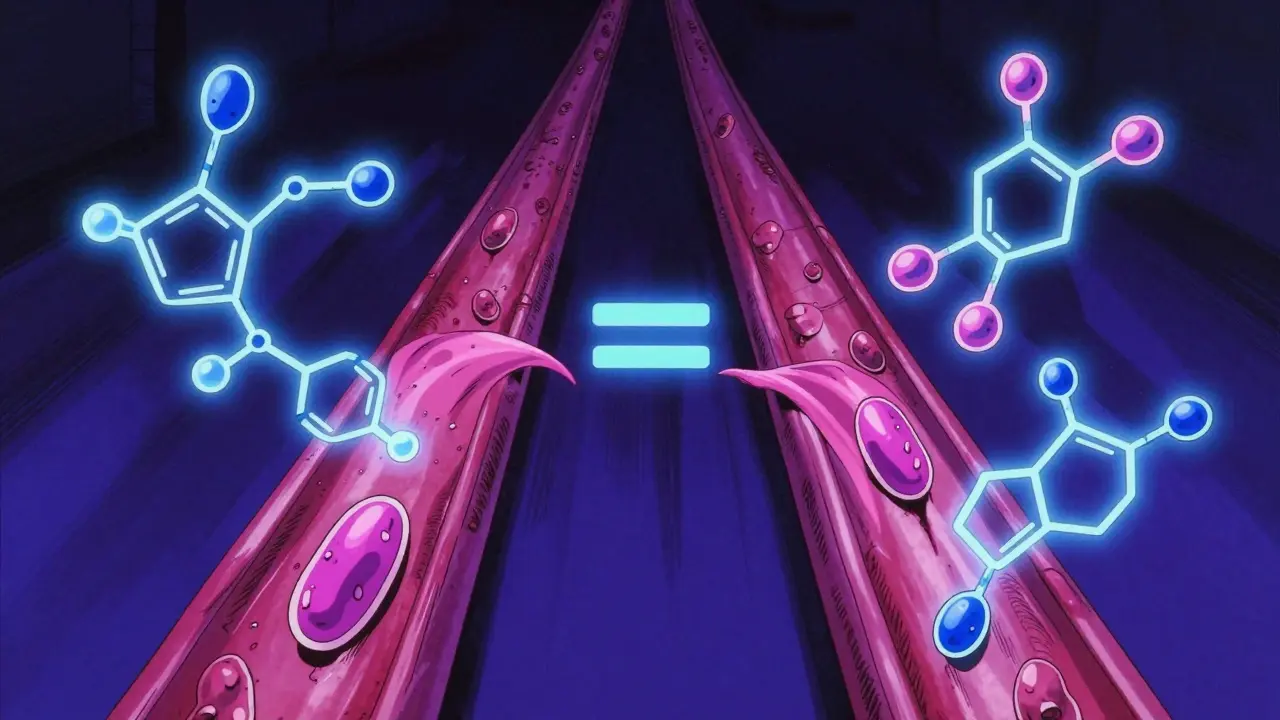
They also must prove bioequivalence. This means the generic drug must deliver the same amount of active ingredient into your bloodstream in the same amount of time as the brand version. Specifically, the performance must be within a tight window (80-125%) of the brand-name product. While the "inactive ingredients"-like the binders, fillers, or the color of the pill-might differ, the part of the medicine that actually treats your condition is identical.
How Competition Drives Prices Down
If you've noticed that some generics are cheaper than others, it's because of market competition. When only one company makes a generic version, the price doesn't drop nearly as much as when five or ten companies are fighting for your business. There is a predictable pattern to how these prices crash once a patent expires.
| Number of Generic Competitors | Typical Price Drop (Relative to Brand) | Market Effect |
|---|---|---|
| 1 Competitor | ~10% Reduction | Limited savings; brand still holds power. |
| 3-4 Competitors | 30-40% Reduction | Significant price drops as competition heats up. |
| 5+ Competitors | 50% or more Reduction | Maximum affordability; prices often hit lowest levels. |
Interestingly, brand-name companies sometimes panic when they see a generic launch. To keep their market share, they might slash their own prices. For example, Bayer recently cut the list price of Nexavar by 50% after a generic version hit the market. This shows that even the "premium" brands are forced to react when the generic vs brand drug prices gap becomes too wide for patients to ignore.
The "Hidden" Costs: List Price vs. Net Price
If you look at a drug's price on a manufacturer's website, you're seeing the "list price." But almost nobody actually pays that. Between the list price and what you pay at the pharmacy is a complex web of rebates and discounts. This is known as the "gross-to-net gap."
Manufacturers often keep list prices high to make their rebates to insurance companies look more impressive, which helps them get their drugs on "preferred" lists (formularies). However, recent trends show that net prices-the actual amount the manufacturer keeps-are staying flatter. This is partly due to new laws like the Inflation Reduction Act is U.S. legislation that allows Medicare to negotiate prices for certain high-cost brand-name drugs to reduce out-of-pocket costs for seniors , which is forcing brand-name companies to be more honest with their pricing to avoid massive government-mandated cuts.
Practical Tips for Saving on Your Meds
Knowing that generics work is one thing; actually getting them at the lowest price requires a bit of strategy. Don't just assume the pharmacy's default is the cheapest option. Here are a few ways to ensure you're getting the best deal:
- Ask for the "Therapeutic Equivalent": Sometimes a drug doesn't have a direct generic, but there is another drug in the same class that is much cheaper and does the exact same thing. Ask your doctor if a "therapeutic alternative" is available.
- Check the "Cash Price": Sometimes, using a discount card or paying cash for a generic is actually cheaper than using your insurance copay. This is especially true for very old, common generics.
- Compare Pharmacies: Generic prices can vary wildly between a big-box retail chain and a local independent pharmacy. A quick phone call can save you $20 per month.
- Request 90-Day Supplies: If you are on a long-term medication, getting a three-month supply is almost always cheaper than three one-month fills.
Common Concerns and Red Flags
While generics are safe for the vast majority of people, there are a few rare cases where the brand name might be necessary. These are called "narrow therapeutic index" (NTI) drugs. These are medications where a tiny difference in the dose or how the drug is absorbed can lead to a big change in how the medicine works (like some blood thinners or seizure medications).
If you are taking an NTI drug, talk to your doctor before switching. In most other cases, if the FDA says it's bioequivalent, you can trust it. If you start a generic and feel like it's not working as well, don't just stop taking it. Keep a log of your symptoms and bring it to your doctor. It's rarely the drug's chemistry, but occasionally a person's body reacts differently to a specific inactive filler used by one manufacturer.
Are generic drugs really the same as brand-name drugs?
Yes. The FDA requires generic drugs to have the same active ingredients, strength, purity, and stability as the brand-name version. They must also prove bioequivalence, meaning they enter the bloodstream at the same rate and to the same extent as the original.
Why is there such a huge price difference?
Brand-name companies spend billions on research, development, and marketing. Generic companies don't have these overhead costs because they are simply copying an existing formula. They can pass those savings on to the consumer, often reducing the cost by 80% or more.
Can I switch from a brand-name drug to a generic?
In most cases, yes. However, you should always consult your doctor first. For most medications, the switch is seamless. For a small number of high-precision drugs (like certain epilepsy or heart medications), your doctor may prefer you stay on a consistent brand to avoid slight variations in absorption.
Do generics have different side effects?
The active ingredient is the same, so the primary side effects are identical. However, generic drugs use different inactive ingredients (fillers and binders). In very rare cases, a patient might be allergic to a specific dye or filler used in a generic version that wasn't in the brand version.
What happens when a brand-name drug's patent expires?
Once the patent expires, other manufacturers can apply for an ANDA to produce a generic version. This usually leads to a sharp drop in price as multiple companies compete for customers. Sometimes the original brand company will even lower their price to try and stay competitive.
What to Do Next
If you're currently paying a premium for a brand-name medication, your next step is a simple conversation. Next time you see your provider, ask: "Is there a generic version of this medication that is bioequivalent?" If the answer is yes, check with your insurance provider to see which generic manufacturer is on their preferred list to get the lowest copay.
For those managing multiple chronic conditions, consider a medication review with your pharmacist. They can often identify where you're paying for a brand name out of habit when a perfectly safe, much cheaper generic alternative has been available for years. Small changes in your prescription choices can lead to hundreds or even thousands of dollars in annual savings.
Divyanshu Giri
April 22, 2026 AT 15:03Saving money on meds is a total game changer! Let's all get those generic wins and keep our wallets happy 🚀
Ajinkya Joshi
April 23, 2026 AT 20:28Oh sure, just trust the government and the FDA blindly because they've always been so honest and efficient with our health
Absolute joke.
Rick Brewster
April 23, 2026 AT 22:04the very essence of our societal structure is built upon these artificial monopolies which ostensibly exist to foster inovation but in reality only serve to alienate the masses from the basic right of survival and the dichotomy between a brand and a generic is merely a semantic veil for the capitalist machinery to grind the poor into dust while the elites sip champagne on their yachts and ignore the systemic failue of the medical industrial complex which is fundamentally broken at its core and needs a complete rebirth of ethcis
Ally Warren
April 24, 2026 AT 07:50It is interesting how we equate price with value in almost every aspect of our lives, yet when it comes to chemistry, the molecular structure remains indifferent to the marketing budget of the manufacturer.
RAJESH MARAVI
April 24, 2026 AT 23:04bioequvailence is just a word they use to trick u into buying cheap stuff that doesnt work!! my cousin tried a generic and felt differnt instantly... total scam!! 🙄
Anantha Lakshmi
April 25, 2026 AT 06:30Everyone should definitely try to save where they can ✨ Let's support each other in making healthy and affordable choices! 💖🙏
Caroline Duvoe
April 25, 2026 AT 13:37everyone knows about the cash price thing lol 🙄 just use goodrx and stop overpaying 💅
Sarah Watters
April 25, 2026 AT 16:54They just want us on the cheap stuff so the big companies can export the high-quality batches to other countries while we get the leftovers produced in factories with zero oversight.
Olayinka Ibukunoluwa Mercy
April 26, 2026 AT 09:12It is so important to be mindful of our health and our finances!!! ❤️ I always encourage my community to talk to their pharmacists about these options... it makes such a difference in the long run!!! 🌟😊
Dan Wizard
April 28, 2026 AT 02:27I have always wondered if the difference in inactive ingredients could actually play a role in how some people experience side effects differently even if the active chemical is the same, and it's quite fascinating that there is a specific category for drugs with a narrow therapeutic index because it shows that science recognizes the nuance in human biology that a one-size-fits-all approach simply cannot address.
Odicha ude Somtochukwu
April 28, 2026 AT 12:03I strongly agree that patients should be empowered with this knowledge... It is a matter of dignity and accessibility!!!
Chidi Prosper
April 28, 2026 AT 14:46Exactly. Get the generics and stop paying the brand tax. It's common sense.
Nicole Antunes
April 29, 2026 AT 20:45I find it quite heartening to see these options becoming more accessible. It is truly a positive step toward equitable healthcare for all. :)
Emma Cozad
May 1, 2026 AT 05:49The whole system is a joke lol... lawoyers and pharma CEOs just eating our lunch while we argue about fillers in pills. typical amerikka.
vimal purwal
May 2, 2026 AT 19:30I must insist that everyone takes the time to thoroughly investigate their current prescriptions because the financial burden of brand-name drugs is an unnecessary hardship that can be easily mitigated through professional consultation with a licensed pharmacist who can provide the most current data on therapeutic equivalents and ensure that the transition to a generic does not compromise the patient's clinical outcomes in any way whatsoever.