Have you ever looked at a prescription label and wondered why one pill is grouped with heart medications while another, treating the same symptom, sits in a completely different category? It’s not random. The way we sort medicines into boxes-what experts call generic drug classifications-is the backbone of modern healthcare. These systems help doctors prescribe safely, insurers pay bills correctly, and regulators keep dangerous substances out of the wrong hands.
But here’s the catch: there isn’t just one list. There are several, and they often contradict each other. A drug might be a "heart medication" for your doctor, a "controlled substance" for the police, and a "Tier 1 generic" for your insurance company. Understanding these layers is crucial if you want to navigate the healthcare system without getting lost in the jargon.
The Therapeutic Lens: Treating the Condition
The most common way healthcare providers think about drugs is by what they treat. This is called therapeutic classification. If you have high blood pressure, you look for antihypertensives. If you have pain, you look for analgesics. Simple, right?
This system is championed by bodies like the Food and Drug Administration (FDA) and the United States Pharmacopeia (USP). Their model organizes thousands of drugs into broad buckets like "Cardiovascular Agents" or "Endocrine Agents." Within those, you get smaller sub-groups. For example, under "Analgesics," you’ll find Non-opioid Analgesics (like ibuprofen) and Opioid Analgesics (like morphine).
- Pros: It’s intuitive. Doctors don’t need a PhD in chemistry to know that an antibiotic treats infection.
- Cons: It gets messy when one drug does two things. Take aspirin. Is it a painkiller? Yes. Is it a blood thinner? Also yes. In a strict therapeutic box, where does it live? This ambiguity can sometimes lead to confusion in complex cases.
In hospitals, this is the gold standard. About 92% of U.S. hospitals use this framework because it aligns directly with patient symptoms and treatment plans.
The Mechanism Approach: How It Works Inside You
If therapeutic classification asks "What does it cure?", pharmacological classification asks "How does it work?" This system groups drugs by their biological mechanism of action.
For instance, instead of just saying "cancer drug," this system might group a medication as an "Epidermal Growth Factor Receptor Kinase Inhibitor." That sounds intimidating, but it tells a specialist exactly how the drug interacts with cells at a molecular level. The National Center for Biotechnology Information (NCBI) tracks over 1,200 distinct pharmacologic classes.
- Who uses this? Mostly researchers, oncologists, and specialists dealing with complex diseases.
- Why it matters: It helps scientists predict side effects and interactions. If you know a drug blocks a specific receptor, you can guess what happens if you combine it with another drug that targets the same receptor.
However, this system is less useful for a general practitioner prescribing antibiotics. Knowing the exact molecular pathway is less important than knowing it kills bacteria.
The Legal Framework: DEA Schedules
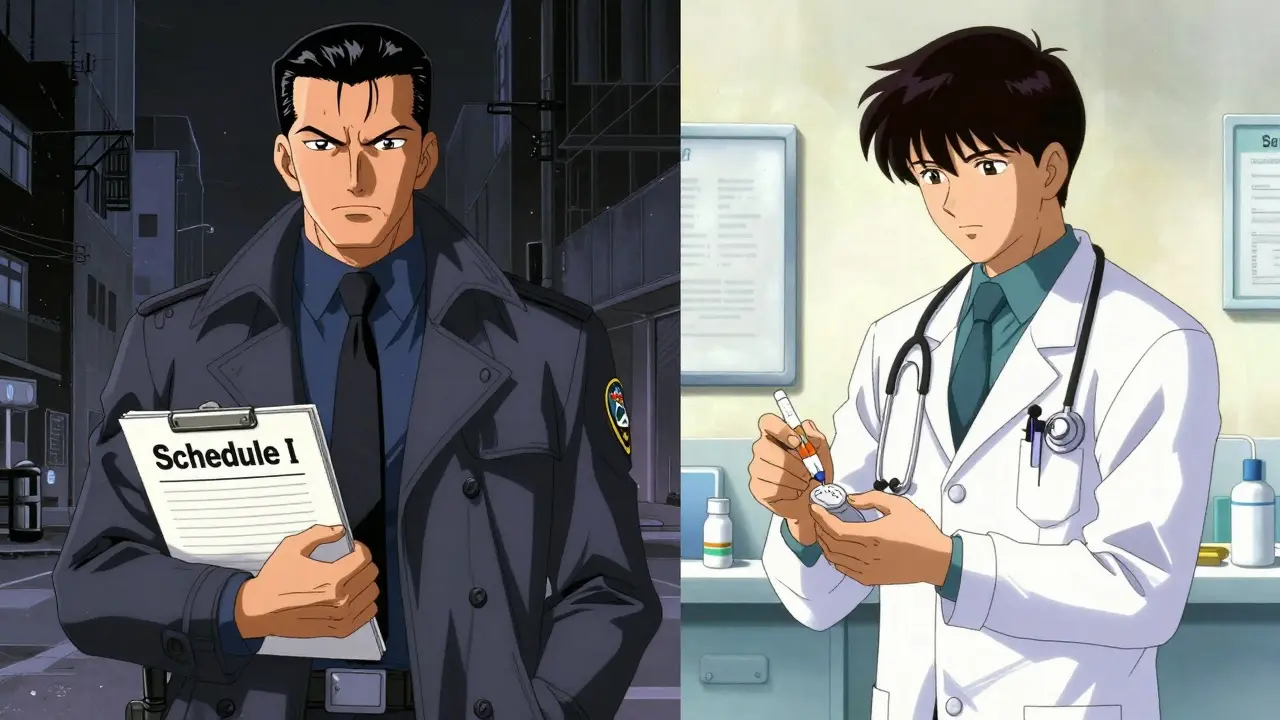
Not all classifications are medical. Some are legal. The Drug Enforcement Administration (DEA) uses the Controlled Substances Act to categorize drugs based on their potential for abuse and their accepted medical use. This is known as scheduling.
There are five schedules, from I to V:
- Schedule I: High abuse potential, no accepted medical use (e.g., heroin, LSD). Strictly illegal to prescribe.
- Schedule II: High abuse potential, but accepted medical use (e.g., oxycodone, fentanyl, Adderall). Requires special prescriptions.
- Schedule III-V: Lower abuse potential (e.g., cough syrups with codeine, certain tranquilizers).
This system creates a huge divide between clinical utility and legal status. For years, marijuana was Schedule I, meaning the government said it had no medical value, even though many states legalized it for medical use. Recently, discussions around the MORE Act have pushed to reclassify it, showing how political and social shifts directly impact these legal categories.
The Economic Layer: Insurance Tiers
For patients, the most frustrating classification is often the financial one. Insurance companies like Humana or UnitedHealthcare don’t care much about mechanisms; they care about cost. They use a tiered system.
| Tier | Type | Cost Impact |
|---|---|---|
| Tier 1 | Preferred Generics | Lowest copay (often $4-$10) |
| Tier 2 | Non-Preferred Generics | Moderate copay |
| Tier 3 | Preferred Brands | Higher copay |
| Tier 4 | Non-Preferred Brands | High copay |
| Tier 5 | Specialty Medications | Highest cost (coinsurance) |
About 75% of generic drugs fall into Tier 1. But here’s the kicker: two chemically identical generics might end up in different tiers simply because of which pharmacy benefit manager has a contract with the manufacturer. It’s not always about clinical difference; it’s about business deals.
The Global Standard: The ATC System
While the U.S. has its own quirks, the rest of the world largely follows the Anatomical Therapeutic Chemical (ATC) classification system developed by the World Health Organization (WHO).
The ATC system is hierarchical. It starts with the anatomical main group (e.g., Cardiovascular System), moves to the therapeutic subgroup (e.g., Antihypertensives), then to the pharmacological subgroup, chemical subgroup, and finally the specific chemical entity.
As of the 2023 update, the ATC system catalogs over 5,000 distinct substances across 14 main anatomical groups. It’s used in 194 countries. Why? Because it allows for global comparison. Researchers can compare how many people in Sweden take statins versus how many in Japan take them, using a standardized code. It’s the language of global public health.
The Naming Clue: Stem Names
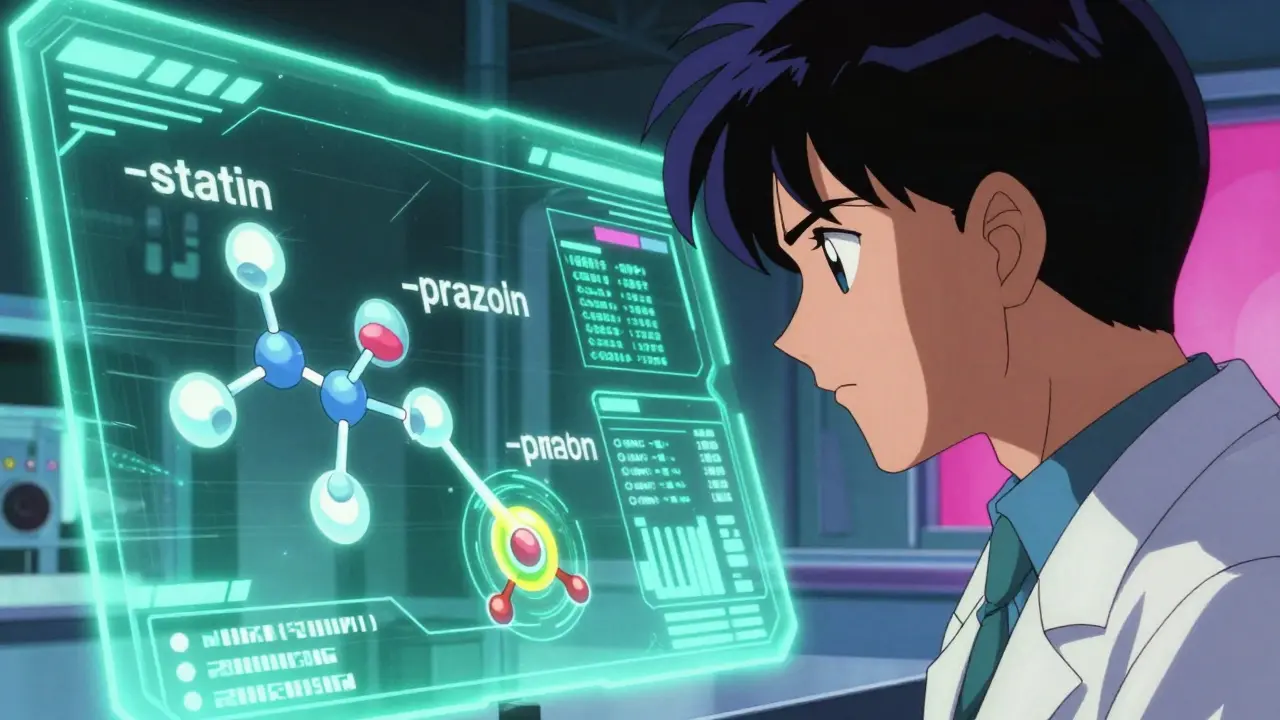
You don’t always need a database to classify a drug. Sometimes, the name itself tells you what it is. This is thanks to the stem naming convention adopted by the USP in 1964.
Generic names are built with prefixes and suffixes (stems) that indicate their class:
- -lol: Beta-blockers (e.g., propranolol, atenolol)
- -prazole: Proton pump inhibitors (e.g., omeprazole, pantoprazole)
- -statin: HMG-CoA reductase inhibitors (e.g., atorvastatin, simvastatin)
- -cillin: Penicillins (e.g., amoxicillin)
There are 87 distinct stems recognized today. This system reduces medication errors significantly. If a nurse sees "-prazole," they immediately know it affects the stomach acid, not the heart. It’s a quick mental shortcut built into the vocabulary of medicine.
Why Confusion Happens
So, why do doctors and pharmacists still argue about classifications? Because these systems overlap poorly.
Take duloxetine. Therapeutically, it’s an antidepressant. Pharmacologically, it’s a serotonin-norepinephrine reuptake inhibitor. Legally, it’s not controlled. Financially, it might be Tier 2. If you’re a patient, you just see "Cymbalta" or "Duloxetine." But behind the scenes, four different systems are trying to describe the same pill.
A survey of physicians found that 68% cite confusion between therapeutic and pharmacologic classifications as a barrier to optimal prescribing. Meanwhile, 79% of primary care doctors spend 12-18 minutes per patient navigating these conflicting systems during medication selection.
The Future: AI and Precision Medicine
The old ways are cracking. New drugs, especially biologics and gene therapies, don’t fit neatly into boxes. A new cancer drug might target three different pathways simultaneously. Does it go in the "kinase inhibitor" box or the "immunotherapy" box?
The FDA is rolling out a "Therapeutic Categories Model 2.0" that allows for primary-secondary indication hierarchies. Meanwhile, AI tools like IBM Watson Health’s Drug Insight platform are using machine learning to predict optimal therapeutic placement with over 92% accuracy.
By 2028, analysts expect 65% of new molecular entities to require novel classification approaches. We are moving toward a hybrid model that combines therapeutic use, genetic markers, and pharmacological action. It’s more complex, but it’s necessary for the era of personalized medicine.
What is the difference between therapeutic and pharmacological classification?
Therapeutic classification groups drugs by the condition they treat (e.g., antihypertensives for high blood pressure). Pharmacological classification groups them by their mechanism of action at the cellular or molecular level (e.g., ACE inhibitors). Therapeutic is easier for general use; pharmacological is more precise for research.
Why are some generic drugs more expensive than others?
This is usually due to insurance tiering. Even if two generics are chemically identical, insurance contracts may place one in a lower-cost tier (Tier 1) and another in a higher-cost tier (Tier 2) based on negotiations between manufacturers and pharmacy benefit managers, not clinical differences.
What are DEA drug schedules?
DEA schedules are legal classifications based on a drug's potential for abuse and its accepted medical use. Schedule I drugs have no accepted medical use and high abuse potential (illegal), while Schedule II-V drugs have medical uses but varying levels of restriction.
What is the ATC classification system?
The Anatomical Therapeutic Chemical (ATC) system is a global standard maintained by the WHO. It classifies drugs by the part of the body they affect (anatomical), their therapeutic purpose, and their chemical structure. It is used by 194 countries for statistical and regulatory purposes.
How do drug stems help identify medication types?
Stem naming conventions use specific suffixes in generic drug names to indicate their class. For example, '-statin' indicates cholesterol-lowering drugs, and '-prazole' indicates proton pump inhibitors. This helps healthcare providers quickly identify drug families and potential interactions.
Lisa Russo
May 22, 2026 AT 01:18Actually you are wrong about everything. The ATC system is not global standard for everyone because many countries still use their own local lists which makes it harder for researchers to compare data accurately. Also saying 92% of hospitals use therapeutic classification is misleading because some clinics use hybrid models that are not counted in that stat. You need to read more before posting hot takes.
Gareth Tyler
May 23, 2026 AT 07:29Hey guys this is really interesting stuff. I never thought about how the same drug could be classified so differently depending on who you ask. It makes me wonder if we should have one unified system that combines all these aspects instead of having doctors lawyers and insurers using different rulebooks. What do you think would be the best way to simplify this for patients?
Sharon O’Mahonh
May 24, 2026 AT 07:26I love how this breaks down the complexity of healthcare into digestible pieces. As someone who works in patient advocacy I see daily how confusing these classifications can be for folks trying to manage chronic conditions. The stem naming convention is such a brilliant tool for reducing errors and I wish more people knew about it. We need more articles like this that empower patients with knowledge rather than leaving them to guess at what their prescriptions mean. Knowledge is power after all.
Jonhnnie john13
May 25, 2026 AT 06:06The argument regarding DEA schedules being purely legal is flawed. While technically true that scheduling restricts access based on abuse potential the medical community often views these restrictions as hindrances to pain management rather than safety measures. The distinction between Schedule II and III substances is arbitrary from a clinical perspective yet carries massive legal weight. This disconnect creates a two-tiered system of care where wealthy patients can navigate bureaucratic hurdles while poorer patients suffer due to lack of access to necessary controlled medications.
Anthony Padilla
May 25, 2026 AT 18:37its crazy how much money goes into keeping these systems separate. i work in pharma marketing and can tell u its all about maximizing profit margins by creating artificial scarcity around certain generics. the fact that two identical pills can cost different amounts just because of which PBM has a contract with the manufacturer is insane. we need reform badly otherwise regular people will keep getting screwed over by corporate greed disguised as healthcare policy
Elizabeth Fandry
May 25, 2026 AT 23:57One must consider the epistemological implications of categorizing biological agents through multiple conflicting lenses 🧐. The very act of classification imposes a false sense of order upon the chaotic nature of human physiology. When we label a substance as merely 'therapeutic' or 'pharmacological' we reduce the profound mystery of healing to mere administrative convenience. This reductionism is tragic indeed 😔. We lose sight of the holistic experience of the patient when we focus solely on molecular mechanisms or insurance tiers. True understanding requires transcending these limited frameworks entirely ✨.
Madeline Petes
May 27, 2026 AT 18:03I totally agree with the part about AI helping with classification. Its so frustrating when my doctor prescribes something that interacts badly with another med im taking. If computers could just figure out all these complex interactions faster then maybe we wouldnt have so many bad reactions. I hope technology gets better soon because right now its too risky for patients who rely on multiple medications daily.
Ramanath Rao
May 29, 2026 AT 12:46This article is completely useless for anyone living outside the United States. In India we have our own National List of Essential Medicines which serves a similar purpose but is tailored to our local health needs and economic realities. Your focus on US insurance tiers and DEA schedules ignores the vast majority of the world population who do not have such expensive healthcare systems. Please write more inclusive content next time instead of just copying American perspectives.
irine sabrina
May 31, 2026 AT 01:55Thank you for sharing this informative piece. It is wonderful to see such detailed explanations of how drugs are categorized. I believe that understanding these systems helps us become better informed citizens and patients. Let us continue to support each other in navigating the complexities of modern medicine with kindness and patience. Every small step towards clarity brings us closer to a healthier society overall.
Gary Helminiak
June 1, 2026 AT 16:48Great breakdown here! 👍 I’ve been working in pharmacy for over ten years and I can confirm that the confusion between therapeutic and pharmacologic classifications is real and it causes no end of headaches for both pharmacists and patients alike. For instance, when a new generic comes out sometimes it’s placed in a higher tier initially until negotiations settle which drives up costs temporarily. It’s not always malicious intent it’s just messy bureaucracy mixed with market dynamics. Keep up the good work spreading awareness about these hidden layers of healthcare 💊✨
dane thorp
June 2, 2026 AT 08:50The discussion around marijuana reclassification is particularly relevant given recent legislative changes. However, the process remains slow and inconsistent across states. Patients suffering from legitimate medical conditions still face barriers despite evidence supporting efficacy. This highlights the need for federal oversight to ensure equitable access regardless of geographic location.
Michael Schurmann
June 3, 2026 AT 18:16You clearly don't understand the intricacies of pharmaceutical economics. Claiming that insurance tiers are merely business deals ignores the rigorous clinical evaluations that go into formulary decisions. Pharmacoeconomic analysis ensures that value-based care is prioritized over simple cost-cutting measures. Your simplistic view betrays a fundamental ignorance of how risk-adjusted capitation models function within managed care organizations. Educate yourself before commenting further.
Christina Mitchell
June 5, 2026 AT 02:49I find it fascinating how culture influences our perception of medication. In some communities herbal remedies are preferred over synthetic drugs due to traditional beliefs. Bridging this gap between Western medicine and indigenous practices could lead to more holistic approaches to classification. We should respect diverse healing traditions while integrating them safely into mainstream healthcare frameworks.
Christopher Laver
June 5, 2026 AT 10:38Boring read. Too much jargon. Just give me the bottom line.