Gene Therapy Drug Interaction Checker
This tool provides general information about potential drug interactions with gene therapy based on current medical knowledge. Results should not replace professional medical advice.
Select a medication to see potential interaction information.
Gene therapy isn’t just another treatment option-it’s a rewrite of your body’s code. Unlike pills or injections that temporarily alter function, gene therapy aims to fix the root cause of disease by delivering new genetic instructions directly into your cells. But this power comes with hidden risks, especially when combined with everyday medications. The danger isn’t always immediate. Sometimes, it shows up years later. And doctors still don’t fully understand how it interacts with the drugs patients are already taking.
Why Gene Therapy Isn’t Like a Regular Drug
Most drugs work by blocking or boosting a chemical signal in your body. They’re designed to be broken down, cleared out, and replaced. Gene therapy is different. It’s meant to last. Once the new gene is inside your cells, it can keep working for years-even for life. That’s the goal. But it’s also the problem.Think of it like installing a new program on your computer. If the program has a bug, you can uninstall it. With gene therapy, once the code is written into your DNA, you can’t just delete it. And if that code accidentally activates the wrong gene, it could trigger cancer. That’s exactly what happened in the early 2000s. Five children treated for a rare immune disorder developed leukemia because the therapy inserted the new gene next to a cancer-causing gene. One child died.
That’s why long-term monitoring isn’t optional-it’s required. The FDA now demands 15 years of follow-up for many gene therapies, especially those using vectors that integrate into the genome. That’s longer than most drugs are even studied. And it’s not just about cancer. The immune system can react unpredictably, changing how your body processes every other medication you take.
How Viral Vectors Disrupt Drug Metabolism
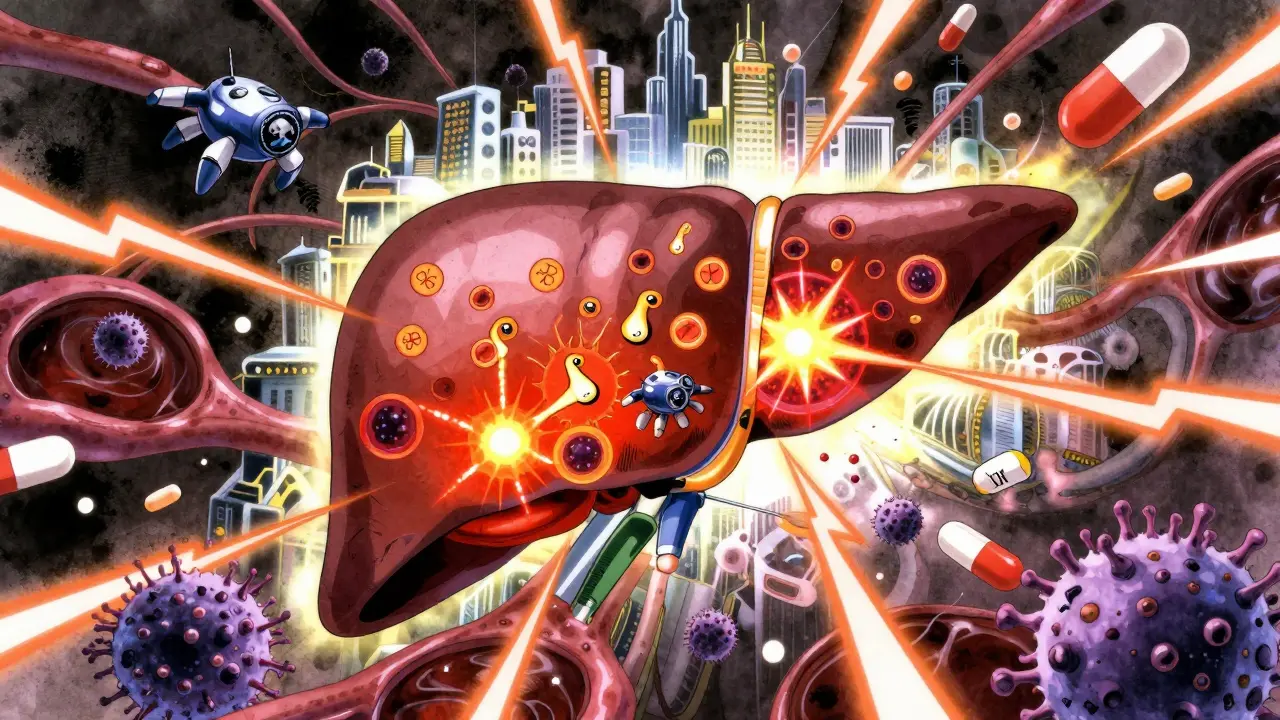
Most gene therapies use modified viruses to carry the new gene into your cells. Adeno-associated viruses (AAVs) are the most common today. They’re generally safe-but they’re still viruses. And your immune system knows it.When a viral vector enters your bloodstream, your body treats it like an invader. Cytokines surge. Inflammation spikes. Liver enzymes change. These reactions don’t just affect the therapy-they affect everything else in your system. One major consequence: your liver’s ability to break down drugs gets scrambled.
Over 70% of prescription drugs are metabolized by a group of liver enzymes called cytochrome P450. These enzymes are sensitive. Infections, inflammation, even stress can slow them down or speed them up. Gene therapy triggers a strong, sustained inflammatory response. That means drugs like blood thinners, antidepressants, or cholesterol meds might build up to dangerous levels-or get cleared too fast to work.
There’s no standard test to predict this. A patient on warfarin might need a 40% dose reduction after gene therapy. Another patient, with the same therapy and same drug, might need no change at all. Why? Because immune responses vary wildly between people. Genetics, age, existing illnesses-all of it matters. And right now, doctors are flying blind.
Off-Target Effects and Hidden Drug Interactions
Gene therapy isn’t always precise. The viral vector might deliver the gene to the wrong tissue. A treatment meant for the liver might accidentally hit the heart. A therapy targeting muscle cells might end up modifying neurons. These off-target effects aren’t just theoretical-they’ve been documented in clinical trials.Here’s where it gets scary: if gene therapy alters a tissue that metabolizes drugs, you get a new kind of interaction. Imagine a therapy that accidentally modifies liver cells to overproduce a certain enzyme. Now, your body breaks down painkillers too quickly. You take your usual dose-and it does nothing. Or worse: the therapy modifies kidney cells, slowing how fast your body clears antibiotics. You develop toxicity without realizing why.
Even more complicated: cell-based gene therapies. These involve removing your cells, editing them in the lab, and putting them back. If those edited cells migrate or change behavior over time, they could start producing proteins that interfere with drugs. No one has mapped these long-term shifts yet. We’re watching for cancer. We’re not watching for drug resistance.
The Immune System Is the Wild Card
Your immune system is the biggest variable in gene therapy safety. It doesn’t just attack the vector-it changes how your whole body responds to everything else.After gene therapy, some patients develop high levels of antibodies against the viral vector. That’s good-it means the therapy won’t work again if needed. But it also means future treatments using similar vectors are off the table. Worse, those antibodies can cross-react with naturally occurring proteins in your body. There are reports of patients developing autoimmune-like conditions after gene therapy, with symptoms mimicking lupus or vasculitis.
These immune shifts alter how drugs bind to proteins in your blood, how they’re absorbed in the gut, and how they’re filtered by the kidneys. A patient on thyroid medication might suddenly need a higher dose. Someone on insulin might find their levels crashing without warning. These aren’t rare edge cases. They’re predictable outcomes of a system that’s been fundamentally altered.
And here’s the catch: we don’t have biomarkers to detect these changes early. No blood test tells you, “Your immune response is now interfering with your statin.” Doctors have to guess. They have to monitor. They have to adjust-and often, they’re doing it without data.
Transmission Risk: When Your Therapy Affects Others
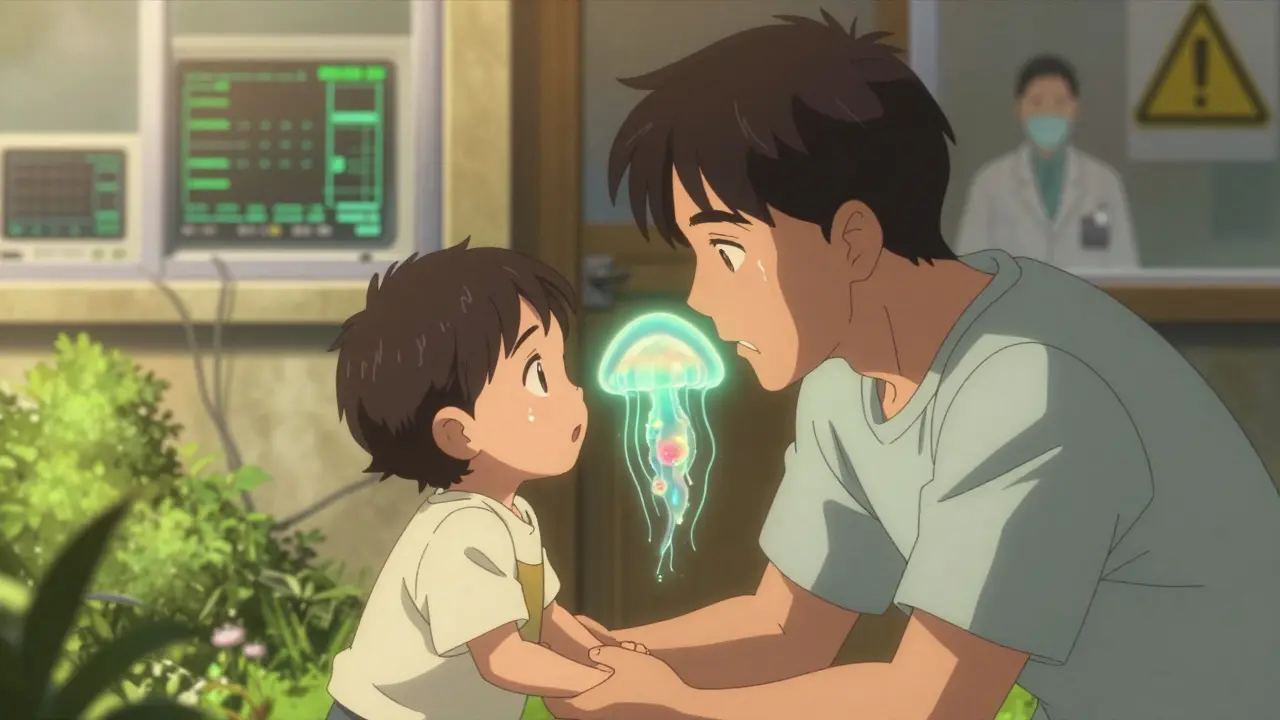
This is something most patients never consider. Some gene therapies use vectors that can be shed-passed to others through bodily fluids. It’s rare, but it’s possible. The FDA requires companies to test for this. But what happens if a family member gets exposed?Imagine a father gets gene therapy for a muscle disorder. A week later, his toddler gets sick with a fever. The father’s saliva carries traces of the viral vector. The child’s immune system hasn’t been tested. No consent was given. No monitoring planned. The child might develop an immune reaction-or worse, the vector could integrate into their cells. We have no data on what happens in these cases. No registry. No tracking. Just fear.
This isn’t science fiction. It’s happened. In one trial, a caregiver tested positive for the vector weeks after the patient’s treatment. The caregiver had no symptoms-but they were now carrying a gene therapy they never agreed to. That’s not just a safety issue. It’s an ethical earthquake.
What Patients Need to Know
If you’re considering gene therapy, you need to ask more than, “Will this fix my disease?” You need to ask:- What drugs am I currently taking-and how might they interact?
- Will I need to stop any medications before or after treatment?
- What are the known immune risks for this specific vector?
- How long will I need to be monitored-and what will they be looking for?
- What happens if I need another treatment in five years?
There’s no checklist. No algorithm. No clear guide. That’s the reality. The science is moving faster than the safety protocols. And patients are the ones paying the price.
The Future: We Need Better Tools
We’re not going to stop gene therapy. It’s too promising. But we need to stop treating it like a regular drug. We need:- Registries that track every patient long-term-not just for cancer, but for every medication they take.
- Standardized pre-treatment drug panels to map baseline metabolism.
- Real-time immune monitoring during and after treatment.
- Guidelines for adjusting common drugs after gene therapy-based on actual data, not guesswork.
Right now, we’re relying on doctors to spot problems after they happen. We need to predict them before they occur. That means more research. More collaboration. More transparency.
Gene therapy is a miracle. But miracles come with consequences. The biggest one? We still don’t know all the risks. And until we do, every patient is part of an experiment they didn’t fully sign up for.
Can gene therapy interact with over-the-counter drugs like ibuprofen or aspirin?
Yes. Even common pain relievers can be affected. Gene therapy triggers inflammation, which can alter how your liver processes drugs. Ibuprofen and aspirin are metabolized by the same liver enzymes that get disrupted by viral vectors. Some patients have reported unexpected bleeding or stomach issues after starting gene therapy while taking these drugs. Always tell your doctor about every medication-even supplements-before treatment.
How long do drug interactions last after gene therapy?
There’s no fixed timeline. For therapies using non-integrating vectors like AAV, interactions may last weeks to months as the immune system calms down. For integrating vectors, changes can be permanent. Some patients show altered drug metabolism for over five years. That’s why long-term monitoring-up to 15 years-is required. The risk doesn’t disappear after a few months.
Are there any drugs that are safe to take with gene therapy?
There’s no universal list. Safety depends on the specific therapy, the vector used, your genetics, and your current health. Some drugs, like certain antibiotics or antivirals, may be avoided entirely during the first few months. Others, like thyroid meds or blood pressure drugs, may need dose adjustments. Always consult your care team before taking anything new-no matter how minor it seems.
Can gene therapy affect how my birth control works?
Potentially. Hormonal contraceptives are metabolized by liver enzymes that can be suppressed or activated by gene therapy-induced inflammation. There have been cases of unexpected pregnancy in patients on birth control after gene therapy. Doctors now recommend using non-hormonal methods during the first year after treatment. Always discuss contraception options with your provider before starting therapy.
Why isn’t there a database of known drug interactions for gene therapies?
Because the data doesn’t exist yet. Gene therapies are too new, and long-term follow-up is still ongoing. Most patients treated in the 2010s are only now entering the 5-10 year window where delayed interactions might appear. Building a reliable database requires tracking thousands of patients over decades. It’s expensive and complex-but it’s urgently needed. Until then, every case is a learning opportunity-and a risk.
Jane Lucas
December 28, 2025 AT 18:07so like... i just took ibuprofen yesterday and now i’m scared im gonna turn into a human pincushion from gene therapy? 😅
Gerald Tardif
December 30, 2025 AT 15:22man, i get it. this stuff’s like installing a new OS on your body and then realizing half your apps are now incompatible. no rollback button. no safe mode. just... hope you didn’t brick your life.
respect to the docs trying to keep up. they’re flying blind with a parachute made of napkins.
Miriam Piro
December 31, 2025 AT 12:04they’re not telling you the whole truth, are they? 😏
gene therapy isn’t just altering your DNA-it’s rewriting your biological identity. and who’s to say the ‘vector’ isn’t also carrying something else? surveillance tech? corporate tracking? the same companies that made mRNA vaccines are now patenting gene edits. what if this isn’t medicine-it’s bio-digital colonization?
they want you to think it’s about cancer or cystic fibrosis. but what about the long game? your immune system gets rewired, your microbiome shifts, your children inherit modified genes without consent. and the FDA? they’re still using 1980s protocols. this isn’t science. it’s a controlled experiment on millions of living people. and we’re all lab rats in a glittery lab coat.
they’ll say ‘no evidence of harm’-but that’s because the 15-year monitoring period hasn’t even started for most. by the time the tumors show up, the patents are expired and the company’s moved on to the next miracle cure.
remember when they said smoking was safe? remember when they said thalidomide wouldn’t cause birth defects? remember when they said GMOs were ‘substantially equivalent’?
history doesn’t repeat-it rhymes. and this rhyme? it’s written in CRISPR.
you think you’re getting cured. you’re actually getting enrolled.
ask yourself: who profits when you can’t stop taking meds? who owns the code inside you?
the answer’s not in the clinical trial documents. it’s in the shareholder reports.
stay vigilant. check your blood. track your meds. don’t trust the ‘safe’ label. nothing in this system is safe. just carefully managed.
and if you ever wake up with unexplained fatigue, joint pain, or sudden drug resistance?
you’re not imagining it.
you’re just the first one to notice.
Liz Tanner
December 31, 2025 AT 15:23hey, if you’re considering gene therapy, please-just sit down with your pharmacist and make a full list of everything you take. even the ginkgo biloba and the melatonin. i’ve seen too many people think ‘it’s just a supplement’ and then end up in the ER because their liver couldn’t handle the combo.
your doctor might not know all the risks yet, but your pharmacist? they’ve seen the patterns. they know which drugs play nice and which ones explode when mixed with inflammation.
and if they tell you ‘we don’t have data,’ ask them ‘what would you do if this were your mom?’
we’re all learning as we go. but we don’t have to go alone.
Babe Addict
January 1, 2026 AT 21:36lol you guys are acting like gene therapy is some rogue AI uploaded into your genome. it’s a viral vector. it’s not sentient. it doesn’t ‘remember’ your meds. the liver enzymes don’t ‘get confused’-they’re biochemically modulated by cytokine levels, which are transient. stop anthropomorphizing biology.
also, ‘off-target effects’ have been reduced by 90% since 2018 with newer AAV serotypes and tissue-specific promoters. you’re citing 2003 cases like they’re current. that’s like complaining about dialysis because 1970s machines had air bubbles.
and yes, immune responses vary. that’s why we have pharmacogenomics. not because it’s a wild west-it’s because medicine is complex. deal with it.
also, ‘shedding’? yeah, you can shed viral capsids. you can also shed flu virus. it doesn’t mean your kid is getting gene-edited. get a grip.
the real danger? people reading this and refusing life-saving treatment because they think they’re being implanted with a spy chip.
Satyakki Bhattacharjee
January 2, 2026 AT 18:48you are playing god. this is not science. this is sin. you change the body that god made. you think you are smart? you are blind. the body is holy. you do not fix what god did not break.
in my country, we pray before surgery. here, you inject code. you are proud? you should be ashamed.
Kishor Raibole
January 2, 2026 AT 23:27It is with profound solemnity that I address the ethical abyss into which modern biomedical science has plunged itself. The notion that one may alter the very architecture of human heredity-without the consent of future generations-is not merely reckless; it is a metaphysical transgression of the highest order.
The FDA’s 15-year monitoring requirement is a bureaucratic fig leaf. What of the grandchildren? The great-grandchildren? The unborn who inherit this genomic lottery without a single vote? This is not therapy-it is eugenics with a Silicon Valley logo.
And let us not forget the corporate calculus: the same entities that monetized pandemic fear now seek to monetize permanent genetic modification. Your insulin. Your blood pressure pills. Your birth control. All now subject to the whims of a viral vector that may or may not be ‘stable’ in your somatic cells.
There is no precedent. No moral framework. No international treaty. Only patents. Only profit. Only the hollow echo of ‘progress’ echoing through the hollowed-out corridors of medical ethics.
Let this be recorded: We did not ask for this. We were not consulted. And when the unintended consequences manifest-when the cancer appears, when the immune system turns, when the child is born with unexplained mutations-we will be told, once again, that the sacrifice was necessary.
And we will have no one to blame but ourselves-for we did not scream loudly enough.
John Barron
January 4, 2026 AT 18:31Okay but have you considered that the viral vector might be triggering epigenetic changes that persist across cell divisions? 🤔
Like, we’re not just talking about enzyme kinetics here-we’re talking about methylation patterns shifting in stem cells. That’s not a drug interaction. That’s a generational reset. And nobody’s tracking germline transmission because the FDA says it’s ‘unlikely.’
But ‘unlikely’ ≠ impossible. And when you’re talking about a therapy that integrates into your genome? You’re not just altering your body-you’re potentially altering your lineage. And no, your ‘consent’ doesn’t cover your great-grandkids. 😭
Also, the fact that we still don’t have a standardized pre-treatment metabolomics panel? That’s not negligence. That’s negligence with a PhD.
And don’t even get me started on the fact that AAVs can cross the blood-brain barrier. What if your ‘muscle therapy’ accidentally edits neurons? Now your dopamine receptors are out of whack. And you think your depression is ‘just stress.’
We’re not ready for this. Not even close. And the fact that people are calling this ‘miraculous’ while ignoring the Pandora’s box is the real tragedy. 💔
Elizabeth Alvarez
January 5, 2026 AT 03:06they’re hiding the real agenda. gene therapy isn’t about curing disease-it’s about creating a population that’s dependent on lifelong monitoring. think about it: if your body changes after treatment, you need blood tests, scans, specialists, new meds. every year. forever.
who profits? the labs. the hospitals. the insurance companies. the drug makers who now sell you ‘adjustment meds’ to counteract the side effects of the cure.
and the worst part? you’ll be told you’re ‘lucky’ to be alive. but what if you’re not alive-you’re modified? what if your immune system never returns to baseline? what if your body becomes a walking biotech experiment?
they say ‘15 years of monitoring.’ but what if the real experiment lasts 50? what if your kids inherit this? what if your grandkids have to take pills just to keep your edited genes from turning against them?
they call it medicine. i call it corporate bio-control.
and the worst part? we’re all too scared to say no.
you think you’re getting fixed. you’re getting branded.
Andrew Gurung
January 6, 2026 AT 17:13Wow. Just… wow. I’m shocked anyone would even consider this. It’s like letting a hacker install a rootkit on your brain and then saying ‘it’s fine, we’ll patch it later.’
You’re not a patient. You’re a beta tester. And the ‘side effects’? They’re features. The bleeding? Feature. The autoimmune flare? Feature. The fact that your birth control fails? Feature.
And the people who say ‘it’s life-saving’? They’re the same people who sold you crypto and NFTs and ‘metaverse real estate.’
This isn’t science. It’s a cult. With lab coats.
And if you’re taking it? You’re not brave. You’re gullible.
Just say no. And tell your friends. 🚫🧬
Paula Alencar
January 7, 2026 AT 10:08As a clinician who has followed gene therapy patients since 2015, I can say with absolute certainty: the greatest threat is not the therapy itself-but the absence of structured, longitudinal, interdisciplinary data collection.
Every patient who undergoes gene therapy should be enrolled in a global registry that tracks every medication, every lab value, every immune marker, every pregnancy, every hospitalization-for 20 years. Not 15. 20.
And it must be public. Open-access. No corporate lockbox. No NDAs. We cannot allow profit motives to obscure biological truth.
We have the technology. We have the infrastructure. What we lack is the political will. And the moral courage.
To the patients: you are not guinea pigs. You are pioneers. And we owe you more than silence. We owe you transparency.
To the regulators: you are the gatekeepers. Do not be persuaded by quarterly earnings reports. Do not be rushed by hype. The genome does not forgive haste.
This is not just medicine.
This is legacy.
John Barron
January 7, 2026 AT 15:45Actually, I just got an update from my geneticist-my AAV therapy triggered a permanent 30% drop in CYP3A4 activity. My statin dose had to be cut in half. My antidepressant? Now I need 2x the dose. And they told me ‘this is expected.’
So yeah, the ‘unpredictable’ part? It’s predictable. Just not documented.
And I’m one of the lucky ones. I had a good team. Most people don’t.
So to the folks saying ‘it’s fine’? You haven’t lived it.
And to the ones saying ‘it’s a conspiracy’? You haven’t seen the lab reports.
We’re in the middle of it. And nobody’s writing the manual.
So here’s mine: keep a drug log. Track your labs. Ask for metabolomics. And if your doctor says ‘we don’t know,’ say ‘then let’s find out together.’
Because if we don’t document this now…
who will?
And when your grandkid needs insulin and their body doesn’t respond? They’ll look back… and find nothing.
Don’t let that happen.