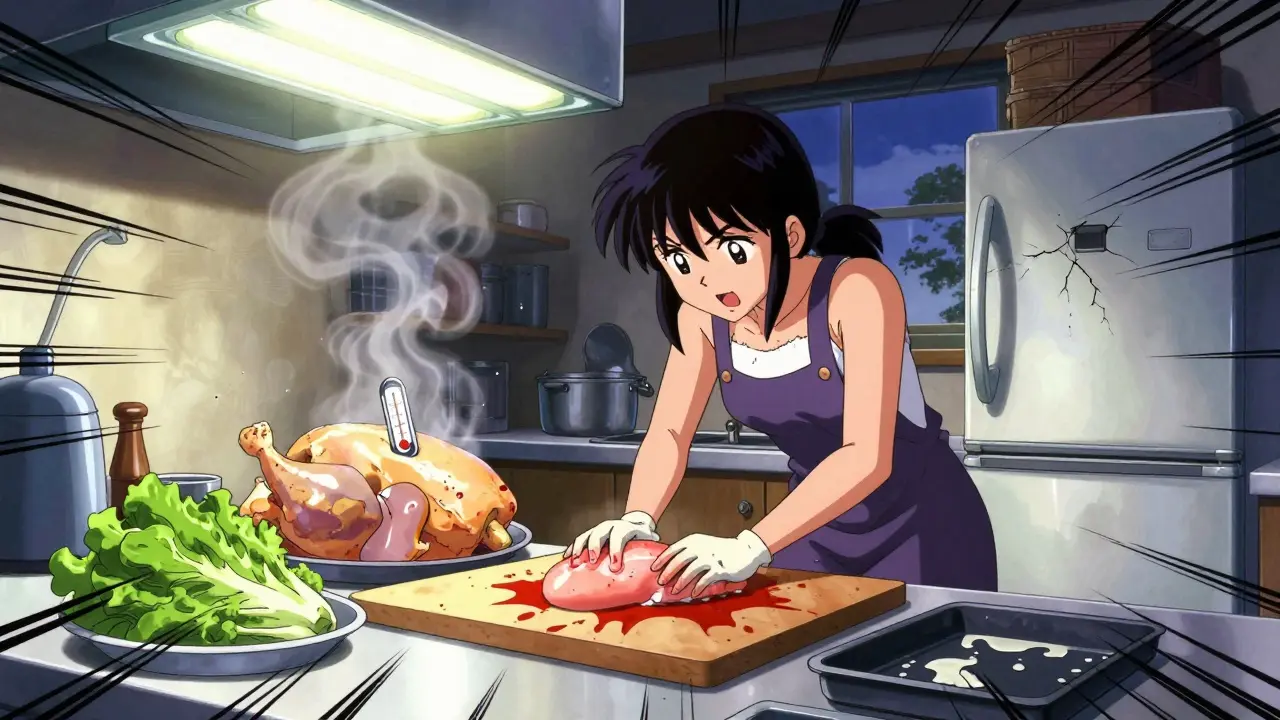
Every year, foodborne illness sends nearly 50 million Americans to the doctor, hospitalizes over 128,000, and kills 3,000. That’s more than the entire population of Nottingham, UK, falling sick just from what they ate. And it’s not just happening in fast food joints or overseas - it’s in your kitchen, your fridge, and that leftover chicken you left out overnight.
What’s Really Making You Sick?
Most people think food poisoning means a bad taco or expired milk. But the real culprits are invisible. Bacteria, viruses, and parasites that grow silently in your food. The CDC tracks the top offenders, and they’re not what you’d expect.Norovirus is the biggest name in illness - responsible for nearly 6 out of every 10 foodborne outbreaks. It spreads fast. One sick cook handling salad can contaminate hundreds of plates. Symptoms hit hard and fast: vomiting, diarrhea, stomach cramps. Most people bounce back in a couple of days, but it’s incredibly contagious. You can spread it even after you feel better - for up to two weeks.
Salmonella is the silent killer. It doesn’t always make you vomit. Sometimes it just gives you a fever and cramps for a week. But it’s behind a third of all hospitalizations from food poisoning. Eggs and undercooked chicken are the usual suspects. In 2022, one in three Salmonella outbreaks traced back to eggs. And it’s not just raw eggs - runny yolks, homemade mayonnaise, cookie dough - all of it carries risk.
Listeria is the quietest and deadliest. It grows in your fridge. Yes, your fridge. Unlike most bacteria, it thrives at cold temperatures. That soft cheese you love? The deli meat you grab for lunch? The smoked salmon on your bagel? All can harbor Listeria. It doesn’t make most people sick, but for pregnant women, the elderly, or anyone with a weak immune system, it’s dangerous. One in five infected pregnant women lose their baby. Listeria causes only 1.5% of foodborne illnesses - but nearly 20% of deaths.
Campylobacter hides in raw chicken. Sixty-six percent of outbreaks link directly to undercooked poultry. It causes bloody diarrhea, fever, and can lead to long-term nerve damage in rare cases. And here’s something you won’t hear in most kitchens: antibiotic resistance in Campylobacter has doubled since 1997. That means the drugs doctors used to treat it are becoming useless.
Escherichia coli O157:H7 is the one that terrifies parents. It’s found in undercooked ground beef, raw milk, and contaminated water. Kids under five are especially vulnerable. One in ten people infected develop hemolytic uremic syndrome - a life-threatening kidney failure. That’s why cooking ground beef to 160°F isn’t optional. It’s survival.
The Danger Zone: Temperature Is Everything
Pathogens don’t just appear out of nowhere. They multiply when conditions are right. The “danger zone” is between 41°F and 135°F. That’s the temperature range where bacteria double every 20 minutes. Leave chicken out at room temperature for two hours? You’ve just created a breeding ground.The FDA Food Code says cold food must stay below 41°F. Hot food must stay above 135°F. But how many people actually check? A USDA study found that nearly half of home cooks judge meat doneness by color - not a thermometer. A pink chicken breast doesn’t mean it’s safe. A brown burger isn’t always cooked through. Only a food thermometer gives you the truth.
Use one. Keep it clean. Wash it after every use. Cook chicken to 165°F, ground beef to 160°F, and steaks to 145°F with a three-minute rest. That rest time matters - it lets heat keep killing bacteria even after you pull it off the grill.
Cross-Contamination: Your Cutting Board Is a Weapon
You wash your hands. You cook your meat. But you’re still at risk - because you’re using the same knife and cutting board for raw chicken and your lettuce.That’s cross-contamination. And it’s one of the most common causes of outbreaks. A study in the Food Control Journal showed color-coded cutting boards reduce cross-contamination by 63%. Use red for raw meat, green for veggies, blue for seafood, and white for dairy. It’s simple. It’s cheap. And it works.
Same goes for your sponge. Don’t use the same one to wipe down counters and clean dishes. Replace it weekly. Or better yet - use paper towels. And never rinse raw chicken under the tap. Splashing spreads bacteria everywhere - your sink, your faucet, your countertops. Just put it straight in the pan.

What You’re Doing Wrong at Home
Most foodborne illness starts at home. Not in restaurants. Not in factories. In your kitchen.Here’s what the data says you’re getting wrong:
- 48% of people judge meat doneness by color - not temperature.
- 37% thaw meat on the counter - letting bacteria grow while the inside stays frozen.
- Only 23% clean their refrigerator drip pans - where Listeria loves to hide.
- 68% of Reddit users who reported food poisoning blamed improper home handling - undercooked chicken, warm fridge, dirty surfaces.
Thaw meat in the fridge. Or in cold water. Never at room temperature. Clean your fridge shelves and drip pans monthly. Wipe them down with hot soapy water. Listeria doesn’t care if you think your fridge is clean - it’s still growing.
Why Food Safety Costs Billions - And Why It Matters
The economic cost of foodborne illness in the U.S. is $15.6 billion a year. That’s medical bills, lost workdays, outbreak investigations, recalls. But the real cost isn’t just money.One Listeria outbreak can cost $15 million. One Norovirus outbreak? $1.8 million. Why the difference? Because Listeria sends people to the hospital - often for weeks. It kills. Norovirus makes people sick for a few days. It’s miserable, but rarely deadly.
And it’s getting worse. Climate change is making food more dangerous. Warmer oceans mean more Vibrio bacteria in shellfish. Heavier rains mean more runoff contaminating leafy greens. The FDA expects a 20-30% increase in foodborne illness from produce by 2050.
At the same time, pathogens are evolving. Antibiotic resistance is climbing. Salmonella now shows multidrug resistance in 23% of cases. That means when you do get sick, the medicine might not work.

What’s Changing - And How You Can Stay Ahead
The good news? Food safety is getting smarter.Whole genome sequencing now lets scientists track outbreaks in days instead of weeks. PulseNet, the CDC’s lab network, can match a sick person’s bacteria to a contaminated product in under four days. That’s how they shut down outbreaks before they spread.
Blockchain and IoT sensors are being tested to track food from farm to table. Imagine knowing exactly which batch of spinach made you sick - and which store sold it - within hours. That’s not science fiction. It’s coming by 2025.
But none of that matters if you don’t change your habits. You can’t wait for the government or the food industry to fix this. You’re the last line of defense.
Here’s what you need to do every single day:
- Wash your hands for 20 seconds - long enough to sing "Happy Birthday" twice.
- Use separate cutting boards for meat and veggies.
- Keep your fridge at or below 41°F. Check it with a thermometer.
- Never thaw meat on the counter.
- Cook meat to the right temperature - always use a thermometer.
- Reheat leftovers to 165°F.
- Throw out food left out more than two hours (or one hour if it’s over 90°F).
- Wash produce even if you’re peeling it - dirt can carry pathogens inside.
When to Worry - And When to Just Rest
Most foodborne illness isn’t life-threatening. You’ll feel awful for a few days. Drink water. Rest. Avoid anti-diarrhea meds unless a doctor says so - they can trap the bacteria in your body.But if you’re pregnant, over 65, have a chronic illness, or your symptoms include:
- High fever (over 101.5°F)
- Bloody diarrhea
- Signs of dehydration (dizziness, dry mouth, no urine for 8 hours)
- Neurological symptoms like blurred vision or muscle weakness
- then go to the doctor. Don’t wait. Listeria and E. coli don’t care if you’re “just a little sick.” They move fast.
Can you get food poisoning from vegetables?
Yes. Leafy greens like spinach and lettuce have caused more E. coli outbreaks than any other food group in recent years. Contamination happens in the field from animal waste, irrigation water, or poor handling. Always wash produce, even if it’s labeled "pre-washed."
Is it safe to eat rare steak?
Yes - if it’s a whole cut of beef like a steak or roast. Bacteria live on the surface, and searing kills them. But ground beef is different. Grinding spreads surface bacteria throughout the meat. Ground beef must be cooked to 160°F - no exceptions.
How long can leftovers stay in the fridge?
Three to four days. After that, even if it looks and smells fine, bacteria like Listeria can still be growing. Freeze leftovers if you won’t eat them within 72 hours.
Do I need to wash pre-washed salad?
The CDC says no - if it’s labeled "triple-washed" or "ready-to-eat." Washing it again at home can actually increase contamination risk if your sink or hands aren’t clean. But if you’re immunocompromised, it’s safer to rinse it under running water.
Can you get sick from eating food past its "best by" date?
"Best by" dates are about quality, not safety. Most foods are still safe to eat after that date - unless they’re spoiled. But for perishables like dairy, deli meats, and eggs, don’t take risks. If it smells off, looks strange, or feels slimy - throw it out.
Final Thought: Safety Isn’t Perfect - But It’s Simple
You don’t need a food science degree to avoid food poisoning. You just need to be consistent. Wash your hands. Cook your meat. Keep your fridge cold. Separate your cutting boards. And when in doubt - throw it out.Food safety isn’t about fear. It’s about control. You can’t control where your food comes from. But you can control what happens in your kitchen. And that’s the only thing that matters when it comes to keeping your family safe.
Kelly McRainey Moore
January 22, 2026 AT 06:02Yikes. I just realized I’ve been thawing chicken on the counter for years. 😅 Time to get a dedicated container for the fridge. Thanks for the wake-up call.
Amber Lane
January 24, 2026 AT 00:39Washed my greens again anyway. Better safe than sorry.
Ashok Sakra
January 24, 2026 AT 13:53THIS IS WHY AMERICA IS FALLING APART. NO ONE CARES ABOUT SAFETY ANYMORE. I ATE RAW EGG NOODLES AND I’M STILL ALIVE. YOU’RE ALL PANICKING FOR NO REASON.
michelle Brownsea
January 25, 2026 AT 13:36Let’s be perfectly clear: the notion that ‘color indicates doneness’ is not merely irresponsible-it’s a catastrophic failure of basic culinary literacy. The CDC isn’t exaggerating; they’re understating. And yet, we continue to treat food safety like a suggestion, not a survival protocol. We’ve normalized negligence. And now, we’re paying the price-in hospital bills, in grief, in lives.
It’s not about fear. It’s about discipline. It’s about respecting the invisible organisms that have outlived civilizations. Your thermometer isn’t optional. Your cutting board isn’t decorative. And your fridge? It’s not a magic box-it’s a breeding ground if you ignore the rules.
And don’t even get me started on ‘best by’ dates. Labels are not laws. Spoilage is not a suggestion. If it smells wrong, feels wrong, or looks like it’s trying to escape the container-discard it. Immediately. No exceptions. No ‘but it’s just a little off.’
We’ve outsourced responsibility to corporations, to regulators, to ‘experts.’ But the last line of defense? It’s you. Right now. In your kitchen. With your hands. With your thermometer. With your will to live.
So stop being cute. Stop being casual. Stop pretending you’re too busy to wash your sponge. This isn’t a lifestyle choice. It’s a biological imperative.
lokesh prasanth
January 26, 2026 AT 06:12u think ur smart but u just scare people. i eat raw meat all time. no prob.
Yuri Hyuga
January 28, 2026 AT 02:25Food safety isn’t just about rules-it’s about respect. 🙏 Respect for the food, for the microbes, for your family. I’ve started using color-coded boards, checking my fridge temp daily, and I even label my leftovers now. Small habits. Big impact. You’ve got this! 💪
Coral Bosley
January 29, 2026 AT 14:00I used to think I was immune-until I got sick for three weeks after eating ‘just a little undercooked’ chicken. My body still remembers. I don’t take chances anymore. Not even a little.
Kevin Narvaes
January 30, 2026 AT 21:45so i got sick after that taco truck thing and i thought it was the salsa but turns out it was the chicken i left out for 3 hours. oops. lesson learned. now i have a thermometer and i dont trust my eyes anymore.
Dee Monroe
January 31, 2026 AT 00:02You know, I used to think food safety was just about avoiding bad restaurants or exotic dishes. But this post? It flipped everything. It’s not about where the food comes from-it’s about what happens between the grocery bag and the plate. Every single day, we’re making tiny choices that either protect us or endanger us. And most of us don’t even realize we’re playing Russian roulette with our guts.
It’s not about being perfect. It’s about being consistent. Washing hands for 20 seconds? That’s not hygiene-that’s self-respect. Using a thermometer? That’s not paranoia-that’s responsibility. Throwing out leftovers after four days? That’s not waste-that’s wisdom.
And honestly? I think we’ve forgotten how to be careful. We’re rushed. We’re distracted. We think ‘I’ve always done it this way’ is enough. But bacteria don’t care about your routine. They don’t care about your taste buds. They just multiply. And they don’t ask permission.
So I started keeping a little checklist taped to my fridge. Wash hands. Separate boards. Check temp. Chill fast. Throw out when unsure. It’s not hard. It’s just… new. And honestly? It’s made me feel more in control than I have in years.
Food isn’t just fuel. It’s trust. And we owe it to ourselves to earn that trust, every single time.
Alex Carletti Gouvea
February 1, 2026 AT 01:49Why are we letting the government tell us how to cook? In my day, people just ate and didn’t whine. This is why America’s weak.
Philip Williams
February 2, 2026 AT 01:16Could you clarify the source of the 68% Reddit statistic? I’m curious about the sample size and methodology.
Ben McKibbin
February 2, 2026 AT 20:32Some of this felt like a horror story-until I realized it’s just Tuesday in most kitchens. I used to think my grandma’s way was ‘traditional.’ Turns out, she just got lucky. I’m buying color-coded boards this weekend. And I’m throwing out my 18-month-old sponge. No regrets.
Melanie Pearson
February 4, 2026 AT 14:34Given the systemic failures in food regulation, the onus is not merely on the consumer, but on institutional accountability. The prevalence of antibiotic-resistant strains indicates a failure of agricultural policy, not personal negligence. To frame this as a behavioral issue is to absolve the corporations that profit from unsafe practices.
Jerry Rodrigues
February 5, 2026 AT 20:50Threw out my old sponge today. Felt weird. Like I just ended a bad relationship.