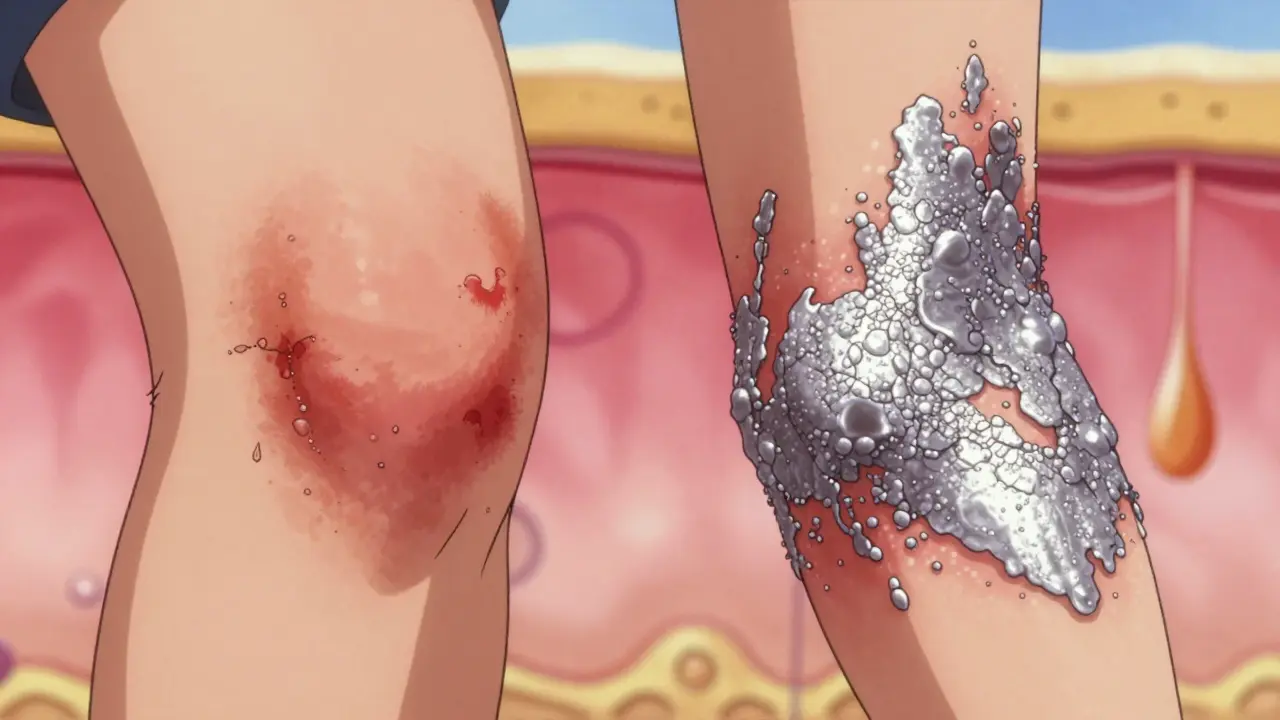
When your skin breaks out in red, itchy patches, it’s easy to assume it’s just eczema. But what if it’s psoriasis? The two conditions look similar at first glance - both cause flaky, irritated skin - but they’re fundamentally different. And mistaking one for the other can mean using the wrong treatment, wasting time, and making symptoms worse. The key isn’t just how it feels - it’s how it looks.
Where the Rash Shows Up Tells You Everything
The first thing to check is location. Eczema loves the folds. You’ll find it behind the knees, inside the elbows, on the neck, wrists, and ankles. In babies, it often shows up on the cheeks and scalp. This isn’t random - eczema flares where skin rubs against skin or where moisture gets trapped. It’s like your body’s weak spots are lighting up. Psoriasis, on the other hand, prefers the outside. Think elbows, knees, scalp, lower back, and even nails. It doesn’t hide in creases - it stands out on the bumps and edges. If you see thick patches on the outside of your knee or a scaly patch on your scalp that won’t brush off, it’s more likely psoriasis. A 2020 study of over 1,200 patients showed that 94% of eczema cases were in flexural areas, while 89% of psoriasis cases were on extensor surfaces. That’s not a coincidence - it’s a diagnostic clue.What the Rash Actually Looks Like
Eczema tends to look messy. The borders are fuzzy, not sharp. The skin is often red on lighter tones, but on darker skin, it turns ashen, purple, or gray. It doesn’t sit on top of the skin - it sinks in. You might see weeping, crusting, or oozing, especially after scratching. In chronic cases, the skin gets thick and leathery - a condition called lichenification. It’s not shiny. It’s dry, cracked, and raw. Psoriasis is the opposite. It’s raised, well-defined, and stubborn. The plaques look like they’ve been stamped on. They’re covered in thick, silvery-white scales that cling tightly. When you scrape them off, you might see tiny spots of blood - that’s the Auspitz sign, a hallmark of psoriasis that doesn’t happen with eczema. The scales are much thicker too: about 0.5mm on average, compared to just 0.1mm in eczema. A 2023 study found 78% of psoriasis lesions had visible scaling, while only 32% of eczema cases did.Nails and Skin Texture: The Hidden Clues
Psoriasis doesn’t stop at the skin. It hits the nails hard. Half of people with psoriasis get pitting - tiny dents like pinpricks - in their fingernails or toenails. Many also experience onycholysis, where the nail lifts away from the bed. You won’t see this with eczema. Only 5-10% of eczema patients get mild ridges or discoloration, but never true pitting. Texture matters too. Eczema skin can be wet, sticky, even weeping in flare-ups. Psoriasis stays dry. It doesn’t ooze. It flakes. And if you get a cut, scrape, or burn? If new patches show up right where the injury happened, that’s the Koebner phenomenon - common in psoriasis (25-30% of cases), rare in eczema.
How It Looks on Darker Skin
This is where things get tricky - and why so many people get misdiagnosed. Most medical images show eczema and psoriasis on light skin. But 75% of the world has skin tones beyond Fitzpatrick I-III. On darker skin, eczema doesn’t look bright red. It looks darker - brown, gray, or purple - with subtle scaling. It blends in. Psoriasis doesn’t look fiery red either. It appears violet, deep brown, or ashen, with silvery scales still visible on top. The scales might be finer, but they’re there. A 2021 study in JAMA Dermatology found misdiagnosis rates for both conditions were 35% higher in patients with darker skin. Why? Because doctors were taught to look for redness - and that’s not always the sign. A 2023 survey of 500 dermatologists showed 68% felt unprepared to diagnose these conditions on skin of color. That’s why patients of color wait an average of 14 months for a correct diagnosis - nearly three times longer than white patients.What Patients Actually Say
Real people describe these conditions differently. On Reddit’s r/eczema, 87% of users say their skin looks “raw,” “weepy,” or “cracked open.” On r/psoriasis, 89% describe their patches as “armor-like,” “silvery,” or “thick as scales.” One user wrote: “Eczema feels like my skin is burning. Psoriasis feels like my skin is wearing a coat of plaster.” A 2022 study in Dermatology and Therapy found psoriasis patients were over three times more likely to say their rash looked “immediately recognizable” - not just to them, but to others. Eczema? More likely to be dismissed as “just dry skin.” That’s the visual gap - psoriasis shouts. Eczema whispers.How to Check at Home - Without a Doctor
You don’t need a microscope to spot the difference. Try this simple test: gently scrape a patch with a clean glass slide or credit card edge. If it flakes into thick, silvery layers - and you see pinpoint bleeding underneath - it’s psoriasis. If it peels lightly, without bleeding, and the skin underneath looks moist or raw, it’s eczema. Also, track the pattern. Eczema changes fast. One day it’s red and itchy, the next it’s dry and flaky - it flares with stress, soap, weather, or sweat. Psoriasis is more stable. Once a plaque forms, it stays for weeks or months unless treated. If your rash comes and goes with triggers, it’s likely eczema. If it sticks around like a stubborn stain, it’s probably psoriasis.
What About AI and Apps?
There are now smartphone apps and AI tools that claim to tell eczema from psoriasis. The FDA approved one in January 2024 - DermAI Psoriasis/Eczema Classifier - trained on 250,000 verified images. It’s 85% accurate on average. But here’s the catch: it’s 22% less accurate on darker skin tones. Why? Because the training data was mostly light-skinned patients. Multispectral imaging - which analyzes how skin reflects light at different wavelengths - can now tell the difference with 92.7% accuracy. But you won’t find that in your phone. These tools are still for clinics and research. Don’t rely on apps. Use them as a starting point, not a diagnosis.When to See a Dermatologist
If you’ve had a rash for more than two weeks, or if it’s spreading, painful, or affecting your sleep or confidence, see a dermatologist. Don’t wait. Eczema can lead to infections from scratching. Psoriasis can be linked to arthritis, heart disease, or depression. Early treatment changes outcomes. Bring photos. Take pictures under natural light, same time of day, same angle. Show how it changes over weeks. Tell your doctor what triggers it - stress? Laundry detergent? Cold weather? That’s more helpful than you think.Final Thought: It’s Not Just About Looks
Eczema and psoriasis aren’t just skin-deep. They’re immune system stories. Eczema is often tied to allergies and asthma. Psoriasis is autoimmune - your body attacks itself. That’s why treatments differ. Eczema responds to moisturizers and anti-inflammatories. Psoriasis needs targeted biologics or light therapy. But you can’t start treatment until you know what you’re treating. And knowing what you’re treating starts with looking closely - at the shape, the scale, the location, the color. Because the skin doesn’t lie. It just needs someone who knows how to read it.Can eczema turn into psoriasis?
No, eczema cannot turn into psoriasis. They are two separate conditions with different causes. Eczema is triggered by environmental irritants and immune overreactions to outside factors, while psoriasis is an autoimmune disorder where the body speeds up skin cell production. One doesn’t evolve into the other. But it’s possible to have both at the same time - though that’s rare.
Is psoriasis always scaly?
Plaque psoriasis - the most common form - is always scaly. But other types aren’t. Inverse psoriasis appears in skin folds and looks smooth and shiny, without thick scales. Guttate psoriasis shows up as small, drop-like spots that may have light scaling. Pustular psoriasis has pus-filled bumps. So while scaling is common, it’s not universal. But if you see thick, silvery scales on raised patches, it’s almost always plaque psoriasis.
Why does my rash look different from pictures online?
Most online images show eczema and psoriasis on light skin. But on darker skin, eczema appears as gray, purple, or brown patches - not red. Psoriasis looks violet or ashen with fine white scales, not bright red with thick silver flakes. If your rash doesn’t match those classic photos, that’s normal. The problem is that medical training still relies heavily on outdated images. Your skin tone matters - and you’re not wrong for looking different.
Can stress cause both eczema and psoriasis?
Yes, stress can trigger flares in both. But the way it triggers them is different. In eczema, stress weakens the skin barrier, letting irritants in. In psoriasis, stress activates immune cells that speed up skin cell growth. So while stress makes both worse, the biological path is different. That’s why calming your mind helps both - but doesn’t cure either.
Is it safe to use steroid creams for both?
Topical steroids can help both conditions short-term, but they’re not equally safe. For eczema, they’re often part of standard care. For psoriasis, long-term steroid use on thick plaques can cause thinning skin or rebound flares. Doctors usually avoid strong steroids on the face, groin, or for long periods with psoriasis. Always follow your doctor’s guidance - don’t self-prescribe.
Can I tell the difference just by touching the skin?
Touch gives clues, but not enough. Eczema often feels warm, damp, or cracked. Psoriasis feels firmer, raised, and drier. But you can’t feel the scale thickness or the Auspitz sign without scraping. And on darker skin, texture differences are harder to detect. Visual inspection - especially looking at borders and color - is more reliable than touch alone.
Does psoriasis itch as much as eczema?
Eczema usually itches more intensely - often before the rash even appears. Psoriasis can itch, but it often feels more like a burning or stinging sensation. Some people with psoriasis don’t itch at all. The itch in eczema is driven by inflammation and nerve sensitivity. In psoriasis, the itch comes from immune signals, not as directly. So if you’re scratching nonstop, it’s more likely eczema.
Are there any home remedies that work for both?
Moisturizing daily is the only home remedy that helps both. Use fragrance-free ointments like petroleum jelly or ceramide creams. Oatmeal baths can soothe itch for both. Avoid harsh soaps and hot showers. But beyond that, treatments diverge. Eczema needs barrier repair. Psoriasis needs scale removal and immune control. Don’t assume one solution fits both.
Mandy Kowitz
January 4, 2026 AT 13:09Michael Rudge
January 4, 2026 AT 16:03Vicki Yuan
January 5, 2026 AT 14:43Jennifer Glass
January 6, 2026 AT 21:57Joseph Snow
January 6, 2026 AT 23:40John Ross
January 7, 2026 AT 17:39jigisha Patel
January 8, 2026 AT 13:16Jack Wernet
January 9, 2026 AT 03:43Charlotte N
January 10, 2026 AT 20:21Catherine HARDY
January 11, 2026 AT 19:55bob bob
January 12, 2026 AT 03:40Uzoamaka Nwankpa
January 13, 2026 AT 15:01Oluwapelumi Yakubu
January 14, 2026 AT 05:35Terri Gladden
January 15, 2026 AT 09:17Enrique González
January 16, 2026 AT 15:23