Carrying prescription medications across international borders isn’t just about packing your pills. If your meds contain controlled substances-like opioids, stimulants, or benzodiazepines-you could face detention, fines, or even jail if you don’t have the right paperwork. This isn’t a rare scenario. In 2022, the International Narcotics Control Board documented 127 cases where travelers were detained simply because their medical letter was missing key details or didn’t match their medication labels. You’re not breaking the law. But if your doctor’s letter doesn’t meet international standards, you’ll be treated like a smuggler.
Why You Need a Doctor’s Letter at All
Every country that’s signed the 1961 Single Convention on Narcotic Drugs or the 1971 Convention on Psychotropic Substances has the right to control who brings in certain drugs. That includes 186 countries worldwide. The rules exist to stop drug trafficking. But they also trap legitimate patients. A doctor’s letter is your legal shield. It proves you’re not carrying these substances for recreation or resale-you’re carrying them because you have a diagnosed medical condition and need them to function.Without it, even a 30-day supply of your ADHD medication or painkiller can be flagged as illegal. In Japan, Adderall is banned outright-even with a letter. In Singapore, carrying more than 30 days’ worth can land you in prison. The letter isn’t optional. It’s your only way to avoid disaster.
What Goes Into a Valid Doctor’s Letter
A generic note from your doctor won’t cut it. The letter must include specific, non-negotiable details. The CDC’s 2023 template spells this out clearly. Here’s what every letter needs:- Your full legal name and date of birth (exactly as it appears on your passport)
- The prescribing physician’s full name, license number, title, clinic address, and phone number
- The generic name of each medication (not the brand name-brand names vary by country)
- The exact dosage, frequency, and route (e.g., 20 mg tablet, once daily, oral)
- The medical condition being treated (e.g., “Attention Deficit Hyperactivity Disorder,” “Chronic Neuropathic Pain”)
- A clear statement: “This patient is under my care and requires this medication for legitimate medical purposes.”
- The physician’s handwritten signature and official letterhead
And here’s what trips people up: the DEA requires additional language for Schedule II drugs (like oxycodone, Adderall, or fentanyl patches). The letter must explicitly state that the medication is a controlled substance under U.S. law. Many doctors skip this. Then travelers get stopped at customs.
Quantity Limits and Packaging Rules
You can’t just pack a six-month supply. Most countries accept a maximum of 90 days’ worth for personal use. The FDA and U.S. Customs and Border Protection (CBP) both enforce this rule. Some countries, like Malaysia and Singapore, cap it at 30 days-even with perfect documentation.Your pills must be in their original, labeled containers. That means the pharmacy label with your name, the drug name, dosage, and prescriber info must be visible. If you use a pill organizer, you’re allowed-but only if you carry the original bottles and the doctor’s letter together. CBP says this is non-negotiable.
For Schedule II-V drugs, you also need your original prescription. That’s not optional. The DEA requires it. So if your doctor gives you a letter but you left your prescription at home, you’re not compliant.
Country-by-Country Differences Matter
Not all countries treat doctor’s letters the same. Assuming one rule applies everywhere will get you in trouble.- Japan: Adderall, Ritalin, and most stimulants are banned. Even with a letter, you can’t bring them in. Alternatives like Lisdexamfetamine may be allowed-but only if approved in advance by Japan’s Ministry of Health.
- United Arab Emirates: You need pre-approval from the Ministry of Health before you even fly. Apply at least 30 days ahead. No exceptions.
- European Union: Most countries accept letters from other EU members. No translation needed if the letter is in English or the local language. Up to 90 days’ supply is standard.
- Canada: Accepts doctor’s letters alone for personal quantities under 100 dosage units. No prescription needed if the letter is complete.
- United States: Requires both letter and original prescription for all controlled substances. No exceptions.
- Singapore and Malaysia: Criminal penalties for exceeding 30 days’ supply-even with perfect documentation. Stick to 30 days or less.
Check the U.S. Department of State’s travel advisories or contact the embassy of your destination country directly. Don’t rely on travel blogs or forums. In 2022, 58% of travelers used incorrect info-and got caught.
Language and Translation Requirements
If your doctor’s letter is in English, that’s fine for most countries. But if your destination country doesn’t use English, you’ll need a certified translation. The FDA requires this for all documents submitted at ports of entry. A Google Translate printout won’t work. You need a professional translator’s stamp and signature. Some embassies will provide translation services or list approved translators on their websites.Pro tip: If you’re going to a non-English-speaking country, ask your doctor to write the letter in both English and the local language. Many international clinics now offer this as a standard service.
What to Do Before You Book Your Flight
Don’t wait until the day before you leave. Start at least two months ahead. Here’s your checklist:- Make a full list of all your medications, including generic names and dosages.
- Call your doctor’s office. Ask them to prepare a letter using the CDC’s 2023 template. Stress that it must include the generic name and controlled substance status.
- Confirm with your pharmacy that your pills are in original containers with labels.
- Check the official government website of your destination country for medication rules. Look for “controlled substances,” “traveling with medication,” or “pharmaceutical import regulations.”
- If you’re unsure, email the embassy. Most have a health or consular affairs department that responds within 3-5 business days.
- Carry two copies of your letter and prescription-one in your carry-on, one in your checked luggage.
According to the International Association for Medical Assistance to Travellers, 72% of physicians don’t include the chemical names of active ingredients. That’s a problem. If your medication is listed as “Adderall” but the country knows it as “dextroamphetamine-amphetamine,” you’re at risk. Ask your doctor to include the chemical name in parentheses: e.g., “Adderall (dextroamphetamine-amphetamine).”
What Happens If You Get Stopped
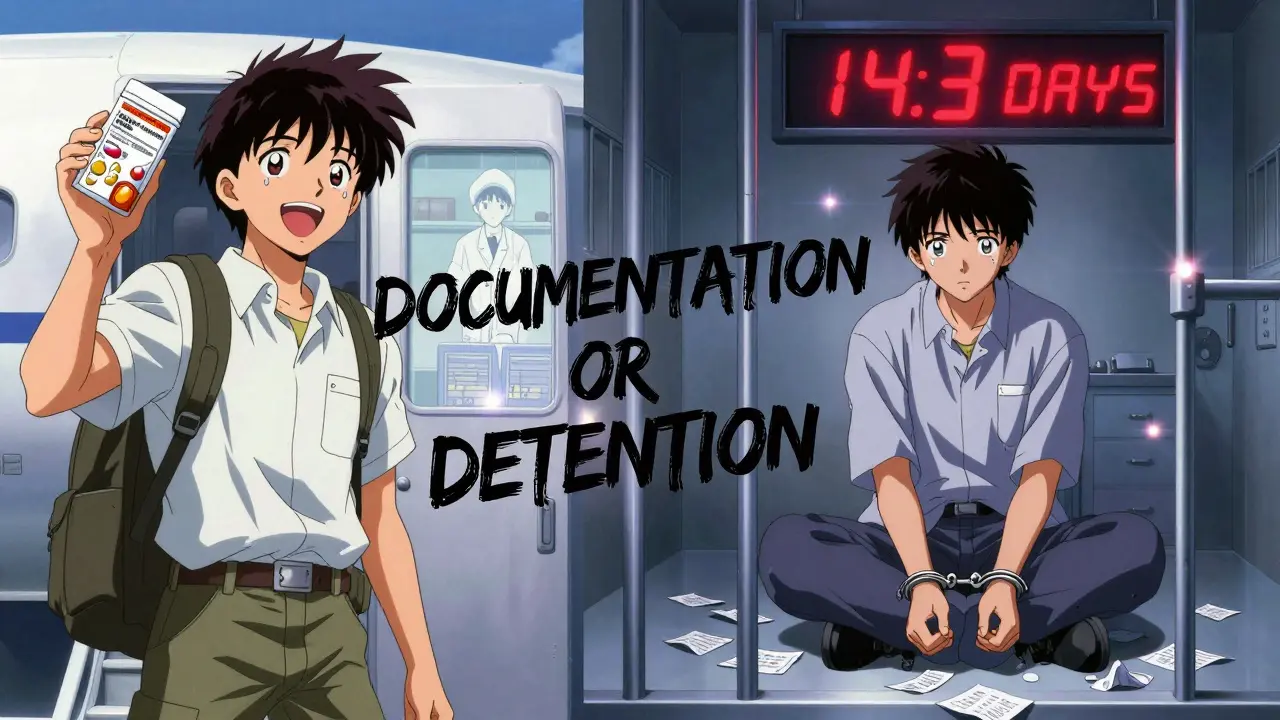
If customs officers question your meds, stay calm. Don’t argue. Don’t lie. Hand them your letter and prescription immediately. Say: “I have a doctor’s letter and prescription for these medications, which are legally prescribed for my medical condition.”Detention isn’t rare. The average detention period for medication-related issues is 14.3 days, according to the INCB. That’s two weeks lost, missed flights, legal fees, and stress. Don’t let it happen to you.
Some travelers try to hide meds in their luggage. Don’t. Border agents have scanners and drug-sniffing dogs. They’ll find it. And if they find it without documentation, the consequences are far worse.
What’s Changing in 2026
The INCB is rolling out a pilot digital medical certificate in 12 European countries. This is a secure, verifiable electronic document that links to your health record. It’s not available globally yet, but by 2025, 41 countries have pledged to adopt it. The European Commission is funding a €2.4 million project to create a unified EU-wide system, launching in late 2024.For now, paper is still king. But if you’re traveling to Europe often, ask your doctor if they can issue the letter in digital format. Some clinics already can.
Also, telemedicine prescriptions are now accepted by the FDA and CBP-if they meet the same standards. So if you got your prescription via Zoom, make sure the letter from your provider includes the same details: name, dosage, condition, and controlled substance status.
Final Reality Check
This isn’t bureaucracy for the sake of it. It’s a system designed to protect public health. But it’s also a trap for the unprepared. The CDC says 68% of medication-related travel incidents happen because people didn’t carry proper documentation. That’s not luck. That’s avoidable.If you take controlled substances, your travel plan isn’t just about flights and hotels. It’s about paperwork. It’s about knowing the rules. It’s about making sure your doctor writes the right letter.
Don’t gamble with your freedom. Get the letter. Check the country rules. Pack the originals. You’ve done everything right to manage your health. Don’t let a missing signature ruin your trip.
Do I need a doctor’s letter for over-the-counter meds?
No. Over-the-counter medications like ibuprofen, antihistamines, or acid reflux pills don’t require a doctor’s letter. The rules only apply to substances listed in international drug control treaties-mostly prescription-controlled drugs like opioids, stimulants, benzodiazepines, and certain sleep aids. But if you’re carrying large quantities (more than 100 tablets), customs might still ask questions. Keep the original packaging just in case.
Can I send my medication ahead by mail?
Almost never. Most countries prohibit mailing controlled substances, even with a letter. The only exceptions are for registered medical shipments between licensed pharmacies. Don’t rely on shipping your pills. Always carry them with you in your luggage, with full documentation.
What if my doctor won’t write the letter?
Many doctors don’t know the requirements. If your doctor refuses, ask to speak with the office manager or a nurse practitioner. You can also visit a travel medicine clinic-they specialize in this. The CDC’s website has free templates you can print and bring to your doctor. Many physicians will sign them once they see the official format.
Do I need a letter for insulin or other non-controlled drugs?
No, insulin and other non-controlled medications like blood pressure pills or thyroid hormones don’t require a doctor’s letter. But it’s still smart to carry a copy of your prescription or a note from your doctor. If you’re questioned at customs, having documentation speeds things up. Some countries also require a letter for large quantities of non-controlled drugs-like carrying 12 months’ worth of insulin. When in doubt, bring it.
Is a letter from my pharmacy enough?
No. A pharmacy printout with your name and dosage isn’t sufficient. Only a letter signed by your prescribing physician on official letterhead meets international standards. Pharmacies don’t have the legal authority to certify medical necessity. Customs officers will reject it.
Matt Beck
January 6, 2026 AT 21:19Just got back from Tokyo and let me tell you… I had to leave my Adderall at the border 😭. No letter? No problem. No pills? BIG problem. My psychiatrist didn’t even know about the ‘controlled substance under U.S. law’ line. I cried in the customs lounge. Now I carry two copies, a notarized translation, and a backup USB with the CDC template. 🙏
Molly McLane
January 8, 2026 AT 05:31For anyone panicking about this-don’t. It’s not that hard. I’m a nurse and I’ve helped 12 patients prep for international trips with controlled meds. The key? Call your doctor’s office 3 months out. Ask for the CDC template. If they say ‘no,’ ask for the office manager. Most clinics have a template now. And yes, the handwritten signature matters. Don’t skip it. You’re not a criminal-you’re a patient who’s doing it right. 💪
Tiffany Adjei - Opong
January 8, 2026 AT 16:05Okay but let’s be real-this whole system is a joke. Why does my ADHD medication get treated like cocaine? I’m not selling it, I’m taking it to function. Meanwhile, people fly with 10 bottles of melatonin and no one bats an eye. The real problem isn’t me-it’s the outdated, fear-driven bureaucracy that treats patients like criminals. Also, Japan banning Adderall? That’s not health policy, that’s cultural xenophobia with a side of control. 🤷♀️
Ryan Barr
January 8, 2026 AT 21:15Letter. Original bottle. Prescription. Non-negotiable.
Everything else is noise.
Cam Jane
January 9, 2026 AT 06:50Y’all, I just got back from Singapore with my oxycodone and I’m alive to tell the tale! Here’s what worked: I printed the CDC template, had my doctor sign it, added the ‘Schedule II’ line, and brought the original Rx + pill bottles. I also carried a printed email from the Singapore Ministry of Health confirming my meds were allowed under 30 days. I showed them everything at once-no waiting to be asked. They nodded, stamped it, and said ‘Have a nice trip.’ No drama. No stress. Just prep. You got this. 💯
Wesley Pereira
January 11, 2026 AT 02:12So let me get this straight-we’re now requiring doctors to write letters that are basically legal affidavits… because the DEA is scared of people bringing their own meds? 😂 Also, ‘original containers’? Bro, I’ve been using pill organizers since 2018. I don’t carry 30 little bottles. And now I need a notarized translation of ‘Lorazepam 1mg po qhs’? Who wrote this? The TSA? The UN? The FDA? The WHO? The UNICEF? Someone please tell me who’s actually in charge here.
Lily Lilyy
January 11, 2026 AT 15:29This is so important. I’m from India and I’ve seen friends get detained for having their epilepsy meds. Please, if you take any controlled substance-don’t wait. Start now. Call your doctor. Print the CDC template. Bring two copies. Carry your prescription. Be kind to customs officers-they’re just doing their job. You’re not asking for special treatment. You’re asking for dignity. And you deserve it. 🌍❤️
Susan Arlene
January 12, 2026 AT 14:28paper is king
but also a pain in the ass
Joann Absi
January 14, 2026 AT 07:23AMERICA IS THE ONLY COUNTRY THAT THINKS ITS DOCTORS ARE GODS WHO CAN WRITE ANYTHING AND THE WORLD HAS TO OBEY 😤
Japan bans Adderall? GOOD. Maybe we should ban ALL American meds until we fix our opioid crisis. Why should the world bend over for US pharmaceutical greed? 🇺🇸💀
Jeane Hendrix
January 15, 2026 AT 20:57Wait-so if my doctor writes ‘Adderall (dextroamphetamine-amphetamine)’ on the letter, does that satisfy both the generic name AND the controlled substance requirement? Or do I need two separate lines? I’m confused. My doctor says ‘it’s all in the letter’ but I’m scared they missed something. Can someone who’s been through this confirm?
Gabrielle Panchev
January 17, 2026 AT 15:43Okay, but let’s talk about the real issue here: why are we still using paper? Why isn’t there a global digital registry? Why do we have to rely on doctors who don’t even know what Schedule II means? Why is the CDC template the only thing keeping people out of jail? This isn’t health policy-it’s a bureaucratic dumpster fire held together by duct tape and hope. And now they’re launching a pilot in 12 EU countries? That’s not progress-that’s a Band-Aid on a hemorrhage. We need a global, blockchain-based, AI-verified medical passport. Not a signed piece of paper. Not a stamp. Not a translation. A system. Please. I’m begging you.
Katelyn Slack
January 18, 2026 AT 20:38just got back from germany and they didnt even ask for my letter 😅 i had it ready just in case but they just looked at the bottle and waved me through. maybe its not as bad as they say? or maybe i got lucky? idk. but i brought my prescription and the original bottle so… maybe that’s enough? 🤔
Melanie Clark
January 19, 2026 AT 19:02They’re lying. This isn’t about safety. It’s about control. The government doesn’t want you to have access to these meds abroad because they’re scared you’ll get addicted. Or worse-they’re scared you’ll realize how many of these drugs are overprescribed at home. They want you to suffer. They want you to be dependent on the system. The letter? The prescription? The bottle? It’s all a trap to make you feel guilty for needing help. Don’t fall for it.
Harshit Kansal
January 21, 2026 AT 04:14I’m from India and I carry my epilepsy meds to Dubai every year. No letter needed. Just the original bottle and the prescription. They ask, I show. Done. But I’ve heard stories of Americans getting detained for having 20 tablets of lorazepam. I think it’s about perception. In the West, they assume you’re a drug dealer. In India, they assume you’re a patient. Different worlds.
Venkataramanan Viswanathan
January 21, 2026 AT 20:38As a physician who has practiced in both India and the U.S., I can confirm: the CDC template is accurate and necessary. However, many doctors in the U.S. are not trained in international travel medicine. This is a systemic gap. I now require all patients traveling abroad with controlled substances to attend a 15-minute consultation. I print the letter, sign it, and include the chemical name in parentheses. I also provide a one-page summary in English and Hindi. It takes 10 minutes. It saves lives. Please, if you’re a doctor-do this. If you’re a patient-ask for it. It’s not bureaucracy. It’s care.