
DOAC Dosing Calculator for Obesity
This tool helps determine the safest DOAC (direct oral anticoagulant) for patients with obesity based on clinical evidence. Enter your height and weight to see personalized recommendations.
When you’re obese, taking a blood thinner isn’t as simple as picking a pill and swallowing it. For years, doctors weren’t sure if standard doses of DOACs - the newer blood thinners like apixaban, rivaroxaban, dabigatran, and edoxaban - worked safely in people with high body weight. The clinical trials that approved these drugs barely included anyone with a BMI over 40 or weighing more than 120 kg. That left a huge gap: millions of people with obesity needed anticoagulation, but no clear rules existed.
Why Obesity Makes Blood Thinners Tricky
Obesity changes how your body absorbs, distributes, and clears drugs. More fat means more volume for the drug to spread into. Your liver and kidneys might process it differently. Your blood flow patterns shift. All of this raises a simple but critical question: Does the same dose work the same way in a person who weighs 250 pounds as it does in someone who weighs 150? For warfarin, the answer was always yes - but with a catch. You had to get your INR checked every few weeks, adjust the dose, and watch your diet. DOACs were supposed to fix that. Fixed doses. No monitoring. But what if the fixed dose wasn’t right for you? Early data was mixed. Some studies suggested higher doses might be needed. Others warned of bleeding risks. Then came the real-world evidence - and it changed everything.Apixaban: The Clear Winner in Obesity
If you’re obese and need a blood thinner for atrial fibrillation or a blood clot, apixaban is the safest bet. Multiple large studies - including one tracking over 15,000 patients - show no difference in stroke or bleeding rates between obese and non-obese users when taking the standard dose: 5 mg twice daily (or 2.5 mg twice daily if you’re over 80, weigh under 60 kg, or have kidney issues). A 2022 registry of 2,147 obese patients (BMI ≥35) found that those on apixaban had a major bleeding rate of just 2.1% per year. Even in patients with BMI over 50, no thrombotic events occurred when they stayed on standard apixaban. That’s not luck. That’s data. The International Society on Thrombosis and Haemostasis (ISTH) says it plainly: apixaban can be used at standard doses in patients with morbid obesity (BMI ≥40 or weight >120 kg). No dose adjustments needed. No extra monitoring. Just prescribe it like you would for anyone else.Rivaroxaban: Almost as Good
Rivaroxaban is a close second. For atrial fibrillation, the standard dose is 20 mg once daily (or 15 mg if your kidney function is low). For treating a blood clot, it’s 15 mg twice daily for the first 21 days, then 20 mg once daily. Studies show rivaroxaban works just as well in obese patients. Bleeding rates are similar. No increased risk of clots. The ISTH and European Heart Rhythm Association both give it a strong recommendation for use in obesity. One thing to watch: Rivaroxaban is absorbed in the stomach, and obesity can delay gastric emptying. That’s why it’s always taken with food - especially the 15 mg and 20 mg doses. Skip the meal, and you might not get enough drug into your system.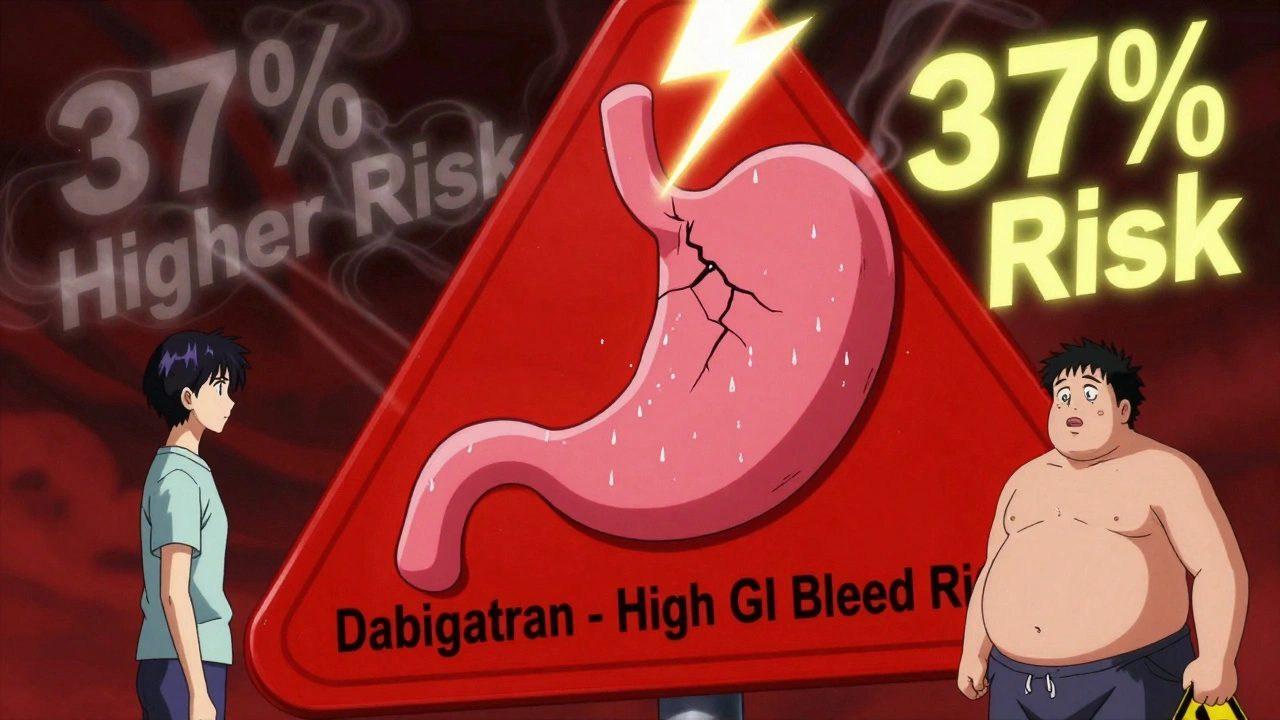
Dabigatran: The Risky Choice
Dabigatran is the outlier. It’s effective at preventing strokes in obese patients - but it comes with a serious trade-off: gastrointestinal bleeding. Data from the ISTH and multiple real-world studies show that patients with BMI over 40 have a 37% higher risk of GI bleeding on dabigatran compared to those with normal weight. In some studies, the risk was more than double. Why? Dabigatran is a large molecule that stays concentrated in the stomach lining. In obese people, this may irritate the gut more. If you have a history of ulcers, GERD, or are on NSAIDs like ibuprofen, dabigatran is a bad idea - especially if you’re overweight. The European Heart Rhythm Association and Anticoagulation Forum both say: use dabigatran with caution in obesity. Many doctors avoid it entirely in patients with BMI over 35.Edoxaban: The Gray Area
Edoxaban is the least studied in obesity. Standard dose is 60 mg once daily (or 30 mg if you’re underweight or have kidney problems). Most studies show edoxaban levels stay stable across BMI ranges. But here’s the catch: in patients with extreme obesity - BMI over 50 or weight over 160 kg - some doctors have seen subtherapeutic anti-Xa levels. That means the drug isn’t working as well as it should. The 2023 ACC/AHA/ACCP/HRS guideline says: consider using the reduced 30 mg dose in patients with BMI over 50. It’s not a firm recommendation. It’s a caution. More data is coming. In the meantime, if you’re on edoxaban and have extreme obesity, your doctor might check your drug levels - especially if you’ve had a clot or bleeding event. Point-of-care testing isn’t widely available yet, but it’s coming.What About Dose Escalation?
You might think: if standard doses work, wouldn’t higher doses work even better? No. And here’s why. The ISTH explicitly says: there is no evidence to support higher than standard dosing of DOACs in obese patients. In fact, giving more than the recommended dose increases bleeding risk without improving protection. One study looked at obese patients on double-dose apixaban (10 mg twice daily). Bleeding rates went up - but clot prevention didn’t improve. That’s not a win. That’s a risk with no benefit. Stick to the guidelines. Don’t guess. Don’t double up. Standard doses are designed to be safe and effective - even for the heaviest patients.
Real-World Outcomes: What Happens in Practice?
In 2014, only 32% of obese patients with atrial fibrillation got a DOAC. By 2022, that number jumped to 78%. Why? Because doctors saw the data. They saw patients on apixaban and rivaroxaban doing fine. No extra bleeding. No extra clots. A 2020 study of nearly 5,000 obese patients found stroke rates were almost identical between those with BMI under 30 and those over 40. Bleeding rates? Also nearly the same. This isn’t theoretical. It’s happening in clinics every day. A 320-pound patient on apixaban 5 mg twice daily - same as a 140-pound person. No lab tests. No adjustments. Just a prescription and a follow-up in three months.What Should You Do?
If you’re obese and need a blood thinner, here’s what to ask your doctor:- Is apixaban or rivaroxaban an option? (Yes, and they’re preferred.)
- Should I avoid dabigatran? (Probably - especially if you have stomach issues.)
- Do I need a special dose? (No, unless your BMI is over 50 - then ask about edoxaban 30 mg.)
- Do I need blood tests? (Not for apixaban or rivaroxaban. Maybe for edoxaban if you’re extremely obese.)
David Ross
December 5, 2025 AT 04:47Let’s be real-this is why American medicine is broken. We have decades of data showing apixaban works fine in obese patients, yet half the docs still panic and default to warfarin because ‘it’s what we’ve always done.’ The guidelines are clear, the studies are massive, and yet we’re still playing Russian roulette with INR checks and dietary restrictions. It’s not just lazy-it’s dangerous. Stop overcomplicating what’s already solved.
Sophia Lyateva
December 5, 2025 AT 23:45wait… so the pharma companies just made these drugs to look good in trials and now everyone’s just supposed to trust them?? what if they’re hiding something?? i heard the FDA gets paid by big pharma and they only approved these because they’re more expensive than warfarin… and what if the bleeding risk is higher but they just don’t report it?? i mean… why would they??
AARON HERNANDEZ ZAVALA
December 7, 2025 AT 05:23I’ve been on apixaban for 3 years now and I’m 280 lbs. No issues. No bleeding. No clots. I used to be terrified of blood thinners because I thought my weight meant I needed more. But my cardiologist just said ‘take the 5mg twice’ and that was it. No labs. No stress. I wish more people knew this was an option. It’s not magic-it’s science. And science says it works.
Melania Dellavega
December 8, 2025 AT 04:48This is one of those rare moments where medicine actually caught up with reality. For so long, we treated obesity like a moral failing instead of a physiological condition. We assumed bigger bodies needed bigger doses-like it was a volume problem, not a pharmacokinetic one. But the data doesn’t care about our biases. It just shows us what works. Apixaban and rivaroxaban don’t care if you weigh 120 or 320. They just do their job. That’s humility in science. And honestly? It’s beautiful.
It makes me wonder how many other treatments we’ve overcomplicated because we assumed ‘more’ meant ‘better.’ Maybe the answer isn’t more drugs-it’s better understanding.
Shawna B
December 9, 2025 AT 12:19so apixaban good dabigatran bad? got it
Jerry Ray
December 11, 2025 AT 05:42Wait, so you’re telling me that a guy who weighs 350 lbs and a guy who weighs 140 lbs get the same pill? That’s ridiculous. If I took the same dose of painkillers as a 120-lb woman, I’d be passed out. Why is this different? There’s no way the drug concentration is the same. This feels like a cost-cutting measure disguised as science.
Nicholas Swiontek
December 12, 2025 AT 21:15YES!!! This is the kind of info I wish my doctor had told me 5 years ago 😭 I was so scared to take anything because I thought my weight made me ‘too risky.’ Apixaban changed my life. No more weekly blood draws. No more worrying about spinach. Just take the pill and live. Thank you for writing this. 💪❤️
Shannon Wright
December 14, 2025 AT 03:59It is profoundly encouraging to observe the evolution of clinical practice in response to robust, real-world evidence. For decades, obesity was treated as a confounding variable to be avoided in clinical trials, rather than a population to be studied with intentionality. The fact that apixaban and rivaroxaban demonstrate comparable efficacy and safety across a wide spectrum of body weights speaks not only to the quality of the pharmacokinetic modeling but also to the courage of clinicians who adopted these guidelines before they were universally endorsed. This is how medicine should progress: data-driven, patient-centered, and free from the inertia of tradition.
That said, we must remain vigilant. While the current evidence is compelling, it is not exhaustive. The DOAC-Obesity trial will provide critical insights into the upper extremes of body mass, where pharmacokinetic variability may still play a role. Until then, we must balance confidence with caution-especially when prescribing edoxaban in patients with BMI exceeding 50.
vanessa parapar
December 14, 2025 AT 14:56Wow, you really fell for the pharmaceutical marketing, didn’t you? Apixaban is expensive, and the ‘no monitoring’ thing is a trap. They want you hooked on a $300/month pill instead of $5 warfarin. And don’t even get me started on how they cherry-picked trials to exclude people with real comorbidities. You think your 280-pound friend is fine? Wait till he gets a GI bleed at 60 and they say ‘oh, it’s just aging.’