When you take a generic pill, you expect it to work just like the brand-name version. But behind that simple tablet or capsule is a high-stakes battle against invisible threats-dust, microbes, chemical residues-that can turn a life-saving medicine into a dangerous one. In generic drug manufacturing, contamination control isn’t just a best practice. It’s the line between a safe product and a public health crisis.
Why Contamination Matters More in Generics
Generic manufacturers don’t have the luxury of brand loyalty or high profit margins. They compete on price, often squeezing every dollar out of production. That pressure makes them vulnerable. A single contamination event can trigger a global recall, wipe out millions in revenue, and destroy trust overnight. The 2020 Valsartan recall is a textbook example. Nitrosamine contaminants slipped into blood pressure meds made by 22 different companies. The fallout? Over $1.2 billion in losses, thousands of patients left without medication, and regulators scrambling to fix systemic gaps. Unlike innovator companies that design drugs from scratch and control every step of the process, generic makers often reuse the same equipment for dozens of different products. One wrong cleaning cycle, one torn glove, one unmonitored air vent-and you’ve got cross-contamination. That’s why contamination controls in generics aren’t optional. They’re survival.What Counts as Adulteration?
The FDA defines a drug as adulterated if it’s made, packed, or stored under unsanitary conditions that could make it harmful. That sounds simple, but the reality is complex. Adulteration isn’t just dirt. It’s chemical residues from previous batches. It’s fungal spores in the air. It’s metal shavings from a worn-out mixer. It’s even human skin flakes or hair if they carry pathogens. The rules are strict. Under 21 CFR 210.3(b)(3), any drug exposed to conditions that could cause contamination is considered unsafe-even if lab tests later show it’s "within limits." That’s because testing alone can’t catch everything. A single batch might pass a test but still be contaminated. That’s why regulators say: prevention beats testing.How Clean Is Clean Enough?
Cleanrooms aren’t just fancy labs with white walls. They’re engineered environments with precise rules. For sterile injectables, the air must meet ISO Class 5 standards: no more than 3,520 particles per cubic meter that are 0.5 microns or larger. That’s about the size of a bacterium. For non-sterile tablets, it’s usually ISO Class 7 or 8. To get there, facilities use:- HEPA filters (99.97% efficient at trapping 0.3-micron particles)
- ULPA filters (99.999% efficient, used in high-risk zones)
- 20 to 60 air changes per hour
- Pressure differentials of 10-15 Pascals between rooms
Manual vs. Real-Time Monitoring
For years, manufacturers relied on manual swabs and cultures. You’d wipe a surface, send it to a lab, wait five to seven days for results. By then, hundreds of pills might already be made-and contaminated. Today, real-time monitoring is changing the game. Devices like the MetOne 3400+ count airborne particles every second. If a spike happens during a batch run, the system alerts operators immediately. A 2022 ISPE study found these systems cut contamination incidents by 63%. Why? Because 78% of contamination events are short-lived. Manual checks miss them entirely. Even cleaning validation is getting faster. ATP bioluminescence tools detect microbial residue in five minutes instead of days. They’re 95% as accurate as traditional cultures. That means you can release a batch faster, with more confidence.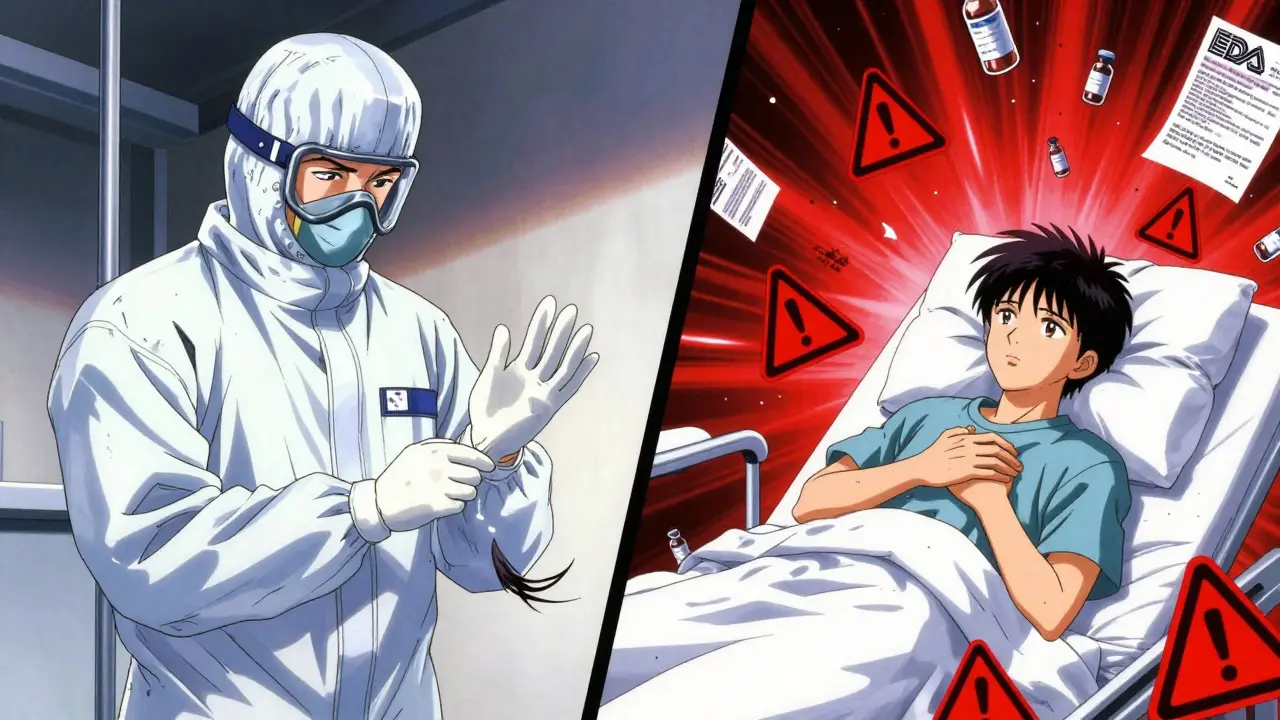
Human Error Is the Biggest Risk
You can have the cleanest room, the best filters, the most advanced sensors-but if a worker forgets to change their gown, or skips a cleaning step, it all falls apart. Dr. Michael Gamlen, a leading industry consultant, says 83% of contamination events trace back to human behavior. That’s not a failure of technology. It’s a failure of process. Common mistakes:- Gowning non-compliance after 8 hours on shift (a 2021 AstraZeneca study showed a 40% drop in compliance)
- Using the same tools for different products without proper cleaning
- Not reporting minor spills or breaches
The Cost of Getting It Right
Contamination control isn’t cheap. A full cleanroom upgrade can cost $80 million for a medium-sized generic manufacturer. Real-time monitoring systems run $15,000 to $25,000 per unit. Training staff on new software like ValGenesis V2 takes 147 hours per user. But the cost of getting it wrong is worse. In 2022, 68% of generic manufacturers reported at least one batch rejection due to contamination. For small companies, one rejection can be fatal. There’s also a big gap between big and small players. Of the top 50 generic manufacturers, 89% use real-time monitoring. Only 37% of smaller facilities do. Why? Upfront costs. A Deloitte analysis found implementation ranges from $500,000 to $2 million. For a small shop, that’s more than their annual profit.What’s Changing in 2025?
The FDA’s new draft guidance, Cross-Contamination Controls for Solid Oral Dosage Forms, is coming into force by 2025. It requires every product to have a Health-Based Exposure Limit (HBEL)-a scientifically calculated maximum safe level of cross-contamination. This isn’t just paperwork. It means manufacturers must now prove, with data, that their cleaning processes can reduce residues to levels below the HBEL. That requires new testing methods, new equipment, and new expertise. The Generic Pharmaceutical Association estimates it’ll cost $1.2 million per facility to comply. Meanwhile, AI is stepping in. Honeywell’s Forge Pharma system uses machine learning to predict contamination risks before they happen. In a Merck pilot, it cut false alarms by 68%. That means fewer shutdowns, less waste, and more trust from regulators.
What Works in the Real World?
Some simple fixes have huge impacts:- Dycem CleanZone mats at entry points reduce foot-borne contamination by 72%, according to a Pfizer generics engineer.
- One batch at a time production reduces cross-contamination by 53%, as shown in a Pharmaceutical Engineering case study.
- Color-coded tools cut mix-ups by 65%.
- Waterless cleaning systems, tested by GSK, cut utility costs by 22% and reduce waste.
What Should You Do?
If you work in generic manufacturing:- Stop relying on end-product testing. It’s not enough-and it’s a violation of CGMP.
- Map your contamination risks using ICH Q9 risk assessment tools. Focus on human factors.
- Start small. Add one real-time sensor. Install Dycem mats. Switch to color-coded equipment.
- Train staff weekly. Don’t wait for an audit to find out they forgot how to gown properly.
- Plan for HBELs. Even if the deadline is 2025, the data collection starts now.
The Bottom Line
Contamination control in generic drug manufacturing isn’t about perfection. It’s about consistency. It’s about knowing where the risks are, and having systems in place to stop them before they start. The stakes are high. The science is clear. And the cost of inaction? Not just financial. It’s human.What is the most common cause of contamination in generic drug manufacturing?
Human error is the leading cause, accounting for 47% of contamination events, according to a 2023 PDA survey. This includes improper gowning, skipped cleaning steps, and failure to report minor breaches. Equipment cleaning failures follow at 29%, and raw material contamination at 18%.
How often are generic drug manufacturers inspected for contamination controls?
The FDA increased inspection frequency by 27% in 2023 for facilities with prior contamination violations. For high-risk facilities, inspections can now occur every 12-18 months, compared to every 3-5 years in the past.
What’s the difference between HEPA and ULPA filters?
HEPA filters capture 99.97% of particles that are 0.3 microns in size. ULPA filters are more efficient, capturing 99.999% of particles as small as 0.12 microns. ULPA is used in high-risk areas like sterile filling lines, but increases energy use by 25-40% due to higher air pressure demands.
Can you test your way out of contamination?
No. The FDA explicitly states that relying on end-product testing for contamination control is a violation of CGMP under 21 CFR 211.110(a). Contamination can be unevenly distributed, so a single tested batch may pass while others are contaminated. Prevention through design and process controls is the only compliant approach.
What are Health-Based Exposure Limits (HBELs), and why do they matter?
HBELs are scientifically calculated maximum allowable levels of cross-contamination between different drugs in shared equipment. They’re based on toxicology data, not arbitrary numbers. By 2025, the FDA requires every generic drug to have an HBEL. This forces manufacturers to prove their cleaning processes are effective enough to reduce residues to safe levels, not just "clean enough to pass a swab test."
Cecelia Alta
January 13, 2026 AT 05:17Okay but let’s be real - if you’re paying $5 for a pill, you’re basically gambling with your life. I had a generic blood pressure med that made me dizzy for a week. Turned out the batch had trace metals. No one told me. The FDA? Too busy chasing pharma CEOs to care about my headaches. This whole system is a pyramid scheme where the bottom gets poisoned so the top gets rich. And don’t even get me started on the ‘color-coded tools’ nonsense - if your workers can’t tell a blue spatula from a red one after 8 hours, maybe they shouldn’t be handling medicine at all.
steve ker
January 15, 2026 AT 01:49George Bridges
January 16, 2026 AT 18:41It’s wild how much goes into something so small. I used to think pills were just powder in a shell. Now I realize it’s like a space mission - one tiny mistake and everything fails. I work in logistics and even I can appreciate how hard it is to keep a room sterile when people are moving in and out every minute. Hats off to the folks who actually do this day in and day out. We take it for granted until something goes wrong.
Faith Wright
January 17, 2026 AT 15:02Oh wow so we’re now policing the sweat of factory workers? Cute. Let’s blame the person in the gown instead of the $2 million facility that can’t afford proper airflow. I’ve seen these plants. The ceilings leak. The floors crack. And they expect a $12/hour employee to be a microbiologist? Meanwhile the CEO’s in Bermuda with a yacht named ‘CleanBatch’. This isn’t about training. It’s about capitalism choosing profit over people. Again.
Audu ikhlas
January 17, 2026 AT 15:19Sonal Guha
January 18, 2026 AT 23:53TiM Vince
January 19, 2026 AT 18:03Just read this whole thing. Honestly? It’s terrifying. I never thought about how a hair or a speck of dust could turn a medicine into poison. I always assumed it was all tested and safe. Now I’m wondering what’s in my own meds. Maybe I’ll start asking my pharmacist where they’re made. Thanks for the eye-opener.
gary ysturiz
January 21, 2026 AT 08:46Small steps matter. Start with color-coded tools. Install those mats. Train your team once a week. You don’t need a $2 million upgrade to save lives. Just care enough to do the basics right. This isn’t about being perfect. It’s about being consistent. And consistency builds trust. One clean room at a time.
Jessica Bnouzalim
January 21, 2026 AT 17:09Okay I just cried reading this. Not because I’m emotional (ok maybe a little) but because I have a cousin who takes meds for epilepsy and one time her generic ran out and they gave her a different batch and she had a seizure. We didn’t know why. Now I know. It’s not just about money - it’s about someone’s kid. Someone’s mom. Someone’s grandpa. Please stop treating medicine like a commodity. It’s not. It’s life. 💔
Prachi Chauhan
January 21, 2026 AT 18:25It’s funny how we think of medicine as this pure, scientific thing - but it’s really just humans trying to control chaos. We build these cleanrooms like cathedrals to order, but the real magic - or failure - happens in the quiet moments when someone’s tired, or rushed, or just doesn’t care. Maybe the real question isn’t how to clean better… but how to make people care more. And that’s not a technical problem. That’s a cultural one.
Jennifer Phelps
January 21, 2026 AT 18:49beth cordell
January 22, 2026 AT 14:07AI predicting contamination?? 😱 That’s wild. Like a crystal ball for germs. I’m 100% here for it. Also Dycem mats?? I had no idea those were a thing. I thought they were just fancy doormats. Turns out they’re saving lives. 🙌 #PharmaTech
Lauren Warner
January 23, 2026 AT 01:02Let’s not pretend this is about patient safety. It’s about avoiding lawsuits. The FDA doesn’t care if you’re clean - they care if you’re compliant. If you can check the boxes on the audit form, you’re golden. Real contamination? That’s just ‘acceptable risk’ if it doesn’t show up in the data. This whole system is designed to look good on paper, not in practice. And the people who pay the price? They never get to speak.
Cecelia Alta
January 23, 2026 AT 23:48Re: gary ysturiz - you’re cute. But telling people to ‘just install mats’ is like telling someone with a leaking roof to use a bucket. If your facility can’t afford real-time monitoring, you shouldn’t be making pills. Period. This isn’t a DIY project. It’s a life-or-death industry. And if your profit margin is so thin you can’t afford to prevent contamination… maybe you shouldn’t be in this business. I’m not mad. I’m just disappointed.
Lelia Battle
January 25, 2026 AT 16:37Thank you for writing this. It’s rare to see such a thorough breakdown of something so invisible yet so vital. I’m a nurse, and I’ve watched patients panic when their generic meds change - not because they didn’t work, but because they felt different. We never knew why. Now I understand. It’s not placebo. It’s contamination. And it’s systemic. I’ll be sharing this with my team tomorrow. We need to ask more questions - not just about the drug, but about where it came from.