Most people know that scrolling before bed isn’t great for sleep-but few realize blue light is the real culprit behind why you lie awake for hours. It’s not just that you’re mentally stimulated by TikTok or emails. The light from your phone, tablet, or laptop is actively messing with your body’s natural sleep signal. Blue light, especially between 460 and 480 nanometers, tricks your brain into thinking it’s still daytime. That means your body holds off on releasing melatonin, the hormone that tells you it’s time to wind down. The result? You feel wide awake when you should be drifting off.
Why Blue Light Disrupts Your Sleep
Your eyes have special cells called intrinsically photosensitive retinal ganglion cells (ipRGCs) that don’t help you see-they help your brain tell time. These cells are super sensitive to blue light. When they detect it at night, they send a signal to your brain’s master clock, the suprachiasmatic nucleus, telling it to stay alert. This isn’t a glitch-it’s an evolutionary adaptation. Sunlight is rich in blue wavelengths, and your body evolved to use that light to stay awake during the day. But now, you’re getting the same signal from your phone at 11 p.m. A 2012 Harvard study found that 6.5 hours of blue light exposure suppressed melatonin for three hours, while green light only did it for 1.5. That’s a huge difference. Modern LED screens emit 30-40% blue light, compared to just 15% from old incandescent bulbs. Even dim screens at 30 cm away can flood your eyes with 30-50 lux of blue light-enough to cut melatonin production by half.The Science Behind the Claims
Not every study agrees. A 2022 University of Toronto experiment found that when researchers controlled for total light intensity and ipRGC stimulation, blue versus yellow light made no difference in melatonin levels. That led some to argue it’s not blue light itself, but just any bright light at night that’s the problem. But here’s the catch: most real-world screen use doesn’t control for brightness. People don’t sit in a lab with perfectly calibrated lights-they scroll in bed with screens at full brightness, often right before sleep. Other studies back up the real-world impact. A 2023 review in Physiopedia showed that people who wore blue-light-blocking glasses for two hours before bed reported better sleep satisfaction, longer sleep duration, and faster sleep onset. Another study found that those who used blue light filters like Night Shift or f.lux fell asleep 15-20 minutes faster on average. That’s not a placebo-it’s measurable. And then there’s the behavioral side. Even if blue light wasn’t the only issue, screen time replaces wind-down routines. Instead of reading, stretching, or meditating, you’re scrolling through news, arguing in comment sections, or watching intense shows. That mental stimulation alone keeps your brain active. As Dr. Matthew Walker from UC Berkeley pointed out, the displacement of calm routines is just as damaging as the light.What Experts Recommend
The American Academy of Sleep Medicine (AASM) says it plainly: avoid screens for at least one hour before bed. That’s not a suggestion-it’s a clinical guideline based on data from the National Sleep Foundation, which found 83% of Americans use devices within an hour of sleep. Harvard Medical School takes it further: if your bedtime is 11 p.m., stop using bright screens after 9 p.m. But what if you need to use your phone or laptop at night? You don’t have to quit cold turkey. Here’s what works:- Turn on Night Shift (iOS) or f.lux (Windows/Mac) at least 2 hours before bed. These tools reduce blue light by about 60%.
- Keep screen brightness under 50 nits-that’s roughly 30% of max brightness on most phones.
- Hold your device at least 40 cm (16 inches) away. Distance cuts light exposure significantly.
- Use red or amber night lights in your bedroom. They have almost no impact on melatonin.
Blue Light Glasses: Do They Work?
Blue-light-blocking glasses are a $3.24 billion market-and for good reason. Over 68% of users on Amazon report better sleep after wearing them for two hours before bed. But they’re not magic. About 22% of users say they barely noticed a difference, and some complain the yellow tint makes reading text hard. Here’s the truth: they help most when combined with other habits. If you wear them but still scroll through Instagram for an hour before bed, you’re not fixing the real problem-you’re just tinting the distraction. The best results come from using them as part of a broader wind-down routine: dim lights, no screens, maybe a book or quiet music.The 90-Minute Rule That Actually Works
One of the most consistent tips across sleep forums like Reddit and Sleepopolis is the 90-minute rule: stop all screens 90 minutes before bedtime. People who follow this consistently report their sleep onset time dropping from 45+ minutes to under 20 minutes. Why 90 minutes? That’s about how long it takes for melatonin to start rising naturally after light exposure ends. If you cut off screens at 9:30 p.m. for an 11 p.m. bedtime, you give your body time to shift into sleep mode. A University of Glasgow study found it takes about 5.7 days on average to form the habit of avoiding screens before bed. That’s less than a week. Start small: pick one night this week to turn off your phone at 9:30 p.m. and see how you feel in the morning.What About Kids and Teens?
Teenagers are the most vulnerable group. Their natural sleep cycle shifts later during puberty, and screens make it worse. The NIH just awarded $2.4 million in 2023 to study blue light’s effect on adolescent sleep-with results expected in 2025. Early data shows teens who use screens after 9 p.m. have significantly lower sleep efficiency and more daytime fatigue. Parents should enforce screen curfews. Not because they’re being strict-but because biology is working against their kids. A bedroom without phones, tablets, or laptops is the best environment for teens to get the 8-10 hours they need.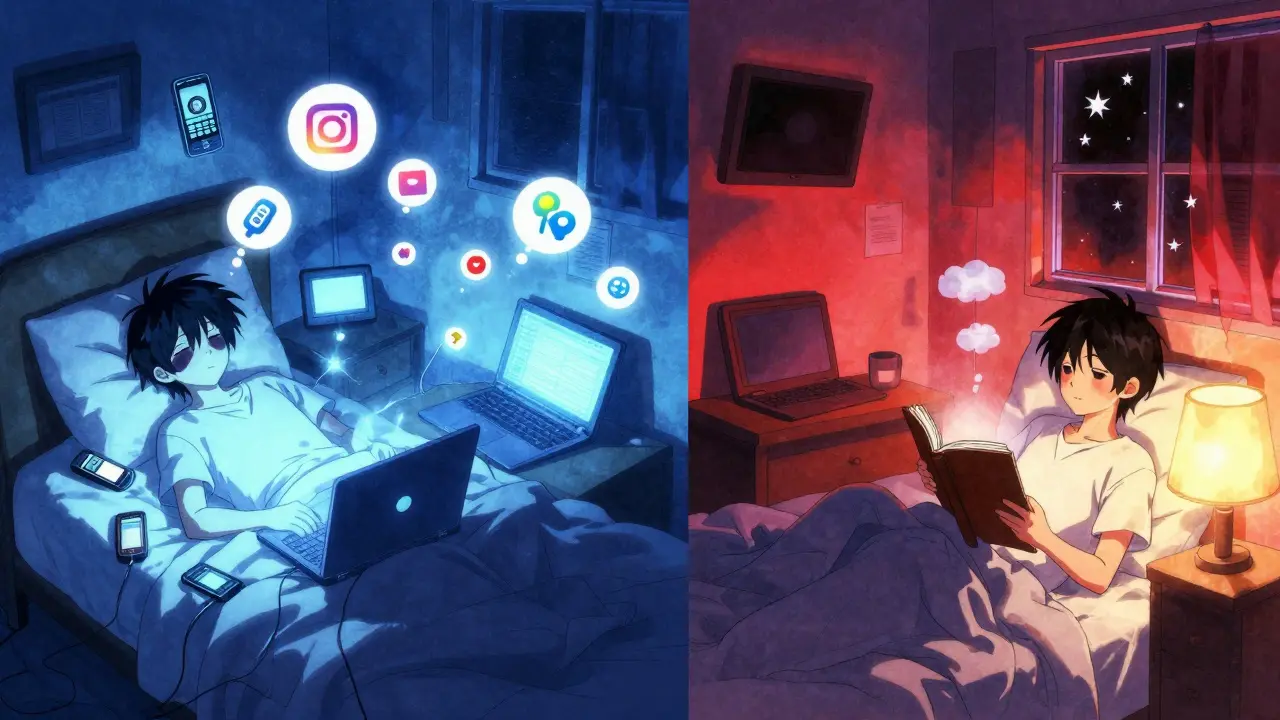
What’s Changing in 2026
Technology is catching up. Apple’s Sleep Focus mode, introduced in iOS 17 in 2023, automatically dims your screen and silences notifications an hour before your scheduled bedtime. Android has similar features. Even some smart TVs now offer “sleep mode” that reduces blue light. The FDA is also reviewing blue light exposure guidelines, with final recommendations expected by late 2024. Meanwhile, companies like Chronomics are launching genetic tests to measure individual sensitivity to blue light-meaning in the near future, your sleep plan might be personalized based on your DNA.What Doesn’t Work
Don’t rely on apps that claim to “block all blue light” while you’re still using your phone. Many are gimmicks. Don’t think wearing blue-light glasses gives you permission to binge-watch Netflix until midnight. And don’t assume turning off the lights is enough-your phone on the nightstand is still glowing. The fix isn’t about buying gadgets. It’s about changing behavior. You don’t need expensive glasses, special bulbs, or a $200 sleep tracker. You just need to stop looking at screens earlier.Start Tonight
Here’s your simple plan:- Set a bedtime alarm for 90 minutes before you want to sleep.
- When it goes off, put your phone in another room or turn it on Do Not Disturb.
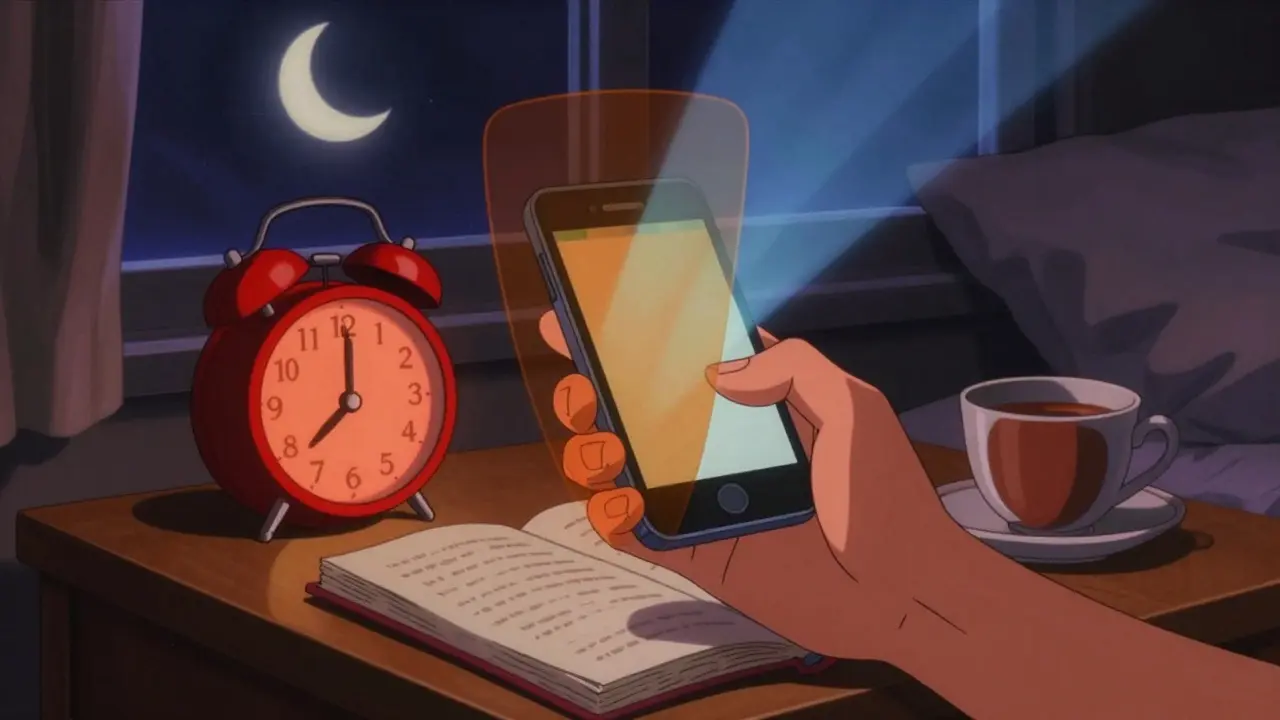
- Use a regular alarm clock instead of your phone.
- Replace screen time with something calm: read a physical book, listen to a podcast without visuals, stretch, or write down three things you’re grateful for.
Does blue light from screens really affect sleep?
Yes. Blue light, especially between 460-480 nanometers, suppresses melatonin production by stimulating special cells in your eyes called ipRGCs. Studies from Harvard and others show this delays sleep onset and reduces sleep quality. Even dim screens can have a measurable effect.
How long before bed should I stop using screens?
The American Academy of Sleep Medicine recommends at least one hour. For best results, aim for 90 minutes. That gives your body enough time to start producing melatonin naturally without interference from artificial light.
Are blue-light-blocking glasses worth it?
They can help, especially if you must use screens at night. But they’re not a cure-all. Users report better sleep when glasses are used with other habits-like dimming lights and avoiding stimulating content. About 22% of users see little to no benefit, often because they still use screens right up until bed.
Does Night Shift or f.lux make a difference?
Yes. These tools reduce blue light emission by about 60%, according to display tests by DisplayMate. They’re effective when turned on at least two hours before bed. But they don’t eliminate all disruption-brightness and mental stimulation still matter.
Can I use my phone as an alarm and still avoid blue light?
No-not if it’s on your nightstand. Even on low brightness, a phone emits enough blue light to interfere with melatonin. Use a traditional alarm clock instead. If you must use your phone, put it in another room and turn on Do Not Disturb.
Is blue light the only reason I can’t sleep?
No. Screen time also replaces calming routines like reading or meditation. The mental stimulation from scrolling, watching videos, or checking emails keeps your brain active. So even if you block blue light, you still need to replace screen time with relaxing activities.