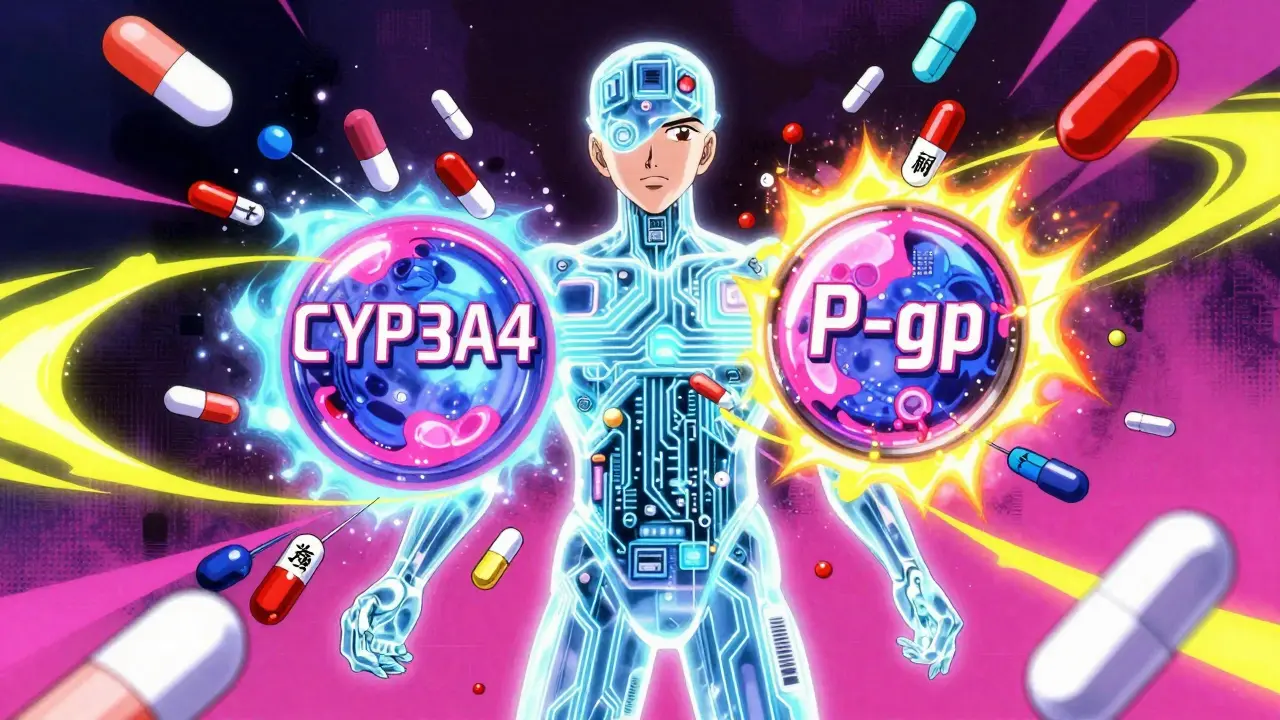
When you take an antiviral medication - whether it’s for HIV, hepatitis C, or another viral infection - you’re not just dealing with one drug. You’re dealing with a system. Your body has powerful enzymes and transporters that decide what happens to that drug: how much gets absorbed, how fast it’s broken down, and how long it stays active. Two of the most important players in this system are CYP3A4 and P-glycoprotein (P-gp). If you don’t understand how they interact with your antiviral, you could be at risk for serious side effects - or worse, your treatment might not work at all.
Why CYP3A4 and P-gp Matter in Antiviral Therapy
CYP3A4 is the most common enzyme in your liver and gut that breaks down drugs. It handles about half of all medications you take. P-gp is a pump that kicks drugs out of cells - especially in your intestines, brain, and kidneys. Together, they control how much of a drug actually reaches your bloodstream and stays there long enough to work.
For antivirals, this is critical. Many of the most effective drugs - like those used for HIV (darunavir, lopinavir) or hepatitis C (grazoprevir, paritaprevir) - are designed to be metabolized or transported by these systems. But here’s the catch: many other drugs - even common ones like statins, blood thinners, or anxiety meds - use the same pathways. When two drugs compete for CYP3A4 or P-gp, one can block the other, causing dangerous buildup or sudden drops in drug levels.
Take ritonavir, an HIV drug approved in 1996. At low doses (100 mg daily), it doesn’t fight the virus - it shuts down CYP3A4. That’s why it’s used as a booster. It slows down the breakdown of other antivirals like lopinavir, letting them work longer and at lower doses. But that same trick makes it a ticking time bomb when mixed with other medications.
How Ritonavir Changes the Game
Ritonavir doesn’t just inhibit CYP3A4 - it does it aggressively. Studies show it can increase the concentration of other drugs by 300% to 500%. For example, when taken with midazolam (a sedative), ritonavir causes midazolam levels to spike so high that patients can fall into a deep, prolonged coma. That’s why mixing them is strictly avoided.
But ritonavir isn’t simple. It also induces another enzyme, CYP1A2. That means it speeds up the breakdown of some drugs - like olanzapine (an antipsychotic) - while slowing down others. This dual behavior makes predicting interactions extremely tricky. One patient on ritonavir might have safe levels of a drug, while another - even on the same dose - could overdose because of differences in their metabolism.
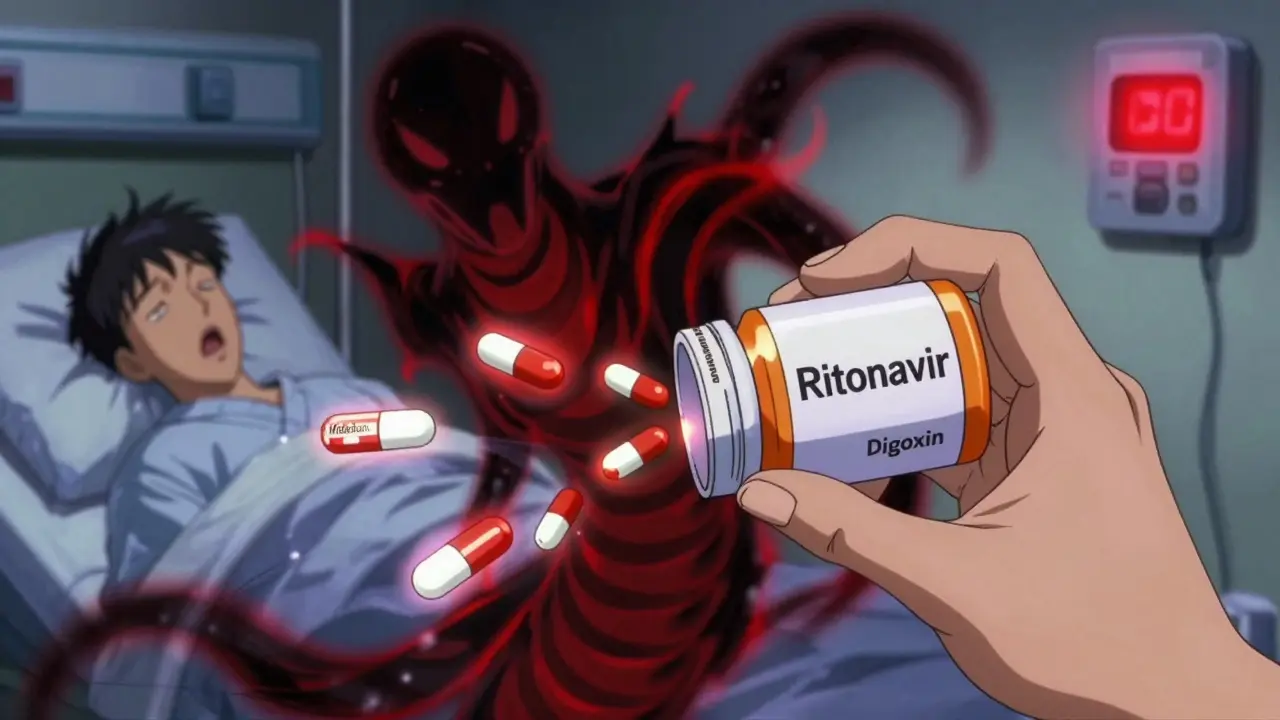
And it doesn’t stop there. Ritonavir also blocks P-gp. That means drugs that rely on this pump to exit your gut - like digoxin (used for heart rhythm) - get absorbed much more easily. Digoxin levels can rise 2.8-fold, pushing patients into toxic territory. The result? Nausea, confusion, irregular heartbeat - and sometimes death.
Comparing Antiviral Regimens: Who’s Safer?
Not all antiviral combinations are created equal. Newer regimens have been designed to reduce interaction risks.
Take the older hepatitis C combo: paritaprevir/ritonavir/ombitasvir/dasabuvir. This regimen increased simvastatin (a cholesterol drug) levels by 1,760%. That’s not a typo - it’s more than 17 times the normal amount. For someone on statins, this could cause severe muscle damage or kidney failure.
Compare that to glecaprevir/pibrentasvir, a newer hepatitis C treatment. Only 17% of common medications need dose changes with this combo, versus 42% with the older one. That’s a huge improvement.
For HIV, cobicistat has replaced ritonavir as a booster in many regimens. It’s just as strong at inhibiting CYP3A4, but it doesn’t induce CYP1A2. That makes it more predictable. But it has its own problem: it blocks kidney transporters (OCT2), which can raise creatinine levels and make kidney function look worse than it is - a false alarm that leads to unnecessary worry or treatment changes.
Then there’s sofosbuvir, a hepatitis C drug that barely touches CYP3A4 or P-gp. It’s one of the safest options for patients on multiple medications. But even sofosbuvir has its own risks - it’s a P-gp substrate, so if you take it with a strong P-gp inhibitor like verapamil, levels can climb.
Real-World Consequences: When Interactions Go Wrong
These aren’t theoretical risks. They’re happening in clinics every day.
In 2021, a 68-year-old man on apixaban (a blood thinner) started darunavir/cobicistat for HIV. Within weeks, he suffered life-threatening bleeding. His anti-Xa level - a measure of blood thinning - hit 384 ng/mL. The safe range is 50-250. He didn’t know the drugs clashed. His doctor didn’t check.
Another case: a woman on warfarin, a classic blood thinner, started a ritonavir-boosted HIV regimen. Her INR (a measure of clotting time) shot up. Four out of twelve patients in a similar situation ended up hospitalized. Warfarin’s narrow safety window makes it one of the most dangerous drugs to combine with antivirals.
And it’s not just prescription drugs. St. John’s wort, a popular herbal supplement for depression, can slash ritonavir levels by 57%. That’s enough to let the virus rebound. Grapefruit juice? It boosts ritonavir by 23% - enough to cause toxicity in sensitive patients.
How to Stay Safe: A Practical Checklist
Here’s what you need to do - whether you’re a patient or a provider:
- Make a full list of everything you take. Include prescriptions, over-the-counter meds, vitamins, herbs, and supplements. Don’t skip the “I don’t think it matters” stuff.
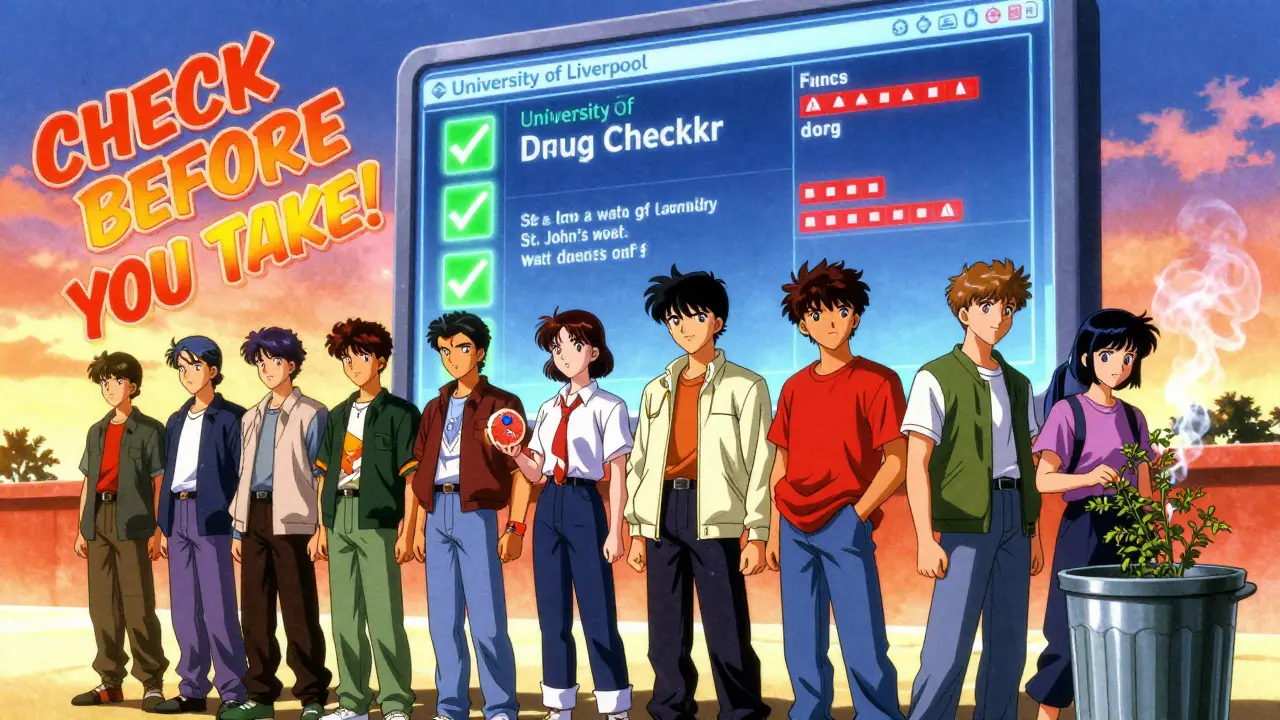
- Use the University of Liverpool HIV Drug Interactions Checker. It’s free, web-based, and updated daily. It’s used in over 90% of European HIV clinics. Type in your antiviral and every other drug - it tells you if there’s a risk, and how to manage it.
- Don’t start or stop anything without checking. Even a new painkiller or sleep aid can be dangerous.
- Ask about alternatives. If you’re on a ritonavir-boosted regimen and need a statin, ask if atorvastatin (lower risk) or rosuvastatin (minimal interaction) can replace simvastatin.
- Track your labs. If you’re on warfarin, digoxin, or statins, your doctor should check levels more often after starting an antiviral.
For providers: Screen every patient at the first visit. It takes 30 minutes. Use electronic health record alerts - Epic and other systems now flag high-risk combinations automatically. That’s cut severe interactions by 31% in some hospitals.
The Bigger Picture: Why This Is Only Getting More Important
By 2025, 39 million people worldwide will be on antiretroviral therapy. Most of them are older, with multiple chronic conditions - high blood pressure, diabetes, heart disease, depression. That means more medications. More interactions.
Dr. Melanie Thompson of the AIDS Research Consortium says it plainly: “As we approach universal treatment, the next frontier is managing the 4.7 average comorbidities per person with HIV. CYP and transporter interactions will determine treatment success more than viral factors.”
New antivirals like lenacapavir are being designed to avoid these pathways entirely. That’s the future. But right now, most people are still on drugs that interact. And until we all get there, the risk remains.
Ignoring CYP3A4 and P-gp isn’t just outdated - it’s dangerous. The science is clear. The tools are available. The only question is: will you use them?
Can I take grapefruit juice with my antiviral medication?
No. Grapefruit juice contains bergamottin, which inhibits CYP3A4 in your gut. This can cause antivirals like ritonavir, lopinavir, or darunavir to build up to toxic levels. Even one glass can increase drug concentrations by 23%. It’s not worth the risk - avoid grapefruit juice entirely while on these medications.
Is St. John’s wort safe with HIV drugs?
Absolutely not. St. John’s wort contains hyperforin, which strongly induces CYP3A4. It can reduce the blood levels of ritonavir, darunavir, and other antivirals by up to 57%. This can lead to treatment failure and drug resistance. Never take it with any antiviral without checking with your doctor first.
Why do some antivirals need a booster like ritonavir or cobicistat?
Many antivirals are broken down too quickly by CYP3A4 to stay effective. Boosters like ritonavir or cobicistat block this enzyme, letting the main drug stay in your system longer. This allows lower doses of the antiviral, fewer pills, and better results. But it also means more drug interactions - so you must be extra careful with other medications.
Can I use over-the-counter painkillers with antivirals?
It depends. Acetaminophen (Tylenol) is generally safe. NSAIDs like ibuprofen or naproxen are usually okay, but can increase kidney strain - especially with cobicistat, which affects kidney transporters. Always check with your pharmacist or use the Liverpool interaction checker before taking any OTC drug.
What should I do if my doctor prescribes a new medication while I’m on an antiviral?
Stop. Don’t fill the prescription yet. Take the name of the new drug and your current antiviral to the University of Liverpool HIV Drug Interactions Checker. If it shows a red flag, ask your doctor for an alternative or a dose adjustment. Never assume a new drug is safe just because it’s prescribed.
Are there any antivirals that don’t interact with CYP3A4 or P-gp?
Yes. Sofosbuvir (for hepatitis C) and lenacapavir (a newer HIV drug) have minimal interaction with these systems. They’re preferred for patients on multiple medications. But even these aren’t completely free of risk - always check interactions, even with safer drugs.
What to Do Next
If you’re on an antiviral, start today. Make your complete medication list. Go to the University of Liverpool HIV Drug Interactions Checker. Type in every drug, supplement, and herb you take. Print the results. Bring them to your next appointment. Don’t wait for a problem to happen. Prevention is the only reliable strategy.
If you’re a healthcare provider, make interaction screening part of your standard workflow. Use the free tools. Train your staff. Update your EHR alerts. The data is clear: systematic screening cuts hospitalizations by 43%. That’s not just good practice - it’s lifesaving.
Antivirals save lives. But they don’t work in isolation. Understanding CYP3A4 and P-gp isn’t optional - it’s the difference between treatment success and a medical emergency.
RAJAT KD
January 9, 2026 AT 00:59Stop taking grapefruit juice with antivirals. Simple. No debate. I’ve seen patients crash their liver enzymes because they thought ‘natural’ meant ‘safe.’ It doesn’t.
Angela Stanton
January 10, 2026 AT 15:46Okay but like… have y’all seen the *data* on cobicistat vs ritonavir? 😩 Like, cobicistat’s this *beautiful* CYP3A4 inhibitor but then it goes and messes with OCT2 and suddenly your creatinine’s up and everyone’s panicking about ‘kidney failure’ when it’s just a lab artifact… 🤦♀️ We’re treating numbers, not people. Also, St. John’s wort? Bro. Just don’t. 🚫🌿
Patty Walters
January 10, 2026 AT 16:15I’m a pharmacist and I see this every week. Patient comes in on darunavir/cobicistat, starts taking ibuprofen for back pain, and two weeks later has GI bleeding. They didn’t think it mattered because ‘it’s just Advil.’
Use the Liverpool checker. It’s free. Takes 2 minutes. Save yourself the ER visit. Also-yes, acetaminophen is fine. No, you don’t need to stop your fish oil. But yes, your turmeric supplement? Might need to go.
Drew Pearlman
January 11, 2026 AT 22:48Look, I get it-this stuff is complicated. But honestly? The real issue isn’t the science. It’s the system. Doctors are overworked. Patients are overwhelmed. Pharmacists are stretched thin. And yet we still expect everyone to memorize every single CYP3A4 interaction like it’s high school biology.
I’ve been on HIV meds for 12 years. I keep a printed list of everything I take. I bring it to every appointment. I screenshot the Liverpool checker results. I don’t trust memory. I don’t trust ‘I think it’s fine.’ I trust paper and a free website that’s been saving lives since 2008.
And yeah, I know someone’s gonna say ‘just use lenacapavir’-but guess what? Most of us aren’t on the bleeding edge. We’re on the stuff that’s been around, that works, that’s covered by insurance. So we gotta make it work safely. That’s not weakness. That’s pragmatism.
Also-grapefruit juice is a trap. Even one glass. Even once. Don’t test it. Your liver doesn’t have a ‘maybe’ setting.
Ian Long
January 13, 2026 AT 10:25Can we talk about how weird it is that we treat antivirals like they’re these fragile, magical potions that can’t touch anything else, but then we throw people on 8 different meds for diabetes, hypertension, depression, and gout like it’s normal?
It’s not the drugs that are the problem. It’s the *stacking*. We’re building pharmacological Jenga towers and then acting surprised when it collapses.
Why aren’t we designing regimens that are *inherently* low-interaction? Why are we still relying on boosters that turn people into walking drug interaction bombs? We’ve had the tech for years. It’s not a science problem. It’s a priority problem.
Chris Kauwe
January 14, 2026 AT 12:43Let’s cut through the noise. CYP3A4 and P-gp aren’t ‘players’-they’re biological gatekeepers. The pharmaceutical industry doesn’t care about your liver. They care about patent life. That’s why ritonavir was repurposed-not because it’s better, but because it extended the lifecycle of a dying drug class.
Cobicistat? Same playbook. A synthetic mimic with a cleaner patent profile. But it still blocks OCT2. Still raises creatinine. Still fools clinicians into thinking the kidney’s failing.
This isn’t medicine. It’s corporate chemistry. And we’re the lab rats.
And don’t get me started on ‘natural’ supplements. St. John’s wort? A plant-derived CYP3A4 inducer. Grapefruit? A fruit-derived inhibitor. Both are unregulated. Both are lethal in context. The FDA doesn’t regulate ‘supplements’ because they don’t want to admit they’ve lost control of the drug ecosystem.
Wake up. This isn’t pharmacology. It’s pharmacological warfare-and we’re losing.
Johanna Baxter
January 15, 2026 AT 22:51I just got prescribed this new antiviral and my doctor didn’t even ask about my CBD oil or my melatonin gummies 😭 I cried in the parking lot. I thought I was being careful. Turns out I’m just a walking interaction waiting to happen. Now I’m scared to take anything. Even my coffee. What if it’s the coffee??
Jerian Lewis
January 17, 2026 AT 04:29Every time someone says ‘just use the Liverpool checker,’ I want to scream. Because what if you don’t have internet? What if you’re homeless? What if you’re 72 and your hands shake and you can’t read small text? What if your only doctor visit is once a year and you’re too scared to ask questions?
The real solution isn’t a website. It’s a system that doesn’t require patients to be pharmacologists just to stay alive.
Phil Kemling
January 18, 2026 AT 00:34There’s a deeper metaphysical layer here. We treat the body as a machine with discrete, isolatable pathways-CYP3A4, P-gp, OCT2-as if biology is a flowchart written in English.
But it’s not. It’s a living, adaptive, context-sensitive ecosystem. The same drug that saves one person kills another-not because of dosage, but because of their history, their stress, their sleep, their gut flora, their trauma.
We’ve reduced human survival to a set of enzyme kinetics. And in doing so, we’ve lost sight of the person inside the pathway.
Maybe the real antiviral isn’t the drug. Maybe it’s the courage to ask, ‘What else is going on in your life?’ before you prescribe another pill.