When you walk into a pharmacy today, the shelves are lined with options that look identical but carry vastly different price tags. For standard pills, this is old news. But when it comes to antibiotic combination products, the landscape is far more complex. These aren't just simple tablets; they are sophisticated medical formulations that integrate two or more active ingredients, or combine an antibiotic with a specialized delivery device like an inhaler or prefilled syringe. Understanding whether a generic version exists-and what that actually means for your treatment and wallet-requires looking beyond the label.
The core promise of generics is simple: same clinical outcome, lower cost. A landmark study published in Nature Communications in May 2021 highlighted that when brand-name antibiotics lose their patent exclusivity, generics typically enter the market at prices 30% to 80% lower. Between 2010 and 2020, the proliferation of generic drugs saved the healthcare system an estimated $2.2 trillion. However, for combination products, the path to affordability is blocked by regulatory hurdles, state laws, and technical complexities that don't apply to single-ingredient drugs.
What Defines an Antibiotic Combination Product?
To understand generic availability, we first need to define what we are talking about. The U.S. Food and Drug Administration (FDA) defines combination products as therapeutic or diagnostic items that combine drugs, devices, and/or biological products. In the context of antibiotics, this usually falls into two categories:
- Dual-Drug Combinations: Formulations that mix two antibiotics to enhance efficacy or prevent resistance. A classic example is piperacillin combined with tazobactam. Piperacillin kills bacteria, while tazobactam inhibits the enzymes that would otherwise destroy the piperacillin. This synergy allows the drug to work against resistant strains.
- Drug-Device Combinations: An antibiotic paired with a specific delivery mechanism. Think of prefilled syringes for intravenous (IV) use, injector pens, or inhalers for respiratory infections. Here, the "device" isn't just packaging; it is integral to how the drug enters the body.
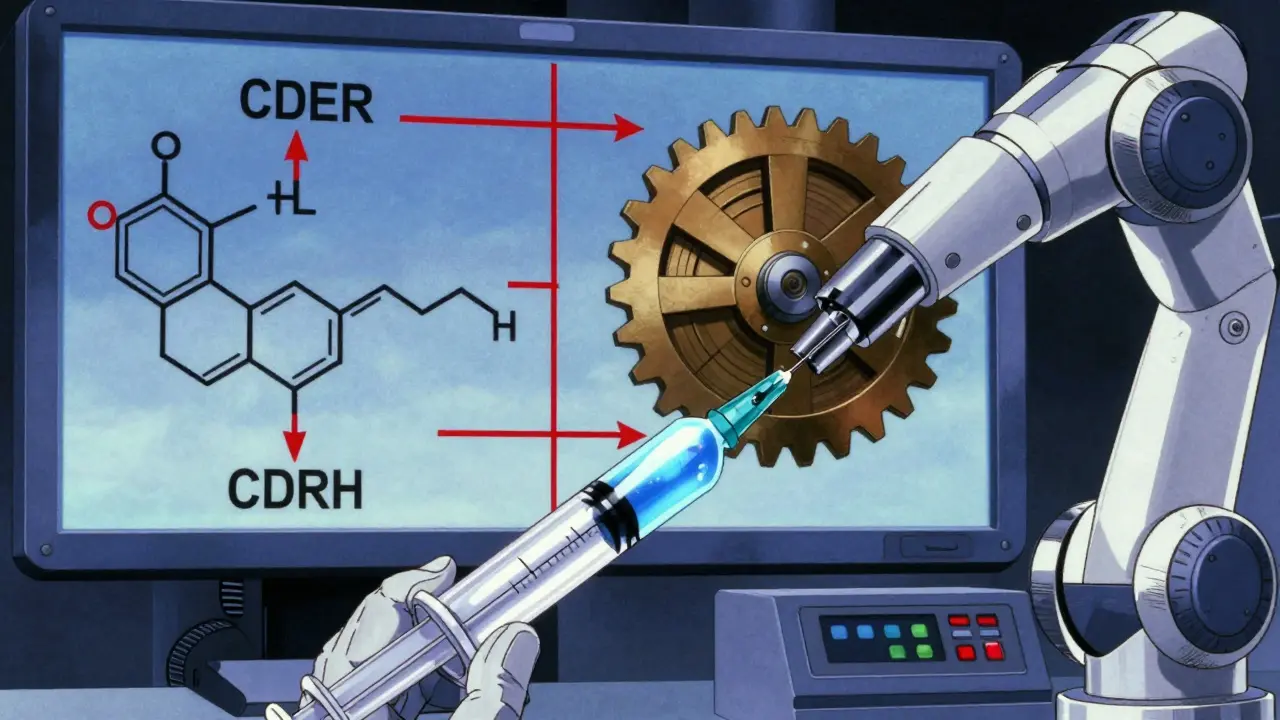
The distinction matters because the regulatory pathway for approving a generic version depends entirely on which component drives the product's primary mode of action (PMOA). If the drug effect is dominant, the Center for Drug Evaluation and Research (CDER) leads the review. If the device aspect is critical, the Center for Devices and Radiological Health (CDRH) takes the lead. This coordination happens through the FDA's Office of Combination Products (OCP), established to handle these hybrid entities.
The Regulatory Hurdle: How Generics Get Approved
You might assume that once a patent expires, any manufacturer can copy the formula. For simple pills, that’s largely true. For combination products, especially those involving devices, the process is rigorous. Manufacturers must submit an Abbreviated New Drug Application (ANDA). Unlike a full New Drug Application (NDA), an ANDA does not require new clinical trials to prove safety and efficacy from scratch. Instead, the applicant must demonstrate therapeutic equivalence to the Reference Listed Drug (RLD)-the original brand-name product.
This sounds straightforward, but "equivalence" is tricky for combination products. A generic drug-device combination product (g-DDCP) must produce identical clinical effects and maintain a comparable safety profile. The FDA requires comprehensive documentation, including:
- A summary of all data gathered and analyzed during development.
- Reports on safety-related considerations and how they were resolved.
- A comparative residual risk assessment.
For instance, if you are developing a generic version of a prefilled syringe containing an antibiotic combination, you must prove that your needle gauge, plunger friction, and fluid dynamics do not alter the dose delivered or cause tissue damage compared to the brand-name version. Any difference in form, function, user interface, or labeling must be justified and shown not to affect safety or effectiveness. This level of scrutiny makes the ANDA process for g-DDCPs complex, costly, and time-consuming, often deterring smaller manufacturers from entering the market.
| Feature | Single-Entity Generic (e.g., Amoxicillin Tablet) | Combination Generic (e.g., Prefilled Syringe + Device) |
|---|---|---|
| Primary Focus | Chemical equivalence and bioavailability | Therapeutic equivalence including device performance |
| Clinical Trials | Rarely required (bioequivalence studies suffice) | Sometimes required if device alters exposure or route |
| Regulatory Complexity | Low (Standard ANDA pathway) | High (Requires OCP coordination and PMOA determination) |
| Market Entry Speed | Fast after patent expiry | Slower due to extensive technical documentation needs |
Market Realities: Does Generic Entry Actually Lower Costs?
The theory is that competition drives down prices. The reality, however, is inconsistent. The 2021 Nature Communications study analyzed prescription patterns for 13 antibiotics following generic entry. The results were mixed. Prescriptions for five antibiotics-including aztreonam, ciprofloxacin, and levofloxacin-increased significantly, ranging from 5% to over 400% within six to twelve months. This surge suggests that lower prices did indeed make these treatments more accessible.
However, other drugs told a different story. Cefdinir saw a significant decrease in prescriptions against historical trends. Others, like clarithromycin, showed trend increases but no significant change in overall volume. Why the disparity? Researchers pointed to "co-interventions." For example, the rise in aztreonam usage coincided with the launch of Cayston, an inhalation treatment for cystic fibrosis. Clinicians began using IV aztreonam to prepare for these inhalations, driving demand independent of generic pricing.
This variability highlights a critical insight: generic availability does not automatically translate to uniform market adoption. Factors such as clinician familiarity, hospital formularies, and specific patient populations play huge roles. Furthermore, legal expert Pasha (2023) notes that current substitution laws are inadequate for combination products. State laws designed for oral small-molecule drugs create unnecessary barriers for complex generics, limiting pharmacist substitution rights and keeping prices artificially high in some regions.

Historical Milestones and Future Outlook
We have seen progress. On October 26, 2010, Hospira launched the first generic version of piperacillin-tazobactam for injection in the U.S. This was a watershed moment, proving that complex IV antibiotic combinations could successfully navigate the generic pathway. Since then, the FDA has worked to streamline processes. The September 2024 REdI conference focused on "Combination Products: Updates and Best Practices," signaling ongoing efforts to refine regulatory strategies.
Looking ahead, the exponential growth in combination products necessitates a multi-pronged approach. Legal scholars advocate for updates at the federal, state, and prescriber levels to remove substitution barriers. The FDA continues to emphasize that additional data is needed if a generic combination introduces a new indication, target population, or route of administration. For patients and providers, the message is clear: while generics offer substantial savings, verifying therapeutic equivalence and understanding local substitution laws remains essential.
Are generic antibiotic combination products as effective as brand-name ones?
Yes, if approved by the FDA, generic combination products must demonstrate therapeutic equivalence to the brand-name Reference Listed Drug (RLD). This means they deliver the same clinical effects and have comparable safety profiles. However, for drug-device combinations, strict testing ensures the device performs identically to the original.
Why are there fewer generic options for combination products than single-drug antibiotics?
The regulatory approval process for combination products, especially those involving devices (g-DDCPs), is more complex and expensive. Manufacturers must prove equivalence in both drug chemistry and device functionality, requiring extensive documentation and sometimes additional clinical data. This higher barrier to entry discourages some manufacturers.
Can my pharmacist substitute a brand-name combination antibiotic with a generic?
It depends on your state's substitution laws and the specific product. While many states allow automatic substitution for single-entity drugs, laws for combination products are often outdated or restrictive. Some states prohibit substitution for drug-device combinations unless explicitly authorized by the prescriber, creating barriers to access even when generics are available.
How much cheaper are generic antibiotic combinations compared to brands?
Studies indicate that generic antibiotics typically enter the market at prices 30% to 80% lower than their brand-name counterparts. Over the decade from 2010 to 2020, generic drug proliferation saved the healthcare system an estimated $2.2 trillion, highlighting the significant economic benefit of widespread generic availability.
What is the role of the FDA's Office of Combination Products (OCP)?
The OCP serves as the central coordination point for reviewing combination products. It determines the Primary Mode of Action (PMOA) to assign the lead review center (either CDER for drugs or CDRH for devices). The OCP ensures that the entire product is reviewed under a single marketing application, streamlining the regulatory process for these complex therapies.